
The animation Dalia and the Red Book takes us on an enchanting and mysterious journey that mixes fantasy and self-discovery, told with sensitivity and captivating visuals. Created and directed by David Bisbano, the film premieres in theaters in six countries, including Brazil, of course. It is an international co-production between Argentina, Peru, Spain, and Brazil, with the voices of actors Danton Mello and Sophia Valverde.
The story revolves around the moment a 12-year-old girl, Dalia, finds a book with a red cover that is not just a physical object but a kind of key that transports her to a world where her own fears, dreams, and hopes come to life. Initially written by her late father, she has only 12 hours to finish it or see her world change completely.

Dalia is a multi-layered character, and the film gradually reveals her insecurities, strengths, and desires. Her interactions with the book and with the other characters she meets along the way reflect aspects of her personality. The audience realizes that each character, situation, and obstacle are mirrors that reveal parts of Dalia that she was previously unaware of. This complex development of the character makes her journey even more captivating.
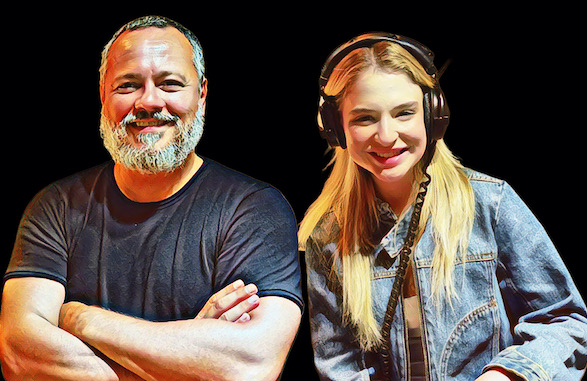
In addition, visually, Dalia and the Red Book is beautiful. More than fantasy, it inspires reflection on the courage needed to confront ourselves and discover who we really are. I spoke with Sophia and Danton in an exclusive chat with CLAUDIA, and there were emotional moments (including tears).
CLAUDIA: Danton, you’ve already participated in other animated films, right, and everything, but how did this one come in and catch your attention, what in particular attracted you to this project? DANTON: Because it’s a South American animation, from a small studio, compared to the big ones in the United States, and when I received the invitation, I also received the material with some drawings, a short clip that wasn’t even completely finished, but I could tell that it had something different, that it mixes techniques, it’s animation, but it also has a bit of stop motion. It’s a pleasure for me and it’s also an incentive, I think we have to see different things, we have to have new studios. I had this recent experience with an entirely Brazilian animation, which was Chef Jack, which is a studio from Minas Gerais, and what got me was that it was something local.
CLAUDIA: And Sophia, how did you get involved with this project?
SOPHIA: I auditioned and I thought I wouldn’t pass, but I passed, thank God! [laughs]. My audition was for a scene, if I’m not mistaken, with the goat. But in the audition, we didn’t get much information about the character, or the story and it took a long time to get feedback. But it worked out!
CLAUDIA: And the story is moving!
DANTON: Yes, the story is cute, it’s beautiful, the story of this girl who has a great loss. It’s hard enough for us to lose our parents, imagine a child! And this father who is so supportive and so loving to her. I am the father of two girls, now women, but I have always tried to create memories with them too. Since they were little, they have lived on film sets, recording sets, backstage at theaters, and that’s why I always see Dalia there with her father, who is an artist, a writer, a creator…
CLAUDIA: Was this personal identification important for the work? Dalia needs to continue a work started by her father…
DANTON: Yes, it’s funny. For example: my oldest daughter graduated in film scriptwriting and wants to do animation, she’s pursuing that. I don’t write, but every character I play is also a creation! [laughs] I really identified with this character, Adolfo, because I’m like that with my daughters to this day. I think it’s important to have a dialogue, to talk, to participate, to be friends, to be together. Adolfo is an artist, and a creator, but he has a beautiful little daughter who he wants to bring into his universe and that creates memories, right? It creates connections… I even have a very funny story. My daughters, as I said, lived in the wings of a theater. When she was in school, one of them had a homework assignment where the children had to draw a picture that reminded them of their father. She drew a lipstick. The teacher called her mother and said, “Look, your daughter didn’t understand what the assignment was about”, but it was at the time that I was doing a play in which I played several characters, including women. My daughter was always in the wings and helped me apply lipstick. Look at her little memory, how beautiful. She was in the wings and her father played several characters and thought “Daddy can do anything”. To this day, she keeps that comic strip, that comic strip that is a little screen and a little lipstick. That memory, that connection, between fathers, mothers, and children is extremely important.
CLAUDIA: Yes, and Dalia, because she has this connection with her father, she has the strength to face challenges and discover herself…
DANTON: And that’s it, it’s about overcoming, this girl who is there in this universe, in this crisis, and she has the figure of the goat – which is her father – who is by her side, encouraging, supporting, stimulating. Every father and mother must be there, to support, to show her the way. [Pauses, getting emotional and holding back tears] I get emotional talking about it because I’ve always done this for my daughters and with them. Today, they are two women discovering themselves. Even though they live in my universe, I always said “You’re going to do what you want. You have to find your own path. You have to find what makes you happy” and that’s what happens in the film. Dalia invents the goat who is her father’s alter ego, who encourages her and shows her that she is capable of doing whatever she wants. Of telling the story she wants and doing whatever she wants. That’s what we have to do. [Pauses again]
CLAUDIA: Parents and children will be moved by Dahlia and the Little Red Book, won’t they?
DANTON: Yes, Adolfo is loving, he brings his daughter to participate, and how incredible it is for a child to create a character from one of her father’s books. It’s enough to make you emotional.
CLAUDIA: And Sophia, how would you describe Dahlia to us?SOPHIA: As a very intelligent, very curious, very loving, very creative person. I’m similar to Dahlia in many ways! [laughs] She’s very kind likes to figure things out, and likes to discover new things.

CLAUDIA: And strong! Because her journey begins from a place of pain, right?
SOPHIA: Yes, she’s a wonderful character, who has her mother, her father there, and the characters from her father’s book. She enters her father’s story and gradually gathers the courage to finish writing his book. Trying to say it without giving too many spoilers, she will live great adventures by entering her father’s book and meeting the characters he created.
CLAUDIA: Do you like writing? Would you try to finish someone else’s book?
SOPHIA: I like writing. When I was younger, I would force all my friends to produce films with me.
I would say, “I’m a director, writer, and actress, and you’re going to help me here too” [laughs] But I sometimes see myself writing something, I think it would be really cool. Like, Dahlia and The Red Book 2, who knows? [laughs]
CLAUDIA: Danton identified a lot with his father. Adolfo. And have you ever said that you’re similar to Dahlia? How did that connection come about?
SOPHIA: Dahlia is doubting whether she can finish the book there was a time in my life when I was a little doubtful about my choices, like “Will I be able to? Will I really be good?” and I think that everyone will go through this one day, or has already gone through it, and will understand that everything will work out, you can do it. And I think that Dália went through this in a very beautiful way, I think that if we could go through it like Dália, sometimes entering a book, it would be much more exciting!
Descubra mais sobre
Assine para receber nossas notícias mais recentes por e-mail.
 miscelana.com