
For those who don’t follow sports, much less American football, the name Aaron Hernandez was only familiar from crime news, perhaps not even then. Distant would be the word. But in 2020, the Netflix documentary The Killer Inside: The Mind of Aaron Hernandez changed that perspective. For Americans, the Hernandez case was a new version of O. J. Simpson, but the association is more recent for us foreigners. In any case, after the success of American Sports Story: The People Vs O. J. Simpson, it was more than obvious that Ryan Murphy would turn to the story. The announcement was made in 2021, but it only aired in 2024.
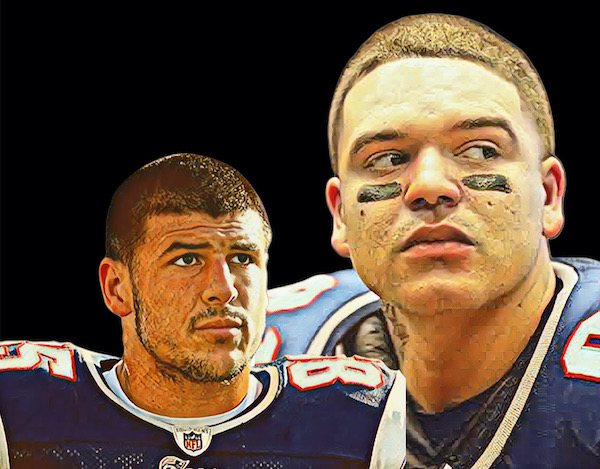
The promising young man with one foot in the criminal underworld
For Latinos who follow football (the real one also known as soccer), Hernandez’s sad trajectory is not exactly ‘new’, there are stories and more stories of talents who end their careers because they are unable to distance themselves from crime, but because it has so many twists and turns and is so sad in every aspect that it is also so remarkable.
Aaron Hernandez was an American football player who had the potential to become a legend in the National Football League (NFL) and played for the New England Patriots, alongside Tom Brady. However, his personal life took a tragic turn when he was arrested in 2013, and accused of murder. The shock of the athlete being involved in the scandal was surprising, but at the same time, he had a history of violence and fights in bars and even in the locker room. But no one expected him to be involved in a murder.
In 2015, he was convicted of the murder of Odin Lloyd, a former football player who was dating Hernandez’s future sister-in-law. But at the same time, he was linked to another murder, now a double, that had happened years earlier in Boston, as well as the attempted murder of a friend. Amid the accusations, a history of sexual abuse, drugs, homosexuality, and neurological problems was revealed. He ended up committing suicide in April 2017 while in prison, when everyone thought he would be released in a few years.
His case attracted a lot of media attention and raised discussions about mental health, the impact of violence, and the effects of brain injuries on athletes.
Murphy’s signature once again makes a difference
I would say that American Sports Story: Aaron Hernandez is what Monsters: The Lyle and Erick Menendez Story is not: respectful, but honest, sensitive,e and moving. The controversy surrounding the Menendez family is that even today, almost 30 years after they brutally killed their parents, Lyle and Erick demand that we feel sorry for them and nearly support them for planning and carrying out a violent crime. Here it’s more challenging: We empathize and sympathize with Aaron, but when he makes a mistake, there’s no way to “forgive” him.
While the Netflix documentary was just as impactful, Ryan Murphy drew on the Boston Globe podcast Gladiator: Aaron Hernandez and Football Inc. to show the athlete’s rise and fall. This makes a big difference because the documentary used the chronological order of how the news was reported as twists – in reverse order of events – and the series, which assumes that we know the drama, builds in chronological order, which humanizes the characters and draws us into Hernandez’s tragic spiral.

There are the relationships with other men that he allegedly tried to hide, as well as his childhood abuse trauma and the question of whether CTE played a major role. CTE, or chronic traumatic encephalopathy, is a progressive, degenerative brain disease that can develop after repeated concussions or head injuries, and a study of Hernandez’s brain proved, after his death, that he was in an advanced stage of the disease after injuries while playing. His family’s defense is that affecting the part of the brain that makes decisions, could have contributed to his paranoia and attitudes that cost the lives of three people and injured a fourth. In addition, the series raises a set of other issues in parallel.
The series: good performances and affection for Hernandez
In 10 episodes, we get to know Hernandez’s youth, dysfunctional family, and secrets, but those that the family continues to deny. Played by a great Josh Rivera, from West Side Story, the version that Murphy presents to us of Hernandez is that of a troubled athlete from the beginning, abusing drugs and alcohol, fueled by frustrations, traumas, and a troubled family and, mainly, fear that his true sexuality would be made public.
His relationship with Shayanna Jenkins (Jaylen Barron), whom he met at school and who became the mother of his daughter, is the perfect facade to hide the fact that he is gay. And this secret is always the trigger for his most violent and paranoid version. Unfortunately for him, it is also the shortcut to tragedy.

Ultimately, the series is a profound reflection on the complexities of the life of an athlete with great potential, but whose sporting greatness was eclipsed by a spiral of violence and personal tragedies. Themes such as mental health, identity, and the devastating effects of brain injuries are woven together with precision. Through a sensitive and honest narrative, we are led to understand the multiple layers of Hernandez’s life, awakening empathy, but also questioning the consequences of his choices. Thus, the story of Aaron Hernandez serves as a warning about the fragility of fame and the weight that secrets and traumas can have on an individual’s life, making us reflect on the complexities that shape human beings, both in and out of the spotlight.
Descubra mais sobre
Assine para receber nossas notícias mais recentes por e-mail.
 miscelana.com