
I have already explained in general terms the basis of the hatred between the Atreides and the Harkonnens, which is not only the basis of the Dune: Prophecy series but of the entire Dune Saga. It is as complex as its prophecies and therefore vital to understand because it gives a new perspective on many betrayals over millennia. I will make a new, more detailed summary now that the series has premiered and we have a better idea of how they want to proceed.

More than 10 thousand years ago…
In the opening voiceover of the series, young Valya (Jessica Barden) warns that since History is written by the victors, the Atreides have destroyed the reputation of the Harkonnens and are not who we think they are. Clearly spiteful, Valya wants to convince us that there is injustice in the narrative, and, in fact, she has grounds for thinking so. The rivalry between the two families will reach Paul Atreides (Timothée Chalamet), 10 thousand years in the future, and now, it also originates in a very distant past.
In the tradition of the franchise, portrayed in the Legends of Dune series, by Brian Herbert and Kevin J Anderson, the mysterious figure of Vorian Atreides, a name we only hear through Valya’s gnashing of teeth, is essential to the entire plot.
Controversial and complex, Vorian is a man who (in theory) we will not see in Dune: Prophecy, but it is necessary to know him because he founded House Atreides.

Vorian was the son of Andrew Skorous, who was born almost another 10 thousand years before the current story. Because he believed himself to be a descendant of King Agamemnon, he adopted his name and rose to prominence as one of the leaders of the Titans group and controlled the Artificial Intelligence networks. He was an inflexible and ambitious man. When he realized that human life was limited in what he wanted to do, Agamemnon put his brain into a mechanical body and human genetic material, becoming a cyborg known as a cymek. His goal was for one of his 13 to continue his work, but only Vorian survived.
In the pre-Butlerian Jihad period, Agamemnon supported the machines and counted on his son, but when he fell in love with Serena Butler, a noblewoman enslaved in the Erasmus machine house, Vorian turned against his father and began to hate the machines. Given his connection to Agamemnon, many distrusted him and a love triangle worsened what was already complex.
Serena was also the lover of Xavier Harkonnen, who obviously disliked Vorian, but over time, the two rivals became great friends and together they were the main strategists in the fight against the machines. In the Butlerian Jihad, amid surprises and betrayals by humans, Xavier and Vorian discovered that Iblis Ginjo, an important human leader in the conflict, was working with the Tleilax to collect organs and Xavier managed to stop the trade, but, due to religious blindness, Ginjo came to be seen as a martyr and Xavier Harkonnen came to be seen as a traitor. Vorian fought to redeem his friend’s name but came up against fanaticism.
The complex figure of Vorian Atreides
Over time, thanks to an anti-aging process by Agamemnon, Vorian remained young and, therefore, easily rose through the ranks of the human army, eventually earning the title of Supreme Commander. His friendship with the Harkonnens led him to help Xavier’s grandson, Abulurd Butler, join the Jihad army and also become friends with the young man.
Abulurd adopted the Harkonnen name in hopes of redeeming the family’s reputation and fought against the cymeks, but it was Vorian who gained the adulation and became corrupted by the Power. He ordered an attack on Omnius that would result in the deaths of two million humans, and Abulurd’s vain disobedience in disabling the fleet’s weapons resulted in his death sentence after the defeat of Omnius and the machines at the Battle of Corrin. Vorian intervened and ordered that, instead of dying, he be branded as a coward. While all the other families would adopt new names, the Harkonnens would forever keep their name so that the shame would not be forgotten. It was after this that Vorian chose his grandfather’s name, Atreus, to found House Atreides while the Butlers adopted the name Corrino, and so on. The desire for revenge is born
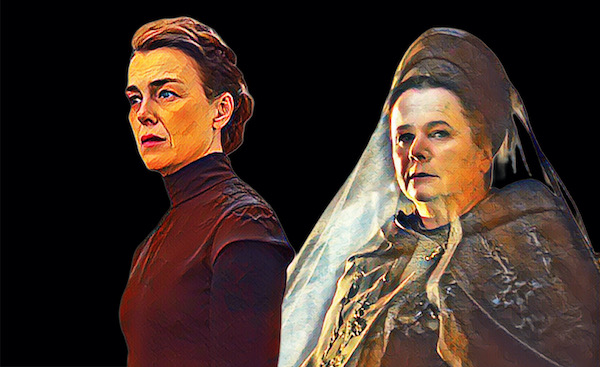
Evgeny (Mark Addy), uncle of Valya (Emily Watson) and Tula (Olivia Williams), is Abulurd’s grandson and is apparently resigned to his shameful status.


Griffin’s (Earl Cave) death, which was left off-screen, was due to the confrontation with Vorian, but not as Valya thinks. Griffin did follow Vorian to Arrakis and the two began a fight, but in the middle of the confrontation, Vorian discovered his wife Mariella and was devastated, but Griffin chose to spare him instead of taking advantage. Fremen law recognizes no mercy and so the two were sent to the desert.
The problem is that two of Vorian’s younger brothers find him on Arrakis and try to force him to join the machines and fight for a new era of the Machines. He refused, but they managed to kill Griffin. Valya learned of what happened but refused to believe it, increasing her desire for revenge against the Atreides.
So when Tula seduces Vorian’s grandson, Orry, she acts in response to her brother’s murder and follows Valya’s guidance. At the same time, Vorian has his own plan to resolve the rivalry between the Atreides and the Harkonnens without spilling blood.
The interference of the opposite effect
In this way, Valya is right in stating that the Atreides’ reputation for good has a foot in propaganda, but nothing is simple in Dune: Prophecy. More than explaining Xavier’s supposed courage or Abulurd’s courage, without showing us any of this, Griffin’s off-screen death may suggest that the series offers us another version of the facts. Will it?


Over the millennia, Paul’s rise confirms Valya’s failures in her plan to eliminate the Atreides, as Paul becomes Lisan al Gaib and the Kwisatz Haderach. In fact, by seeking revenge at all costs, it is argued that she paved the way for Paul Atreides’ inevitable victory.
In other words: the Harkonnens were indeed harmed by the Atreides, indirectly or unintentionally, but in the end, they never achieved their revenge. Is there no way to counter the prophecy?
Descubra mais sobre
Assine para receber nossas notícias mais recentes por e-mail.
 miscelana.com
1 comentário Adicione o seu