
The stories of English kings are fascinating. The most popular period in general memory may even be that of the Plantagenets, Yorks, Lancasters, and Tudors, but successful series such as Vikings, The Last Kingdom, and Vikings: Valhalla had also shed light on the Anglo-Saxon dynasties, the historical period between 410 and 1066 AD when the Germanic people dominated Great Britain after the end of the Roman Empire.
George R. R. Martin was directly inspired by this period to write parts of Fire & Blood, which is now the basis for House of the Dragon, but, most notably, it was Vikings: Valhalla that came closest, even though it ended its story just as it was about to enter the era of the last Viking kings on English soil. It’s no wonder 2025 we will return to this period with the series King and Conqueror, which will air with 8 episodes to tell the story of the last Anglo-Saxon king of England: Harold Goodwin.

I must warn you about one important thing: the names will be very similar to those we heard in Vikings: Valhalla, but the perspective will be reversed: those we saw as antagonists will be the good guys, and vice versa. King and Conqueror is almost a “continuation”, even though the series is not connected.
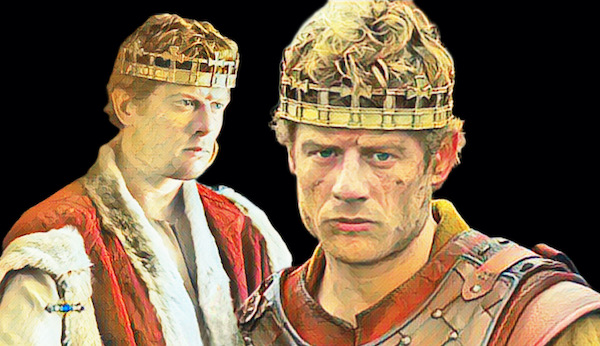
In this BBC production (which is internationally owned by Paramount), actor James Norton will play Harald, and Nikolaj Coster-Waldau (from Game of Thrones) will play William the Conqueror. The story will explore the confrontation that defined the continent’s future for a thousand years through a pair of interconnected family dynasties, concluding with the shocking Battle of Hastings in 1066, where the fight for the Crown reached epic proportions.
Announced in 2023, the series has a great cast and a curious fact. Norton, who is the producer, wanted to play William, but since his contract with MAX for The Nevers prevented him from committing to another series while it was in production, he had to give up the role and start playing Harold of Wessex, whose defeat in battle frees him from the plot in the 1st season. Don’t even complain about SPOILERS because Harold’s death is History, there is no way to hide it. On the female side, Juliet Stevenson, Clémence Poésy, and Emily Beecham bring to life some of the strongest women in the English monarchy. Let’s remember each of the main ones?
Harold Godwinson, the last Anglo-Saxon king
I’ve warned you before and I’ll say it again: we need to reverse the narrative of Vikings: Valhalla that placed the Godwinsons as villains.
Harold Godwinson (Norton), or Harold II, was king for only a few months and was linked to Cnut the Great, as his mother, Gytha Thorkelsdóttir (Clare Holman), was the Viking’s sister. Harold’s father was Godwin (Geoff Bell), the Earl of Wessex, who changed sides whenever there was an advantage. He, who was an enemy of Queen Emma (Stevenson), began his political career supporting King Edmund Ironside but became one of King Cnut’s closest friends when he was named Earl of Wessex.
Having survived the period of instability during Cnut’s reign, Godwin opposed Cnut’s initial successor, Harold Harefoot, and supported Harthacnut. His animosity towards Queen Emma only increased when he was implicated in the murder of Alfred Aetheling, Harthacnut’s half-brother and younger brother of King Edward (Eddie Marsan) the Confessor.
When Harold Harefoot died in 1040, Harthacnut ascended the English throne, and Godwin’s power was threatened, he cleverly swore an oath and presented gifts to the new king, putting himself on good terms with him. The problem was that two years later, Harthacnut also died and the Crown went to Edward the Confessor, but the new king’s marriage to Godwin’s daughter Edith once again resolved the problem. For a while, at least. When King Edward died without an heir, Godwin’s son Harold was chosen to succeed him, becoming the first English monarch to be crowned in Westminster Abbey. Two weeks before facing William at Hastings, he managed to prevent the invasion of York by his Viking rival Harald Hardrada of Norway.
Harold was married to Edith (Beecham) the Fair, a political union of mutual interest because after his father died in 1053, he was the most powerful man in England after the king. The Godwins were against the growing Norman influence in the country, the faction that was sympathetic to Queen Emma and her descendants. Edward, for example, spent more than 25 years in exile in Normandy and is said to have chosen his maternal relative, William of Normandy, as his heir. The controversy over this choice is at the heart of the whole drama.
William believed himself to be Edward’s successor and others the succession, but some historians doubt whether it was really the king’s choice. This only worsened the enmity between the two. In 1051, for an uncertain reason, Harold ended up in Normandy and was captured, held hostage, and handed over to William.
The two became friends when Harold saved two men from quicksand at Mont Saint-Michel and was knighted, with the famous Bayeux Tapestry and other Norman sources claiming that Harold swore to support William in his claim to the English throne. Depending on the version, the crisis came when Harold broke this oath after Edward’s death.

The version in favor of Harold says that before falling into a coma, Edward recommended to his widow (Harold’s sister) that the kingdom be passed to her brother-in-law. The coronation was quick, which is one of the arguments that proves that he usurped the throne. In any case, when William learned of the “betrayal”, he immediately decided to invade England, building approximately 700 warships and transports for this purpose, with the support of the Church.
The next time Harold and William saw each other was the final when they faced each other at the Battle of Hastings. Harold and two of his brothers were killed in the battle. Legend has it that Harold died from an arrow in the eye, although it is still certain that he died from an arrow wound to the head. His widow, Edith the Fair, was called to identify the dismembered body on the battlefield. She did so to ensure a Catholic burial for Harold, whose body was buried on the altar of the church at Waltham Holy Cross, which he had built when he was king. Today, the spot is marked by a stone slab in the cemetery (originally the site of the high altar before the Reformation).
And William?
Well, William the Conqueror was the first Norman king of England (as William I). A descendant of Rollo (remember him from Vikings?), he was already Duke of Normandy (as William II) when he invaded England, defeating Harold Godwinson at the Battle of Hastings. The rest of his life was marked by struggles to consolidate his rule over England and its continental lands.

William was crowned king on Christmas Day 1066 in London. He died in September 1087 while leading a campaign in northern France, and was buried in Caen. His reign in England was marked by the building of castles, the establishment of a new Norman nobility in the land, and a change in the composition of the English clergy. After his death, his kingdom was divided between his sons: Normandy went to Robert, and England went to William Rufus.
The series? It promises to be exceptional!
Descubra mais sobre
Assine para receber nossas notícias mais recentes por e-mail.
 miscelana.com