
When the South Korean series Squid Game premiered on Netflix in 2021, we were isolated at home, still distressed by the COVID-19 pandemic and calculating when we would return to a “normal” life. The fictional dystopia seemed like a frightening reality and the simple theme of the series paradoxically entered a frighteningly realistic environment. What you would do for money was taken to another dramatic level.
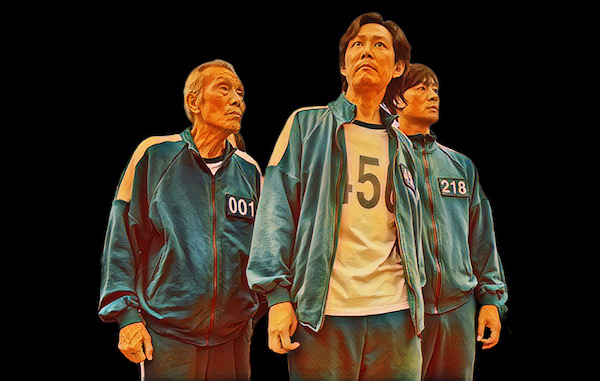
To the surprise of many, with splendid photography, a lot of creativity, and a tight script, the series became a phenomenon, winning more than 30 awards, including 6 Emmys that awarded Best Actor (Lee Jung-Jae, the first Asian to win in the category) and Best Director, among others.
The story follows Seong Gi-hun (Jung-Jae), a desperate and indebted man who receives a mysterious invitation to participate in a competitive game with the promise of an exorbitant cash prize. He joins 455 other players in similar financial situations to compete in a childish game with seemingly simple rules. However, they soon discover that being eliminated from the game is, in fact, a literal risk, and the consequences of losing are deadly. As the games progress, alliances and betrayals emerge, exploring greed, morality, and human desperation. The main focus is on the psychological and physical clash between the players, against the backdrop of a critique of social inequality and capitalism.
Gi-hun’s evolution from a smartass and over-the-top rascal to a man traumatized and embittered by what he witnesses (and does) is torturous at most times. Everyone’s lives are marked by hopelessness, and in a world of unforgiving rules, where survival becomes the only priority, consequences are inevitable. Time and time again, we see that economic inequality is on par with the moral collapse caused by a society that values profit above all else. Gi-hun, who is far from the ideal hero, is the one who transforms and takes us on his journey.

In addition to him, we meet several characters whose impact makes us feel their departures. Parallel to Gi-hun, we follow the suicide mission of Hwang Jun-ho (Wi Ha-Joon), a police officer who infiltrates the organization of the games in search of his missing brother, Hwang In-ho (Lee Byung-hun). As he discovers the behind-the-scenes, Jun-ho confronts a shadowy system where human lives are commodities, managed by mysterious figures such as the Front Man, whose role is to enforce the rules of the games, but who gradually gains greater autonomy and power.
The Front Man, a calculating villain, runs the games under the command of anonymous elites, and his presence raises questions about the price of serving a cruel system. His personal connection to other characters and his motivation deepen the moral dilemma that permeates the series: who is really guilty?
SPOILERS from season 1 that connect to season 2
Gi-hun is the winner of the games, but instead of going to start his life over in the United States, he is unable to use his fortune and is still traumatized. At the end of the season, he decides to stay and unmask everyone behind the Squid Games. On Jun-ho’s side, he ends up reaching the Front Man who reveals himself to be his brother, In-ho, before shooting him. In-ho falls off the cliff injured and we don’t know if he will survive.
While In-ho’s motives are not fully explored, it is implied that he made this choice to survive and perhaps to rise in a ruthless system and is the antagonist of Gin-hun.
A bloody and even more intense return
Clearly, some do not consider the second season as impactful as the first, but I disagree. The script maintains the sadism that is characteristic of the series, with new and exciting characters and always a twist ahead of us.
Three years after the games, Seong Gi-hun remains determined to dismantle the deadly games that traumatized him. With the means, he invests in a tortuous network of amateur investigators to get to the game where he needs to find the enigmatic recruiter who plays ddakji in the subway. Gi-hun’s plan maintains its innocent essence because the plan is to expose the games and dismantle them, but even now skilled with weapons and strategy, Gi-hun is not the best reader of people.

Hwang Jun-ho survived the shot and the fall but was demoted to traffic cop, even though he follows the island where the games take place. In an unlikely coincidence, he and Gi-hun join forces with the same goal, but of course, they end up separated when Gi-hun ends up entering the competition again and Jun-ho tries to help him and find him from the outside.
The highlight of the story is the disguise of Hwang In-ho, the Front Man, who enters the game as 001 and pretends to be Gi-hun’s friend (once again z o 456). The fact that even after the previous game Gi-hun did not suspect 001 or ask more questions irritates us, but it is consistent with the character. For us, who know what is going on, it is even more terrifying to see the villain circulating among the innocent with all his hypocrisy and evil.
The games are almost the same, that is to say, we start with the legendary giant doll, but the other activities are new, which for us is as shocking as for the characters. We can already anticipate some misfortunes and deaths along the way, but we quickly connect with the current group.

The new games are even more brutal and challenging, which is made worse by Gi-hun being virtually ignored by the participants who see him as a survivor, thus the justification they needed to feed their greed with each round. This time, more people want to leave, but they cannot because the end of the game requires votes and there is always one who succumbs to the value of the ever-increasing prize.
What Squid Game continues to show with brilliance and creativity is that the series is a very uncomfortable mirror of the human being, regardless of culture. Morality goes out the window when the choice to laugh seems within reach, in simple games that destroy our ethics or hope.
The second season has fewer episodes – seven – two episodes less, but its abrupt ending without a solution is because the third season will come out in 2025. It is perverse like the game, but it leaves us wanting one more before it ends. Proof that playing with fire can burn us…
Descubra mais sobre
Assine para receber nossas notícias mais recentes por e-mail.
 miscelana.com