
In 2005, writer Robert Harris was impressed by the papal election system, which reminded him of the Roman Senate system. At the time, Pope John Paul II had passed away and the historic conclave that followed elected Pope Benedict XVI, and Harris thought it would make a good fictional story.
Little did he, or the world, know that just 8 years later there would be a new conclave thanks to the resignation of Benedict XVI and that a South American pope would be elected: Pope Francis. With the public’s view of the conclave’s internal process through the media, the writer who was writing his Cicero Trilogy returned to the idea he had back in 2005 and thus, in 2016, published The Conclave.
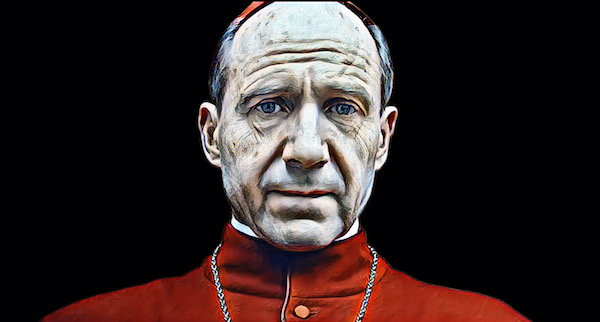
The story with major twists and turns in the political backstage of the Vatican was a success and, in 2024, it hit theaters with Ralph Fiennes leading the cast and emerging as one of the big favorites for the Oscar. He is Cardinal Lawrence (in the book, Lomeli) who is the main character and president of the conclave, designated to oversee the process of electing the new Pope.
Although he is experienced and respected, he is going through a crisis of faith. He is the one who unravels the mysteries behind the death of the previous Pope and ensures that the new one is elected fairly and transparently. Fiennes has always been considered one of the great actors in theater and cinema in the last 30 years, and talking about a great performance of his is kind of obvious. Just like in The Constant Gardener, where he gave a show, in The Conclave the actor mixes a soft but intense interpretation and his charisma makes the whole plot believable. The maxim that seems easy but is even more difficult applies here because the failures of the Cardinal accused of ambition, but who ostensibly wants to do the right thing, is a new and incredible opportunity for Hollywood to finally recognize Ralph Fiennes‘ talent with an Oscar.

Turning a conversation about politics and religion into a thriller is the great merit of The Conclave, which has stunning photography and a script with great surprises and twists. The political and social issues that affect the Catholic Church, including the fight for the preservation of power, morality, and economic issues, gain a new perspective, after all, the outcome depends on the choice of the new Pope, who can change the direction of the Catholic Church.
In the hands of Edward Berger, whose All Quiet on the Western Front was such a success two years ago, The Conclave is yet another great work that leaves us guessing and enchanted at the same time. Even more so because the script is written by the great Peter Straughan, who co-wrote the excellent 2011 version of John le Carré‘s Tinker Tailor Soldier Spy.
Faithful to the book, we perceive all the characters’ anxieties and thoughts even without dialogue, but with the undeniable naturalness with which the dialogues navigate, even in the complexity of the Catholic Church. In addition to Fiennes and his subtlety, Stanley Tucci and John Lithgow are spectacular, in a cast that is all wonderful. When the real surprise of the story comes to light, it is impossible not to be left speechless.

That is why the success of The Conclave, both on paper and on screen, is not limited to the intrigue and suspense of its plot, but also to the way it forces us to reflect on the mechanisms of power, faith, and morality that transcend the Catholic Church. At a time when traditional institutions are challenged by social and political issues, the film invites us to ponder the role of beliefs and human interests in building the future.
The immersive experience goes beyond the simple choice of a Pope — it is an exploration of the invisible forces that shape the most powerful decisions in the world. In the end, The Conclave not only entertains us with its twists and turns and exceptional performances, but also leaves us with an important question: to what extent are institutions truly transparent, and how can power be manipulated in the name of something greater? The mystery of the conclave, more than a papal election, is perhaps a reflection of our search for answers and direction in times of crisis.
Descubra mais sobre
Assine para receber nossas notícias mais recentes por e-mail.
 miscelana.com