
Incredibly, the production of a piece created in 1910 and rethought in 1949 is still modern in 2025. Even more incredible is that a ballet that varies between 47 and 31 minutes and brings together three geniuses of the 20th century still exists. The Firebird is not as popular as Swan Lake, but its impact on the life of a ballerina is not far behind.

There are several versions of the ballet around the world, from the original by Mikhail Fokine to that by George Balanchine, but it is this latest version created for the New York City Ballet in 1949 that usually causes the greatest impact. With sets and costumes by none other than Marc Chagall, the production was re-enacted in 2025 to pay homage to the ballerina for whom it was created: Maria Tallchieff.
Interestingly, a work so Russian in soul and structure was the one that marked the first great success of Balanchine’s company, which turned 90 in 2024. A work that became famous with Serge Diaghilev‘s Ballets Russes and whose trajectory is as fascinating as the magic of its main character.
Inspiration from Russian folklore
The enigmatic and impactful figure of Serge Diaghilev is truly an incredible legend. The Russian entrepreneur had a radar for bringing together the best and most innovative artists in the Visual Arts, Music, and Ballet. When he created the Ballets Russes in 1909, he brought together Michel Fokine, Léon Bakst, Alexandre Benois, Tamara Tarsavina, Anna Pavlova, Vaslav Nijinsky and Igor Stravinsky, among other geniuses. He knew he wanted to promote Russian culture abroad, but even more, to create something unforgettable and beautiful.
Fokine’s first works, who was tired of Marius Petipa’s already rigid style, were The Dying Swan and Les Sylphides, which reflected his modern vision: short ballets, without interruptions or complex narratives. Practically just dance and music (something that Balanchine would take to another level years later). They were extremely successful, paving the way for more similar works.

Since the first two could have been international stories, Fokine delved into Russian folklore for his next work. He was enchanted by Benois’ suggestion of the poem The Winter Journey, by Yakov Polonsky, written in 1844 and which spoke of sorcerers, princesses, and the magic of the Firebirds. Visually rich, mysterious, and adventurous, everyone liked the proposal.
The script combined other elements of Russian fairy tales to show the clash between good and evil in ballet. With music by Stravinsky and sets by Bakst, The Firebird premiered before the choreographer was satisfied with the result, with Fokine himself in the main male role and a young Tamara Karsavina as the magical being.
The naturalness of the steps, the vitality, and the expressiveness that The Firebird brought to the Paris stages made the work an immediate success. The fact that the Firebird was so different from the usual swans, fairies, or princesses in dance added mystery and even calculated rebellion to the role. It became forever linked to Karsavina, who decades later personally taught Margot Fonteyn all the steps when the Royal Ballet staged its version in 1954.


The Firebird was the first ballet written by Igor Stravinsky, who was not particularly pleased with the experience, but its success ensured that the partnership would be repeated several times, and so came Petrushka (1911) and The Rite of Spring (1913).
One of the innovative parts of the score includes leitmotifs to highlight the deadly and supernatural elements of the Firebird. In addition to the bird’s theme, the conclusion of the work is extremely famous and if you listen carefully, you will hear several classic soundtracks inspired by Stravinsky’s work, such as the score for North by Northwest by Elmer Bernstein, composed 40 years later.
The ballet’s music has been adapted into three concert suites, recorded by various conductors to this day. Fokine’s vision remains the most influential, but thanks to the genius of Balanchine (who also worked with the Ballets Russes), it reached the United States in an even more modern form.
A Ballet for Maria
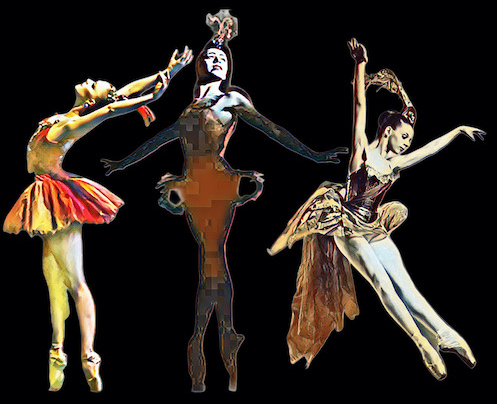
The story of the ballet is that of Prince Ivan, who works with the mythical Firebird to defeat the evil sorcerer Koschei the Deathless and rescue captured princesses, one of whom he marries. In 1948, Balanchine, already enchanted by Maria Tallchief‘s talent and her athletic and dramatic strength, chose this piece to revise and mark the debut of what would become the New York City Ballet. In his version, shorter than the original, what stands out are the mythical elements of the bird.
The first performance was at the City Center with scenery and costumes by the painter Marc Chagall. The screams and applause at the end, as the ballerina recalled years later, were unexpectedly enthusiastic, as if they were watching an American football match. A star and a dance legend were born. A moment she would never forget.
The displeasure with Chagall
Having an artist like Chagall designing the costumes and sets is indeed unexpected, but it was a “use” by Balanchine. The painter had created everything for another production of the ballet, but when it failed before it even premiered, everything was shelved.
The producer who kept the sets and costumes gave them to the New York City Ballet and Balanchine obviously used them without mentioning that, although unpublished, they had not been designed for him. When Chagall found out (or saw, depending on the sources) he was furious that he had not been consulted beforehand and Balanchine had to remove the painter’s name from any publicity for the ballet.
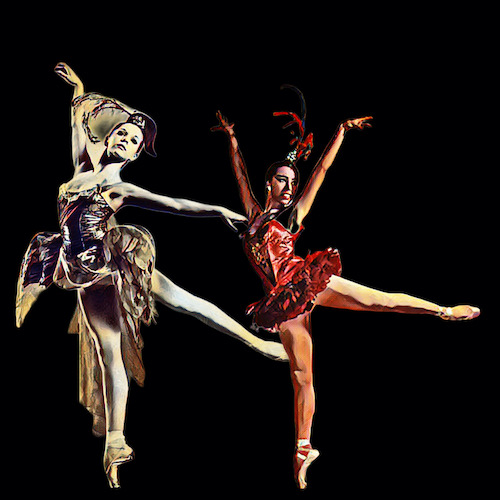
After Maria left the NYCB, The Firebird was “stored” until, in 1970, Balanchine identified the talent of a teenage Gelsey Kirkland, deciding to rescue the work for her. The costumes were revised by Madame Karinska (based on the original) and this version is still in the company’s repertoire, with further changes made by the choreographer between 1972 and 1980. For a time, Chagall’s costumes were no longer used, but they were revived for the most recent productions.
Alongside Jacques d’Amboise, Gelsey was on the cover of several magazines when The Firebird was revived and also began to have ballet as her signature role. Among the most famous productions, there is the complete version by Fokine, filmed with Margot Fonteyn in 1959, and excerpts with Maria Tallchief that attest to the fact that The Firebird has maintained its importance over 115 years. Only what is perfect stands the test of time.

Although American Ballet Threatre performed the complete ballet in the 1990s, it was the 2012 version, created by Alexei Ratmansky for Misty Copeland and Marcelo Gomes, that was a great critical success.
Thus, The Firebird, with its blend of Russian tradition, artistic innovation, and a story full of magic and mysticism, remains one of the most relevant and fascinating works in world ballet. It not only stands the test of time but also evolves, touching new generations of dancers and audiences, an inexhaustible source of inspiration and challenge, showing that true art, when genuine and innovative, has the power to span centuries and enchant different eras and cultures.
Descubra mais sobre
Assine para receber nossas notícias mais recentes por e-mail.
 miscelana.com