
There are so many clichés about Paul Newman that it is hard to escape: legend, star, brilliant, handsome… I like how the New York Times summed him up 17 years ago when he passed away at 83: magnetic titan. Yes, he was much more than legendary; he was a giant and greater than a myth. And every tribute is worth it on the day that would mark the centennial of his birth, April 26, 2025.

Everything surrounding Newman’s name leads us to superlatives because without any question he was one of the most revered actors in the history of American cinema in the 20th century, with a solid filmography, a gallery of iconic characters, a stable marriage with the great Joanne Woodward, an Oscar and not forgetting philanthropy, Paul Newman defined the maximum status of what all Hollywood stars aspire to be. Obviously, Ethan Hawke‘s excellent documentary, The Last Movie Stars, from 2022, revisited the entire narrative with greater transparency, but the fact is that perfection demands imperfection, and rewatching his story alongside his wife is essential to love him even more.
It’s ironic to think that a man with as much artistic talent as he was handsome had so much difficulty establishing himself in Hollywood. That’s because Paul Newman was surrounded by geniuses like his personal friends Marlon Brando, James Dean, and Steve McQueen, as well as Joanne, of course, and they all advanced much faster than he did. His on-screen persona – that of the empathetic rebel – blended with the “real” Paul, a man who hid his pain and mistakes with a high-spirited image. And no, we cannot and do not want to ignore his legendary and perfect blue eyes. In more than 65 films in a career spanning more than five decades, they always “stole” the scene. But of course, he was much more than a pretty face and a talented actor. His life and work transcended the screen and continue to inspire generations.

The Beginning: Breaking Expectations
Paul Newman grew up in a middle-class family in Ohio, and from a young age, he showed an interest in theater, participating in school plays. During World War II, he enlisted in the Navy, serving as a radio operator on aircraft, and when Peace ended, he eventually enrolled in the Yale School of Drama, where he perfected his acting technique despite going against his father’s expectations that he would continue to lead the business (a chain of sporting goods stores). But it was in New York, training at the Actors Studio under the guidance of Lee Strasberg, that Newman became one of the references in the famous “Method”, which marked his emotional and realistic approach to all characters.
His first steps towards fame were on the Broadway stage, but a beauty like his would never go unnoticed by the studios, and the actor made his film debut in The Holy Grail (1954), where he played a Greek slave who creates the silver cup used in the Last Supper. Newman called this film the worst ever made in Hollywood, but the initial failure was quickly overcome with Someone Up There Likes Me (1956), a role he inherited after the premature death of James Dean, and which revealed his talent and magnetism. From then on, he became one of the most sought-after actors in the business, starring in hits such as Cat on a Hot Tin Roof (1958), The Sweet Bird of Youth (1962), and The Merchant of Souls (1958).
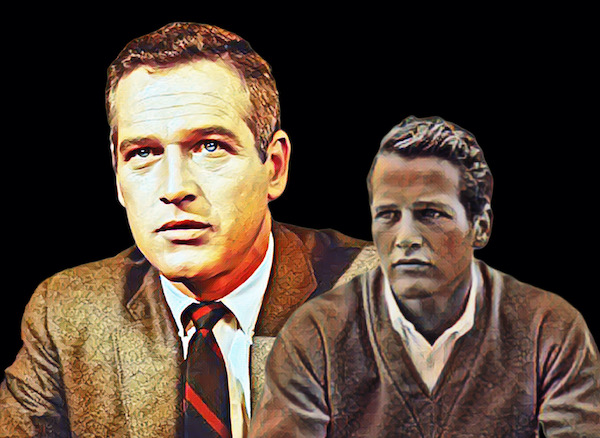
Newman brought intensity and charm to his characters, creating an immediate connection with the audience. He did not limit himself to classic heroes; he preferred to explore ambiguous and contradictory roles, such as the rebel Luke in The Hustler (1967) and the con artist Henry Gondorff in The Sting (1973).
As biographers point out, stardom came relatively quickly, but recognition as a serious actor, which was what Newman most desired, took much longer. That is why we have a gallery of flawed heroes and winning anti-heroes until, in 1986, he finally received his Oscar for Best Actor for The Color of Money. This event was historic because Martin Scorecese‘s film was the sequel to The Hustler, from 1961, making Paul Newman the only actor to win for a role recreated 25 years after the original. It was his only win after eight nominations. He was also honored with an honorary Oscar for his philanthropy.

Off-screen: Adrenaline on the track, a successful businessman, and peace in a lasting marriage
An adrenaline junkie, Paul Newman became a successful race car driver, winning several Sports Car Club of America national driving titles and competing at Daytona in 1995 as a 70th birthday present to himself. At the same time, he decided to sell a salad dressing he had created as a joke, which was a huge success, eventually expanding the business to other foods such as lemonade, popcorn, spaghetti sauce, and more. Most importantly, the profits were donated to charity. We’re talking about more than 200 million dollars.
His union with Joanne Woodward, a friend he had known since the beginning of his career, led him to divorce his first wife, but it lasted more than 50 years. They met while still working on Broadway and later made 10 films together. At first, Joanne (who won an Oscar for Best Actress in The Three Masks of Eve in 1957) was the bigger star between the two, but over the years, the dynamic reversed and Paul Newman became more famous internationally. I recommend watching Ethan Hawke’s documentary to learn more about both of them.

Cultural Legacy
Paul Newman died on September 26, 2008, at the age of 83, from lung cancer. He was diagnosed about a year before his death but kept his condition private for much of that time. The disease was publicly confirmed in mid-2008, by which time he had stopped aggressive treatments and chosen to spend his final months at home with his family.
Newman was a former smoker, having quit in the 1980s, but he often expressed regret for having started smoking in his youth, something he believed contributed to his cancer. His passing marked the end of an era and was widely mourned by fans and colleagues alike.
Ultimately, Paul Newman was no longer just an actor but a symbol of integrity, charisma, and humanity. He left a profound impact on pop culture, inspiring not only fans but other artists as well.
His legacy transcends Hollywood. He is remembered as one of the last representatives of an era when talent was more important than fame and as an example of how success can be used to transform the world.
One hundred years after his birth, Paul Newman remains a titan, not only for his films but also for his extraordinary life off-screen. He was a man who lived with passion, dedicating himself to creating art and doing good. Revisiting his work is more than a celebration; it is a tribute to an artist and humanitarian whose light will never fade.
Descubra mais sobre
Assine para receber nossas notícias mais recentes por e-mail.
 miscelana.com