
In a month, filming for the penultimate season of House of the Dragon will begin and fans are nervous about what is to come in 2026. There are so many changes to the original content that the concern is valid.

I am one of the annoying purists when it comes to House of the Dragon and I support George R. R. Martin‘s criticisms of the artistic decisions of the series, especially in the 2nd season. There were many adaptations to the chosen section – A Dance with Dragons – from the appearance of characters to their ages and the relationships between them. These things never bothered me when I watched Game of Thrones before I started reading the books, but they got me here.
Unlike A Song of Ice and Fire, Fire and Blood is very straightforward, its chapters work as a potential series with a beginning, middle, and end, full of controversy and wonderfully entertaining. That’s why I didn’t think changes were necessary, such as creating a rivalry between Rhaenyra Targaryen and Alicent Hightower with details different from those on the pages, but ok, we can live with them. However, along the way, Maelor Targaryen WAS MISSING and now the crossroads of the series have become complicated. Like: A LOT.
Making Alicent and Rhaenyra the same age has already complicated the issue of the children of the Green Queen and Viserys I: there were four, we only saw three in the 1st season. But Daeron Targaryen would have great importance in the civil war and everyone was confused when he was virtually ignored.

Problem “solved” with two or three lines of dialogue, explaining that the child grew up far from King’s Landing. We can swallow it. However, Helaena and Aegon II created another impasse. The young couple – in the book – would have three children: twins and a younger son, but in the series, we only saw two: Jaehaerys and Jaehaera. Maelor was eliminated from the plot.
The announcement of James Norton as Ormund Hightower was celebrated for confirming once again that Daeron will enter the war (we are still waiting for the name of the actor who will play the prince), but the worst of the doubts remains: how will they solve Maelor’s problem?
To do this, we need to discuss the details because, although he was still a child, Maelor’s fate became a major political issue and his absence in House of the Dragon suggests that the series is making some important adjustments to the story.
Why is Maelor’s absence a big problem? The impact on Helaena Targaryen’s story
Helaena’s life in Fire and Blood was shaped by deep personal tragedy, especially because of her children, and without Maelor, her arc changes drastically. In the book, Helaena suggests giving up Maelor to save Jaehaerys, but when her firstborn is murdered, she is devastated by the loss and guilt of her choice. She eventually takes her own life because of it, after learning the details of Maelor’s death, who was later hunted down and killed by angry mobs.
There is no way to lend his part of the story to Jaehaera (who will also have a sad end, but grows to adulthood and is forced to marry Rhaenyra’s son, Aegon III). Without Maelor in the series, Helaena’s arc can be simplified, perhaps focusing solely on the loss of Jaehaerys. This could make her story less complex and tragic, losing an important element of the book’s depiction of her grief.


Maelor’s Political Role
House Hightower and other Greens still regarded Maelor as the last male heir to Aegon II, making him a pivotal political figure during and after the war. His survival could have fueled the conflict even after Rhaenyra’s death. However, Maelor was killed brutally and chaotically.
While traveling to Oldtown to seek safety, he was seized by a mob. The townspeople argued over his fate—some wanted to send him to Rhaenyra’s supporters, while others wanted him dead. A butcher’s wife finally smashed his head against a wall, killing him. This horrific and violent death symbolized the destruction of the Greens’ legacy and helped solidify the final victory of the Black faction. Had Maelor survived, he could have been a rallying point for the Hightowers and prolonged the civil war, but his death marked the end of the Dance of the Dragons.
With Maelor’s death, the only remaining child of Aegon II and Helaena was Princess Jaehaera, who eventually married King Aegon III (Rhaenyra’s son), a marriage that united the two warring branches of House Targaryen, helping to stabilize the realm after the devastating civil war.
Had Maelor survived, the political situation could have been much more complicated, possibly leading to further conflict between the surviving Greens and Blacks.
Why did the series cut Maelor?
It is still unclear why Ryan Condall excluded Maelor from the narrative. If, as has been said, it is to simplify things because there are so many characters as it is, the drama that many considered the most striking (Helaena’s arc) will be condensed and her decline, instead of slow through multiple tragedies, will focus on the murder of Jaehaerys.
On the other hand, having a prestigious actor like Ormund Hightower suggests that we will follow more of the conflicts that surround Maelor’s death.


Ormund Hightower, Lord of Oldtown, one of the richest and most powerful cities in Westeros, was one of the main supporters of Aegon II and commanded a strong army for the Greens. However, he was killed in battle by Lord Roddy the Ruin at the Second Battle of Tumbleton. His death weakened the military position of the Greens, but House Hightower still had influence
After Aegon II’s death, the surviving family and Ormund’s supporters saw Prince Maelor as the Greens’ only chance of maintaining any claim to the throne.
The decision to send Maelor to Oldtown
After Aegon II was poisoned, the blacks took control of King’s Landing, and so the remaining greens needed to protect Maelor, since he was still technically Aegon II’s heir. They decided to send him to Oldtown, the seat of House Hightower, where he would be under the protection of Ormund’s family and supporters. Had Maelor reached Oldtown, the greens could have continued their resistance under his name, possibly even challenging Aegon III’s rule.
But on the journey, Maelor was intercepted at Bitterbridge—a city that had suffered greatly during the war. The townspeople were furious with the Targaryens because their city had been ravaged by both sides during the war, and when the townspeople learned that Maelor was the last surviving son of Aegon II, they were divided over what to do. Some wanted to send him to Rhaenyra’s supporters as a prisoner, and others wanted to kill him to prevent any chance of the Greens regaining power.
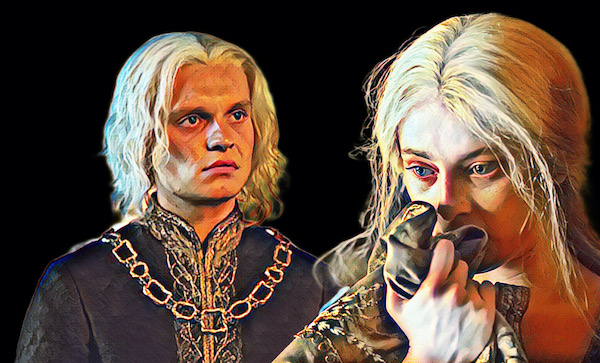

During the argument, a butcher’s wife took matters into her own hands. She grabbed Maelor and smashed his head against a wall, killing him instantly. This shocking act ensured that there would never be a male heir to Aegon II to challenge the new Black rule. With the prince’s death, the Greens lost all legitimacy and were forced to accept Aegon III as king.
But the main problem with excluding Maelor from the plot goes beyond the defeat of the Greens. His murder was not only brutal but also deeply symbolic because its traumas show how the war had gone too far, leading to the deaths of even innocent children. Furthermore, all the political chaos of the transition will have less weight. Furthermore, with Maelor’s death, House Hightower lost its last chance to maintain influence on the Iron Throne. Indeed, it never achieved the same prestige again.
As Martin wrote in a now-deleted post, “Maelor alone means little. He is a small child, has not a line of dialogue, and does nothing of importance other than die… but where, when, and how, that matters. Losing Maelor has weakened the ending of the Blood and Cheese sequence, but it also cost us the Bitterbridge scene with all its horror and heroism, undermined the motivation for Helaena’s suicide, and this in turn sent thousands into the streets and alleys, screaming for justice for your ‘murdered’ queen. None of this is essential, I suppose… but it all serves a purpose, it all helps tie the storylines together so one thing follows another in a logical and compelling way,” he complained.
It is possible to tell a good story that is already bloody in itself without any of the details mentioned, as MAX claimed in defending the choice of Ryan Condall. But that is a shame, no one can disagree.
Descubra mais sobre
Assine para receber nossas notícias mais recentes por e-mail.
 miscelana.com
1 comentário Adicione o seu