
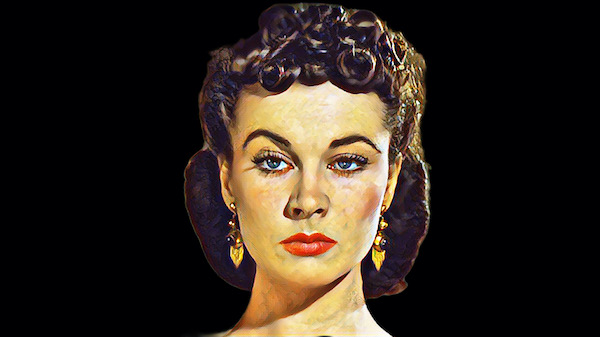
I have always been a fan of Vivien Leigh, ever since I discovered her when I first saw “Gone with the Wind” on some of the broadcast TV shows. Everything about what was still “the greatest film ever made in Hollywood” was dramatic, grandiose, and full of legends. She was beautiful, talented, and English, and carried the 3-hour film on her back. After I don’t know how many years, I am still enchanted by her, but for different reasons.
The first biography I read about her, written by Anne Edwards, revealed to the world for the first time a truth that had been hidden for decades: behind the scenes, Vivien suffered from a disorder that was still little known in the 1950s, at the time called manic-depressive psychosis. Today it is better known as bipolar disorder and is characterized by alternating periods of mania and depression. The treatment? High-voltage electric shocks. A painful, ineffective, but traumatic process.

Since this discovery, the narrative about Vivien has always focused on her fragile mental health, much more than her undeniable talent (she has two Oscars for Best Actress), which is sad. Vivien’s fans have a tendency to try to protect her memory, highlight the importance of her legacy, and keep her story alive.
In this scenario, in the middle of the pandemic, I was approached by the writer Lyndsy Spence, who was researching Vivien Leigh‘s time in Brazil in 1962. At the time, Vivien was introduced to the actress Maria Fernanda, who played Blanche Dubois in the theater (a role for which Vivien won theater awards and an Oscar), but she noticed that her colleague was sad. Maria Fernanda, daughter of the poet Cecilia Meireles, was worried about her mother, who was hospitalized and very ill. Vivien secretly found out about the hospital and went to visit the poet, who was shocked when she woke up and saw “Scarlet O’Hara sitting next to her in the hospital”. She wrote a poem for the actress, one that Lyndsy quotes in the book and that is not very well known, but it reflects exactly who Vivien was and what she felt in that moment of empathy.
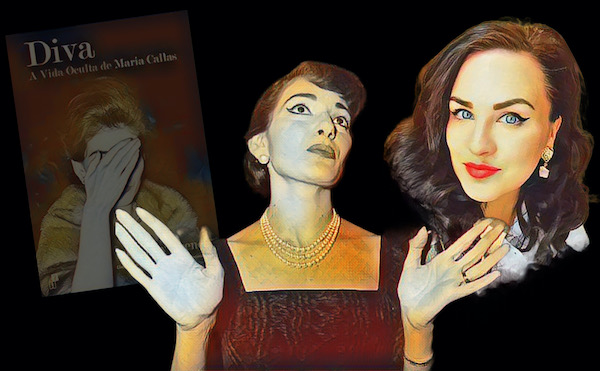
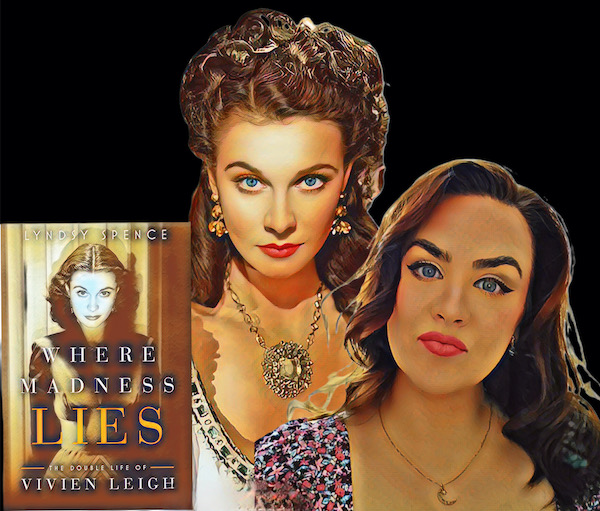
Since then, Lyndsy and I have been in touch, I interviewed her about the biography she wrote about Maria Callas, “Cast-a-Diva”, which was one of the sources for the film “Maria”. We agreed that we would talk again when the book about Vivien Leigh was finished, which took another two to three years. The book is called “Where Madness Lies” and will arrive in the United States in early 2025. There is still no forecast for it to be translated here (but I hope it will be soon!) and Lyndsy spoke exclusively to Bravo! Magazine about what her work revealed about one of the greatest legends of theater and world cinema.
BRAVO!
Nice to see you again! I have to congratulate you. I know the story, Vivien, I’ve read, like you, every biography I could get my hands on, I’ve seen every documentary I could get my hands on, and yet I was very, very moved by your book. I had to sit down for a few days, it really moved me. And I knew the story, so I wasn’t expecting [to be moved], but you hit a nerve, as they say in English. You touched something very deep. Coming back to people who don’t know Vivien Leigh: how did you “discover” her?
LYNDSY
Like everyone else, it was with “Gone with the Wind,” but I already knew the name “Vivien Leigh,” because her mother, Gertrude, was related to my Irish great-grandfather. I’ve always been interested in knowing who Vivien was behind Scarlet O’Hara and Blanche Dubois and her marriage to Laurence Olivier. So when I was 17, I wrote a script for a film, and that’s how I managed to get a literary agent and producers interested.
BRAVO!
But the book wasn’t written at that time…
LYNDSY
No. I put it aside and did other things focusing on the Mitford sisters [in addition to Maria Callas and Vivien Leigh, Lyndsy wrote biographies of other women such as the Mitford sisters and the Duchess of Argylle], but I always felt like there was something incomplete with Vivien. But because I had been trolled because of the Maria Callas book, I didn’t want to write another one [some fans and authors were offended that Lyndsy revealed Callas’s addiction to prescription drugs in her book, something that is in the movie “Maria”]. But my editor at the time said, please write another book and asked “What happened to Vivien Leigh?”, and quietly, I started working on something.
BRAVO!
And what was the main challenge?
LYNDSY
I didn’t want to end on a sad note. I thought she had so much sadness, and I think I said something like, when she died, she had the privilege of being alone, because it had all happened in front of millions of people and she finally had that dignity, but I also wanted to end it on a high note. I thought, when am I going to finish this book? How should I end it?

BRAVO!
And how did you find the solution?
LYNDSY
And I was listening to the recordings of your last partner, Jack Merivale. OK. I have to admit I didn’t like him, I felt like “You’re taking advantage of Vivien,” but when I read it, I realized he was so good to her, and he was a nice guy. Listening to his recordings at the UCLA Archives, he talked about the most perfect day he had with Vivien before she died. And I won’t give any spoilers, but I use that as the ending to mean that after all the drama, she finally had peace. And then I wrote an addendum, even though a lot of people say “That’s kind of weird.”
BRAVO!
Why did you choose that?
LYNDSY
In my head, I was writing a movie script instead of doing a straight biography. If someone wanted to adapt it, they could just use it, because with Callas I wanted the book to be almost like an opera libretto. With Vivien I wanted to get inside her head, when you’re so down and nothing makes sense, nothing is linear. So I wanted to use the triggers to tie her story together and put her back in control. She was always trying to find her way back home.
BRAVO!
And did you like how it turned out?
LYNDSY
I don’t think I could have done it when I was 17 [the original script], but obviously, I’m older, and I hope I pulled it off. There’s always that part of you that thinks the fans are going to be so horrible, but they weren’t. Some people are going to think this is crazy, and some do. But like you, most people who’ve read it have felt like it resonated with them, especially women. It almost touched a nerve, but I don’t want to traumatize anyone who reads it! [laughs].
BRAVO!
One of the surprises I had, the title of the book indicates if anyone doesn’t already know, that Vivien was diagnosed with a condition at the time called “manic depression,” but today it’s suggested to be Bipolar Disorder, a chronic condition characterized by mood swings. At the time there was no treatment, and Vivien was basically treated like a crazy person.
LYNDSY
Yes, her husband [Laurence Olivier] believed that Vivien was schizophrenic and he was probably right. Even today, with her [fragile] level of mental health, it would be very difficult to treat her, because unfortunately, with some people it seems that medicine doesn’t work, and that’s very sad.


BRAVO!
And the fact that she was an actress in such a fragile state – actors have to have a heightened sensitivity to perform as someone else – and she didn’t even know exactly who she was.
LYNDSY
Exactly.
BRAVO!
As you said, it’s sad. The sadness remains. You feel sad for her, for the lack of control she had, the understanding and everything. But one of the surprises of the book is that you go straight to the point. It opens when she is in the worst crisis [on the set of “In the Way of the Elephants”, when she had a breakdown and couldn’t complete the film]. Why did you make that choice?
LYNDSY
Usually, when I write my history books, I’m always interested in what happens before a war or a conflict. There’s this false sense of security, of paranoia. Look at the fires in Los Angeles: one minute people are at the Golden Globes, and the next everything is destroyed. I’m interested in that in human nature. And I thought about Vivien, where one minute everything is normal and predictable, and the next it’s spinning out of control.
BRAVO!
In a way, we tend to think that the most important moment in her life was meeting Laurence Olivier, or playing Scarlet O’Hara, but it was a virtually forgotten film that changed her entire narrative and exposed her to the world…
LYNDSY
… and to her peers in the industry. When she went back to Hollywood to do studio work, people thought she was being very rude. People were very negative and judgmental. Once her problem was no longer private, everyone had an opinion. It’s almost as if she was completely naked in front of everyone she knew. Her true essence was gentle, even if she swore, she was kind and generous. When she recovered from the darkness, she realized that people were afraid of her.

BRAVO!
I confess that at one point or another in the book I felt like she wasn’t a good person, and I wasn’t ready to not see her as bad. Or evil. And I confess, I read Laurence Olivier’s biographies, just to know more about her. I wanted to know how he would talk about Vivien, but today I also find the insistence of the version of this great love bothering me, that the end was a toxic relationship and that it was a great passion, but far from perfect.
LYNDSY
For me, Vivien’s first husband, Leigh Holman, is the great love story of her life. I felt that maybe if she had lived a little longer, even though they weren’t romantic again, they would certainly have been companions. In the end, Vivien seemed to gravitate towards him at many moments like Christmas, birthdays, and parties. I felt like they could have gotten back together.
BRAVO!
He really loved her and even though he expected something different, let her be who she wanted to be: an actress. After the split, he took care of their daughter and helped Olivier when Vivien collapsed. His love brought a bit of…
LYNDSY
…Peace, yes. When I was working on the book, I listened to a lot of Taylor Swift, just to get in the mindset and she has this lyric that I thought summed it up perfectly where she says trying to change the ending, Peter losing Wendy [it’s the song Cardigan]. There’s a picture of Leigh and Vivien as newlyweds, they’re together holding a dog, and another picture of an older couple, taken before Vivien died, with them also holding a dog. I felt like everything in between was just noise and that was the end of their book. Jack Merrivale said that Vivien never lost control in front of Leigh, so he never saw her yelling or being violent. He knew she was hurting, but he was never the target. He was naturally a good man, and I think she was very fortunate to have him.


BRAVO!
During your research, what surprised you?
LYNDSY
I knew her story very well, so it was certainly her relationship with Leigh Holman. I always saw him as a silent person, not important, but I understood that he may have been the most important person of all. I also didn’t realize until I started hearing things and reading things that Olivier resented Vivien for much longer than I knew. I think he said that he “couldn’t have loved her all this time.”
BRAVO!
Influenced by Olivier, Vivien devoted herself more to the theater where her performances, although praised, were not immortalized…
LYNDSY
In fact, after 1953 [when she had her nervous breakdown], it was very difficult to ensure that the studios trusted her, and I think that’s also why she stayed more in the theater. She did smaller films like “Deep Blue Sea,” until Blanche Dubois came along [in A Streetcar Named Desire, for which Vivien won her second Oscar for Best Actress]. Other actresses, if you think about it, like Anne Bancroft, after winning the Oscar for “The Miracle Worker,” continued to grow, but Vivien seemed to regress.
BRAVO!
Maybe the role of Blanche was too close to reality for her?
LYNDSY
Maybe. It’s true, because when she did “Titus Andronicus,” she was very ill. Someone told me that they knew about her illness and all the things that happened, but that they were very touched after reading my book and knowing that she had worked so hard even though she was very ill. That’s why “Where Madness Lies” is also a testament to her strength.
BRAVO!
Isn’t it amazing that Hollywood hasn’t explored Vivien’s story on the big screen yet?
LYNDSY
Sometimes I think there are barriers to some things. Gene Tierney is another actress, with the same illness and the same story as Vivien, who hasn’t been “discovered” by today’s Hollywood. Sometimes it just takes someone who is interested and has the passion to direct and do it properly to make it happen.
BRAVO!
Who do you think could play Vivien today?
LYNDSY
Well, sometimes I think physically, like her looks, I think Rachel Weisz would be a good choice, but in terms of the emotion and the English reserve, and the drama, I think Kate Winslet would have that range. Also, the actress who played Lady Sibyl in “Downton Abbey” [Jessica Brown Findlay] looks like the young Vivien. Vivien had a very soft voice when she was younger.
BRAVO!
Julia Ormond played her in My Week With Marilyn
LYNDSY
Yes, she played her with authority. I had forgotten about her. Someone played her in the Ryan Murphy [Hollywood] series, as a drunk. It was so offensive.
BRAVO!
Still, on Vivien Leigh, how do you see her falling in love with Peter Finch?
LYNDSY
When I first started researching him, I thought he was going to be this unsophisticated guy, but I was surprised that he was very polite, and very sensitive, but massively complex. He was a womanizer and an alcoholic, but Vivien was certainly attracted to him, something she had lost with Olivier and that was obviously the driving force. Peter Finch was quite damaged and that bonded them. Olivier was very closed off and kind of hid his past traumas, all the things that had happened to him in his childhood, and made Vivien feel hysterical. Peter and Vivien were kindred spirits. When they met again in the 60s, he was worse off and she was on another spiritual level, as if she knew her time on Earth was coming to an end. She had reached this kind of nirvana, she had made peace with herself, with her past, and with her family. He died young too, but he didn’t get that inner peace he was looking for in all the wrong places. The fact is that Vivien really loved Olivier. They were more “Twin Flames” than soulmates. In my opinion, the most important factor, and it’s the same with Callas and Onassis, is that there was no “closure”. Olivier didn’t give her that closure and she was always looking for “what did I do wrong?”, “Can I apologize?”, but He avoided her. When there’s no closure, you keep coming back, don’t you?
BRAVO!
So who’s next for the biography?
LYNDSY
Maybe Sibyl Leake. What I love about Sibyl Leake is that she was a famous witch in the 50s and 60s. During the war, she cast horoscopes for the Nazis to trick them and lure them to England, where they were captured. Everyone thought she was crazy, but she went to America in her 40s and became a celebrity, wrote books, and gave interviews.
Descubra mais sobre
Assine para receber nossas notícias mais recentes por e-mail.
 miscelana.com