
The story of lyricist Lorenz Hart, who died of pneumonia in 1943 at 48, has irresistible tragic overtones for a beautiful drama. So much so that Richard Linklater, reunited once again with Ethan Hawke, is making a splash in Berlin with his film, Blue Moon, which won Andrew Scott the Best Supporting Actor award. Yes, there is already talk of an Oscar for Hawke in 2026, but we will get there. Why film the story of an alcoholic who died 82 years ago in 2025? Surely many generations have never heard of him!
Yes, true. Few remember who Lorenz Hart was, but his songs are considered some of the most timeless, re-recorded and beloved on the planet, with gems such as Bewitched, The Lady Is A Tramp, My Funny Valentine, Manhattan, I Could Write A Book, It Never Entered My Mind, My Romance, Little Girl Blue, Where or When, Thou Swell, Ins’t It Romantic and, of course, Blue Moon, just to name a few. Few wrote “love rejection” and melancholy with the precision of Hart, dubbed by playwright Jerome Lawrence as “the poet laureate of masochism.” Shrewd, romantic, rhythmic, and precise, Hart wrote about suffering and vulnerability, something that reflected his own personality.

However, more than a tormented poet, Hart was an intense man, aware of his talent and never disciplined by success. His partnership with composer Richard Rodgers (played by Scott in Linklater’s film) turned them both into stars, with 20 years of success on Broadway and Hollywood. But while Hart, as a result of his alcoholism, practically stopped at the peak of his career, Rodgers would later be elevated to legend when he began working with Oscar Hammerstein III (Simon Delaney). And it is basically this turning point that marks the story of the film Blue Moon.
The talent and torments of a poet of pain
Lorenz Hart was born in Harlem, New York, the eldest of a couple of Jewish immigrants. It was with his father that Lorenz and his brother discovered theater and musicals, but it was only when a mutual friend of Rodgers met him, when they were studying at Columbia University, that the lyricist’s life changed.
Together, Rodgers and Hart wrote music and lyrics for no less than 26 Broadway musicals, with a partnership of more than 20 years marked by great friendship, but irreversible wear and tear due to Hart’s growing dependence on alcohol.

In the film, this entire story needs to be known beforehand because it focuses on the opening night of Oklahoma!, the musical that Hart refused to do and marked the duo’s separation. The lyricist, by the way, would die a few months later.
If at first everything was excitement and happiness, soon the two’s disparate personalities entered the equation. Hart was “uncontrollable”, his legendary parties lasted for days, he would sleep until noon, wake up with a hangover, and then go back to drinking. He would disappear for days, be found injured on the street, and so on to the point that they claimed that even though he was present, he was rarely there. For Rodgers, for whom discipline was everything, working with Hart became desperate. But they liked each other, with a creative fusion where sometimes the lyrics came before the melody and sometimes the other way around, but it never lasted long.
An early goodbye and a life marked by loneliness
When they reached 1942, there was a split. They were hired for a musical that would become Oklahoma!, but Rodgers demanded that Hart stop drinking. He refused, just as he had refused the musical’s offer. He walked out the door and Rodgers sought Hammerstein to replace him. Thus was born the most significant duo in Broadway musicals, collaborating for 16 years (until Hammerstein died in 1960), on classics such as The Sound of Music, The King and I, South Pacific, and Carousel, among others.
Blue Moon focuses on the opening night of Oklahoma!, imagining Hart going to congratulate Rodgers at the cast party. There they parade stories and sorrows, giving the audience a glimpse of the complexity of Lorenz Hart. And for the first time, it will be clarified what later became obvious: Hart was secretly gay, although he had unresolved love affairs with women, particularly Elizabeth Weiland (Margaret Qualley).
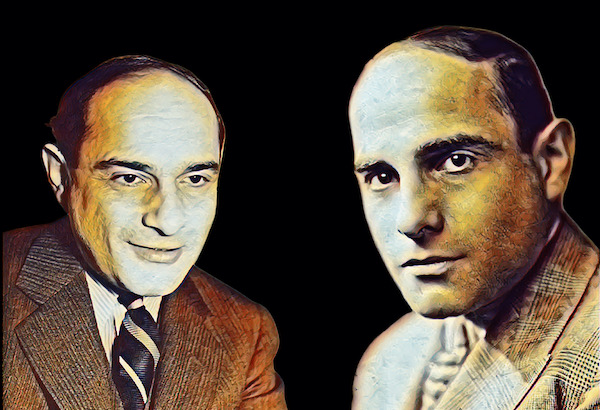
Hart and Rodgers would later write six new songs for the re-release of A Connecticut Yankee, but he didn’t even make it to the first night of the show. After disappearing for two days, he was found – drunk – in the gutter of a bar in the middle of winter. He was taken to the hospital but died of pneumonia just two days later. Rodgers was devastated by his death.
Critics and biographers highlight the complex Lorenz had about his appearance, which made him, as he said, “impossible to love”: he was short (less than 1.60 m) and bald. His intelligence and friendliness made none of this relevant, which is why they also believed that his reputation as a voyeur was just a euphemism or protection from friends who didn’t want to talk about his homosexuality.


The biopic and its impact on the 2026 Oscars
Just five years after his death, Hollywood has already bet on a biopic: Words and Music. Starring Mickey Rooney as the lyricist, the version of his death is almost an act of desperation after being rejected by the woman he loves. Blue Moon certainly doesn’t go that route.
Those who have seen the film complain – a lot – about the choice of Ethan Hawke to play Lorenz Hart. The actor is tall and far from bald, but heavy makeup and camera tricks are used to “disguise” it. And his performance, everyone says, is spectacular. Not to mention Andrew Scott‘s award.

Even with the 2025 Oscars just a week away, experts are already mapping out the next group of people who have a chance, and Blue Moon is ahead of the game by bringing together Hawke (who has already been nominated), Scott (a favorite who should be nominated) and Richard Linklater himself, who has already been nominated five times.
Interestingly, he is in the middle of adapting Stephen Sondheim‘s musical Merrily We Roll Along, which he wants to film like Boyhood: over many years. The cast includes Paul Mescal, Ben Platt, and Beanie Feldstein. So for now, it is all about Blue Moon.
Lorenz Hart‘s story is, above all, a portrait of genius marked by pain, of talent that transcends time, and of the vulnerability that echoes in his lyrics. Blue Moon not only recaptures his trajectory, but also revives his legacy for a new generation that may not know his name, but certainly knows his songs. If Ethan Hawke and Richard Linklater can capture the lyricist’s soul with the same intensity that he poured into his words, the film has everything to be one of the highlights of the next awards season. After all, as Blue Moon itself proves, there is something eternal in melancholy transformed into art.
Descubra mais sobre
Assine para receber nossas notícias mais recentes por e-mail.
 miscelana.com
1 comentário Adicione o seu