
In recent years, we have seen a growing appreciation for women on screen in roles that were previously predominantly male. The search for more complex and active female representations has led us to an interesting phenomenon: Actresses and female audiences are clamoring for female characters who, in addition to playing leadership roles, also engage in intense physical battles, often wielding swords. This desire was clearly expressed by Emma D’Arcy, the actress who plays Rhaenyra Targaryen in House of the Dragon, who asked that her character, originally not described as a fighter in George R. R. Martin’s book Fire & Blood, have a sword and actively participate in the battles of the next season. The request was granted, generating discussions about the compatibility of this decision with the Game of Thrones universe and the nature of the character.

This demand for women wielding swords is not an isolated phenomenon. Over the years, several female characters have come to represent the desire of an audience that wants to see powerful and fearless female figures who are not limited to the role of damsels in distress. However, this change has generated both praise and criticism, highlighting the pros and cons of transforming women into warriors and combatants.
The Appeal of Female Warriors
The desire to see women wielding swords is linked to a legitimate desire for more realistic and varied representations. For a long time, female characters in fantasy works were limited to passive roles. They were maidens, figures of love or sacrifice, or even powerful queens in distant castles, but rarely showed active combat ability. Female audiences, especially, seek more than passive representation: they want to see women as multifaceted figures who are as complex and complete as their male counterparts.
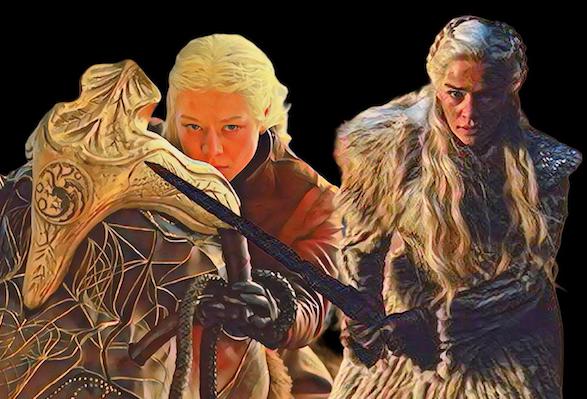
The example of House of the Dragon with Rhaenyra Targaryen is a reflection of this desire. In the original story, Rhaenyra is not described as a warrior but rather as an ambitious monarch with a strong sense of leadership. However, the decision to allow the actress to take on a more combative role makes sense, given the current context of representation. Women today want to see themselves in characters who are not only powerful intellectually or politically but also physically and combatively. This reinforces the idea that, in a fantasy world, women can be both leaders and warriors.
The Targaryen Dynasty and the Warrior Tradition
The Targaryen house, famous for its lineage of dragons and its connection to war, has some female figures who stood out on the battlefield. Many of the Targaryens were known for their warrior blood, and some of them even wielded swords with great skill. In House of the Dragon and other works in the A Song of Ice and Fire universe, we see a great interest in highlighting the women of House Targaryen as active and decisive figures in the history of Westeros.
One example is Princess Rhaenys Targaryen, who in Fire & Blood is described as a skilled and courageous woman. Although she was not specifically a sword-fighting warrior, her strength lay in the way she commanded and positioned herself during the Dance of the Dragons. She piloted her dragon, Meleys, with great skill and was one of the women who fought fiercely during the Targaryen civil war. Her direct action in battle, despite not involving hand-to-hand combat, places her as one of the most powerful female figures in Targaryen history, challenging the idea that women needed to be limited to roles of consort or passive ruler.


Rhaenyra Targaryen, as we mentioned, is another character who, although originally described as an ambitious and determined ruler, is a reflection of the Targaryen warrior tradition. Although her involvement in combat was mainly strategic, her ascension to the throne and her fight for the crown in a world dominated by men shows the complexity of her character, where physical combat, the use of dragons, and political warfare intertwine.
The Case of Arwen in The Lord of the Rings
However, not all changes are well received. When, in the first Lord of the Rings film, Arwen, a character played by Liv Tyler, takes a more active role in the fight, especially in the scene where young Frodo is defended against the Nazgûl, it generated criticism from some of the public. Arwen, in the books by J.R.R. Tolkien, is an elf whose main contribution to the story is her love for Aragorn and the choices he makes regarding his future. The addition of a fight scene for Arwen was seen by some as an attempt to force a masculinization of the character, something that is not present in the original work.


At the time, the public argued that, although it was an effort to strengthen the female character and give her more relevant action, it would compromise the authenticity of the narrative. This debate reflects the dilemma of adaptations: Is it acceptable to transform characters to meet the expectations of modern audiences, or do these changes dilute the essence of the original material?
In any case, with the success of the first film, Peter Jackson and Phillipa Boyens achieved autonomy and brought the character closer to the books.
On the other hand, Éowyn, the woman of Rohan, does what Arwen almost did in the films: she becomes a true warrior. She fights in the battle of the Pelennor Fields and defeats the Witch-King of Angmar, one of the most powerful figures in The Lord of the Rings. Éowyn’s battle, hidden behind male armor, has become one of the most iconic scenes in the fantasy genre. Éowyn breaks the barriers of her traditional role as a woman, proving her courage and skill with the sword. This exemplifies how audiences, especially female audiences, seek to see more than the typical maiden or passive figure: they want to see heroines who not only defy fate but also can fight for their own ideals.
In the Rings of Power series, Galadriel is presented as a much more active figure on the battlefield. She is shown as a determined warrior who seeks revenge against the Dark Lord, Morgoth, after the destruction of her kingdom and the death of her brother. Contrary to her representation in the books, where she is a character who has already achieved a high degree of wisdom and serenity, in the series, she is a more impetuous and energetic young woman, taking part in several battles and physical confrontations.
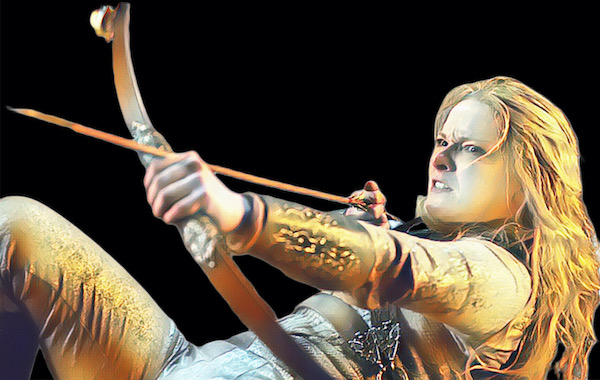
Although the series has creative license to expand and adapt the story, this change in Galadriel’s character has generated debate among fans and scholars of Tolkien’s work. Some believe that this version of Galadriel is an adaptation to make the character more accessible to modern audiences, showing a more active and combative heroine, something that aligns with the demand for strong female characters in contemporary productions. Others, however, believe that this approach strays from the essence of Galadriel in the books, who is a figure of calm, wisdom, and spiritual power rather than a physical warrior.
Daenerys in Game of Thrones
Another interesting example is Daenerys Targaryen, who, in Game of Thrones, becomes one of the central figures of the plot but in a very different way. She does not fight physically with swords but with dragons and military strategies. Daenerys is a character who is undoubtedly powerful and fearless, but her strength does not come from direct combat but rather from the control of powerful resources and the ability to manipulate and command armies. This created an interesting contrast with other female characters in the series, such as Brienne of Tarth, who, unlike Daenerys, actually wields a sword and actively participates in combat, as well as Arya Stark, who becomes a trained assassin.
Throughout the series, Daenerys faces a constant battle between her humanity and her rise to power. Her involvement with dragons, therefore, represents a mythical power that opposes conventional physical strength. This distinction is interesting because it shows that not every female character needs or should be a sword-wielding warrior, but can instead find her strength in other forms of power. The only image of the Queen wielding a sword, without exactly knowing what to do with it, was improvised by actress Emilia Clarke in the battle against the Night King. Knocked down by Drogon and surrounded by zombies, she picks up a sword to try to defend herself, even though she is awkward. She is saved by Jorah Mormont, who loses his life so that she can survive.

The Case of Brienne of Tarth
Brienne of Tarth in Game of Thrones is another example of a female warrior, but with a different approach. She does not have the imposing presence of a dragon or the charisma of a political leader, but her skill in sword combat and her unwavering loyalty to her principles make her one of the most admired characters in the series. Brienne represents the woman who fights not for ambition or power but for honor and duty. Her presence in Game of Thrones subverts traditional expectations, and her role as a female warrior has been one of the most celebrated representations of women in combat on TV.
Similarly, Arya Stark follows a unique path as a warrior, initially driven by revenge but evolving into a highly trained and independent fighter. Her journey, which takes her from a young noblewoman to a lethal assassin, redefines female archetypes in fantasy. The presence of both characters in Game of Thrones subverts traditional expectations, cementing their roles as some of the most celebrated representations of women in combat on TV.

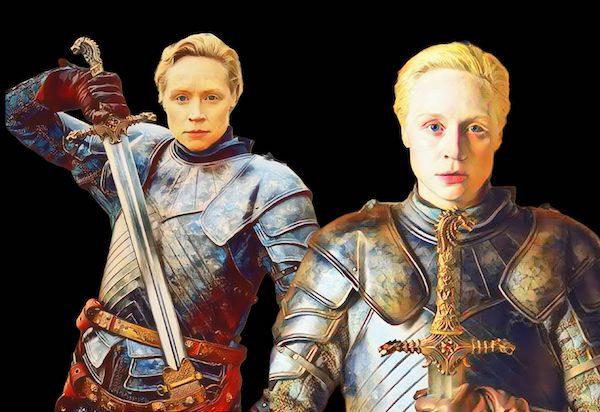
We have others, but these are the main ones. However, Sansa Stark remains consistent until the end. Even in the battle against the dead, when Arya hands her a dragonglass dagger, she doesn’t know what to do with it. “Stick it with the pointy end,” the youngest taught her. It wasn’t necessary, but almost!
The Negative Side: Anachronism and Authenticity
It is undeniable that the increasing representation of women fighting with swords or wielding other types of weapons is linked to a genuine desire to see women more active in narratives. However, this can create a mismatch between the construction of the world and the historical or fictional context. The case of House of the Dragon, for example, involves a change that, although it meets a contemporary demand for empowered women, can be seen as an anachronism within the original work, which describes female characters differently. This is the central dilemma of adaptations: in trying to appeal to a more modern and demanding audience, the essence of the source material can be lost, something that was so important in stories like The Lord of the Rings or Game of Thrones.
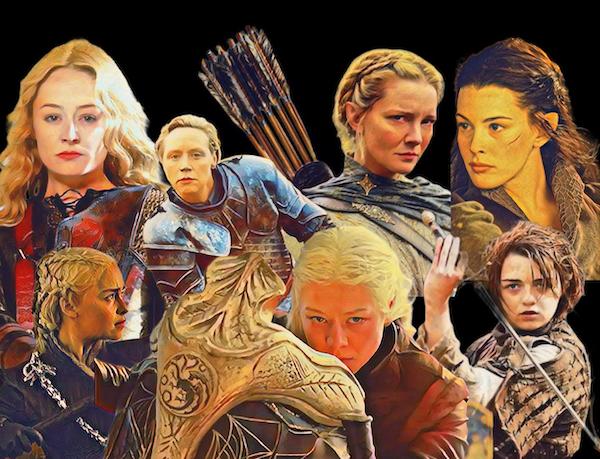
Furthermore, the idea that a female character can only be empowered or strong if she is wielding a sword can be limiting. There are many other forms of power and strength for female characters, such as intelligence, leadership, moral courage, or even strategic skills, as shown in Daenerys Targaryen or Cersei Lannister. Limiting female empowerment to physical combat can reinforce stereotypes of masculinity and undermine the idea that women can be powerful in many ways.
Diversity of Representations
The growing demand for women wielding swords reflects a positive cultural shift, but it also raises interesting challenges. The important thing is to ensure that representations of women in active roles, whether with swords or other forms of power, are authentic to their stories and do not result in a simple attempt to please the audience. Female characters can be strong and powerful in many different ways, and the world of fantasy adaptations offers the chance to explore these different facets in a richer and more complex way.
Descubra mais sobre
Assine para receber nossas notícias mais recentes por e-mail.
 miscelana.com
1 comentário Adicione o seu