
Working in the local newsroom in Rio, as I did in 2004 at TV Globo, meant editing a good deal of news about crime and violence in the city, a sad and complex reality for every Carioca. I was part of the team covering stories now significant in recent history. Still, among them, Dona Vitória’s story has always been one of the most emblematic and moving. The elderly woman, whose identity was kept secret for more than 20 years – for security reasons – decided, on her own, to film the frightening daily life that she witnessed from her window: shootings, violence, drug sales, and other criminal activities happening without the slightest embarrassment. Her historic initiative was revealed by the newspaper Extra and led to the arrest of drug traffickers and corrupt police officers. A fascinating story that is now portrayed in the film Vitória, starring Fernanda Montenegro, which will hit theaters in early March 2025.
The premiere in Rio was marked by emotion and the presence of the crew and cast, including a discreet appearance by Fernanda Torres, who came to honor her mother and her husband, Andrucha Waddington, the film’s director after her long Oscar season. I was close to everyone, alongside the actor Antônio Pitanga, who became emotional throughout the story, which is, in fact, very touching. The behind-the-scenes of Vitória is surrounded by tears, not only because of the difficult and inspiring journey of Dona Joana da Paz, which I will talk about later.

The film was originally directed by Brenno Oliveira, who died at the age of 58 in the middle of filming. Director of the successful films Dois Filhos de Francisco e Gonzaga: de pai para filho, Brenno was filming in the countryside of Pernambuco when he suffered a massive heart attack in 2022. The film would be his first formal partnership on screen with his wife and screenwriter, Paula Fiuza. As a friend of the couple and Brenno’s partner, Andrucha took on the challenging mission of continuing the project, tying up loose ends, and delivering the story with respect for his friend’s initial vision. And, since Fernanda is 94 years old, this is also announced as her last work on screen, although I hope she changes her mind and gives us more performances.
With this context and my experience in the newsroom, where I closely followed my bosses and colleagues who were extremely careful with the safety of the real Dona Vitória, I found myself traveling back in time throughout the film. The massage therapist and former maid, Joana Zeferino da Paz, is, without a doubt, a modern heroine and worthy of all tribute. Since the recordings could identify the author of the images, and due to the corruption among the authorities at the time, there was an imminent risk to her. The long discussions about how to report and give credit to Dona Joana’s courage without compromising her life were a true lesson in journalism, something that I carry in my heart to this day. This part is represented in the film by the sensitivity and dedication of actor Alan Rocha, who plays reporter Flávio Gusmão, author of the Extra reports and the book Dona Joana da Paz, which served as the basis for the script.
Although it seems like a “local history” film, Vitória addresses universal themes: loneliness, resilience, courage, and the faith that the world can be more just if everyone does their part. Of course, with Fernanda Montenegro on screen, there are long looks that say much more than words, and this talent is splendidly explored. I confess that I missed a more present soundtrack (Antônio Pinto wrote the music that only appears in the credits), but, reflecting later, I realize that silence was necessary for the emotion to emerge from the emptiness of social indifference, which is exposed at different moments and gains strength.
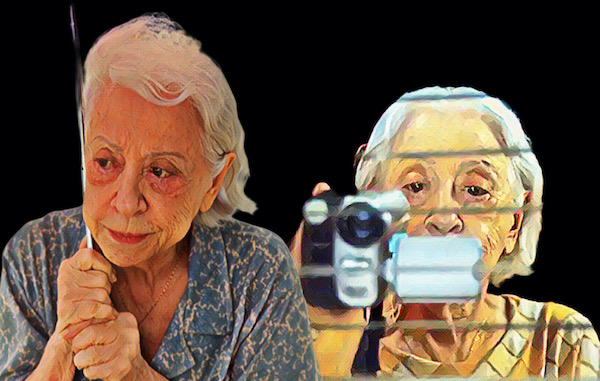
The script includes lighter moments, although, in some cases, the disparity between the actors is more evident, especially when the supporting actors do not have the same intensity as Fernanda Montenegro. Still, the story manages to generate anxiety, even knowing the outcome. Cleverly, the film does not delve into police corruption, but, for those who know the details, it might be interesting to contextualize a little more the greater risk faced by the elderly woman, who was literally in the crossfire.
The monologue in which we learn about Joana’s hard life and her resistance to abandoning her name and her home is one of Vitória’s high points. There, we feel the weight of a difficult choice between justice and conformity. She, of course, teaches us that the hardest path should not be avoided. Thanks to her courage, around 30 people were arrested, including police officers and drug traffickers, but Dona Joana remained in hiding under another name until she died in 2023 at the age of 97.
Thus, Vitória is not just a film about an episode in Rio’s history but a universal reflection on courage, resilience, and the struggle for justice. Fernanda Montenegro‘s performance, Andrucha Waddington‘s sensitive direction, and the portrayal of Dona Joana da Paz‘s life remind us of the strength that lies in small choices and the importance of doing what is right, even when faced with great challenges. Dona Joana’s story remains an example that courage can transform reality, even at the cost of great sacrifices.
.
Descubra mais sobre
Assine para receber nossas notícias mais recentes por e-mail.
 miscelana.com