
Reading Jane Austen is a form of escapism where a happy ending is guaranteed. Is that really true? In the year that we celebrate the 250th anniversary of the writer’s birth, I propose to embark on a well-known debate among fans of her work: who would be her saddest heroine?
It is not an easy or clear answer. In general, fingers will turn to Anne Elliot, the protagonist of Persuasion, precisely because, throughout the book, she, a 27-year-old woman, is considered old and without marriage prospects, dealing with deep regret as she reflects on the consequences of her decision to break off her engagement to Captain Frederick Wentworth. Although her eventual reunion with Wentworth offers a hint of hope, it is inherently bittersweet, highlighting both the enduring nature of love and the pain of missed opportunities. Still, my choice is another, I warn you.

“The more I know of the world, the more I am convinced that I shall never see a man whom I can really love.”
Marianne Dashwood in “Sense and Sensibility”
Let’s return to all the “candidates,” as there are others who embody a series of struggles and challenges, demonstrating deep sadness. Before returning to Anne, another heroine often considered Austen’s most melancholy is Fanny Price, from Mansfield Park. Growing up in a family that frequently mistreats her, Fanny struggles with self-doubt and a deep sense of not belonging. Her unrequited love for Edmund Bertram, who initially fails to recognize her worth, further amplifies her sadness, especially as she navigates the complexities of the Bertram family dynamics. Certainly, if we broaden the concept of sadness to include more than just having a husband, Fanny, as a poor heroine, takes the lead, but she is not my choice.
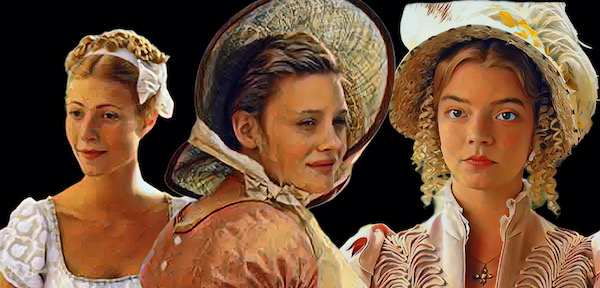
Oddly, some people put Emma’s spoiled Emma Woodhouse in the running, even though she is often seen as confident and self-assured. Between the lines, Austen reveals sadness through her misguided attempts to matchmake and control the fate that has left her motherless and emotionally dependent on a grieving father. Emma’s efforts lead to significant misunderstandings and emotional turmoil for herself and others. Emma’s eventual realization of her shortcomings, combined with her initial misalignment in love and friendship, lends a bittersweet quality to her character arc.
Finally, we come to a poignant figure, none other than Marianne Dashwood from Sense and Sensibility. Marianne is characterized by her intense emotions and passionate nature, but her love for John Willoughby, a charming man who seduces her with implicit promises of eternal love but who abandons her for a financially advantageous union, is heartbreaking to the most cynical. This breakup leaves her in a state of almost destructive despair, made worse by the fact that, unlike her sister Elinor, Marianne does not know how (and does not want) to contain her emotions. Her grief is both physical and emotional, to the point of becoming seriously ill, flirting with death before finally recovering. Marianne’s “evolution” (more on this later) reflects the social constraints of her time and is a journey from youthful idealism to a more moderate understanding of love, resonating with themes of loss and growth. Yes, she marries, but was she really happy? For me, Marianne is the most complex and sad character in Jane Austen’s universe.
“Love is not love which alters when it alteration finds, or bends with the remover to remove. Oh no! It is an ever fixed mark that looks on tempests and is never shaken”
William Shakespeare

Marianne Dashwood is a central character in Sense and Sensibility, initially the “sensibility” of the title, while her sister Elinor is the “reason.” Spirited, Marianne embodies the romantic idealism of the early 19th century, which leads her to embrace life with fervor and intensity, unlike Austen’s more timid heroines. Marianne is unafraid to show her feelings, whether in love or despair, which makes her relatable and deeply human.
What also sets Marianne apart in Austen’s world is her deep belief in the power of love and her disdain for social conventions that dictate propriety and restraint, exemplified by her impulsive passion for Willoughby, which later forces her to deal with the consequences of idealizing love in a society that values reason and morality.
At the time, Marianne’s journey was seen as an example of growth and transformation, as she learns to reconcile her emotional impulses with the need for practical considerations. But, seeing Marianne evolve from a fiery young woman into someone who values balance and reason can also be seen as a portrait of a soul crushed by society. Her eventual acceptance of Colonel Brandon’s more steadfast love reflects her growing up, where she comes to value constancy and security instead of a carnal and passionate love.

Interestingly, the duality between emotion and rationality is a recurring theme in Austen’s works, but, in general, the protagonists are the personification of reason and restraint, leaving the counterpoints as the grayer characters (and even antagonists). This is not the case with Marianne, one of the heroines that Jane Austen makes us love.
“It is not time or opportunity that is to determine intimacy;—it is disposition alone. Seven years would be insufficient to make some people acquainted with each other, and seven days are more than enough for others.”
Marianne Dashwood in “Sense and Sensibility”
In today’s world, we can certainly argue that Marianne Dashwood’s character resonates with many themes relevant to today’s culture, particularly those personified by Millennials, as she reflects the emphasis on authenticity and emotional expression. At a time when many are advocating for mental health awareness and the importance of being true to one’s feelings, Marianne’s struggles and eventual journey toward self-acceptance echo these sentiments.
Another “millennial” trait of Marianne’s is her undeniable narcissism, which blinds her to Elinor’s silent suffering and accuses her of being callous and resigned for not fighting for Edward Ferrars when she does not know, or seek to know, the true circumstances of her sister’s constant sadness.

Yet, Marianne also illustrates a significant tension between individual desires and societal expectations. The “punishment” for her emotional overreaction can be seen as a commentary on the consequences of living solely by one’s feelings in a world that demands a certain level of restraint and practicality. In contemporary discussions, it can be argued that Millennials often face similar dilemmas: the desire to live authentically versus the realities of social pressures, responsibilities, and personal limitations.
The ultimate message of Sense and Sensibility can, therefore, be overwhelming: from passionate idealism to a more measured acceptance of fate and joy in a life less aligned with her initial dreams, it is not necessarily a “happy ending.” That is why, even today, Marianne Dashwood stands out as a figure whose struggles and eventual adaptation can resonate with modern audiences, particularly those who value emotional honesty while also facing the challenges of social expectations and personal growth.
What is positive about Marianne’s intense suffering is that she is surrounded by the love of her family unconditionally. Her marriage to Colonel Brandon can be interpreted as a resigned compromise, but, as this was valued in Jane Austen’s time, the text itself suggests that she embraced a second chance at happiness and was victorious. But there is something darker implied in this “victory”: Marianne marries him because she needs to move on, because her belief in all-consuming love has been shattered, and because society does not give her many other options. For a young woman without her own fortune, remaining single would be a limited and possibly lonely prospect. Thus, her marriage can be seen as a final blow to the destruction of her youthful illusions.

“Marianne could never love by halves; and her whole heart became, in time, as much devoted to her husband, as it had once been to Willoughly”
Jane Austen “Sense and Sensibility”
When compared to Anne Elliot, Marianne is a tragic character in the moment but not in essence. Anne has lived a silent and constant sadness for years, without any certainty that anything will change. Marianne, on the other hand, finds herself crushed by grief, but because she is so young and so full of life, she has the luxury of a new beginning. Her suffering is visible, desperate, and almost theatrical, while Anne’s is melancholic, resigned, and much more prolonged. If Marianne represents the overwhelming pain of a wounded youth, Anne embodies the persistent sadness of a lost opportunity. The difference lies in the conclusion of the stories.
No other Jane Austen heroine has had to make the sacrifice that Marianne Dashwood did. Anne, despite having lost years of happiness, keeps her essence and feelings intact and unites with Wentworth. She is still capable of loving in the same way. Marianne, on the other hand, seems to have completely transformed. She learns to be “sensible” but loses part of the fire that made her who she was.
Does this make Marianne the saddest character in Jane Austen’s novel? Possibly, if we consider not only the pain she feels but the fact that she has to give up herself to survive. The question that remains is: Is Marianne really happy at the end of the story, or is she just resigned? I doubt that her reading would be the same today…
Descubra mais sobre
Assine para receber nossas notícias mais recentes por e-mail.
 miscelana.com