
No woman can deny the accuracy of Mike White‘s vision and writing about various types of women and how they relate to men and, above all, to each other. This third episode is worth discussing one of the great successes: the three childhood friends who reunite on a trip to Thailand to catch up and enjoy some alone time.
In contrast to Olivia and Paula in the first season and Harper and Daphne, what makes the friendship between Laurie, Kate, and Jaclyn so fascinating in The White Lotus is how their complex personalities and individual journeys intertwine, highlighting the various layers of the contemporary female psyche. Each of them, with their fears, insecurities, and contradictions, seeks to assert themselves and fit in, but at the same time, finds themselves in constant conflict with the need to remain true to themselves. Their friendship, which at first glance may seem like a sincere and joyful reconnection, soon reveals hidden tensions.
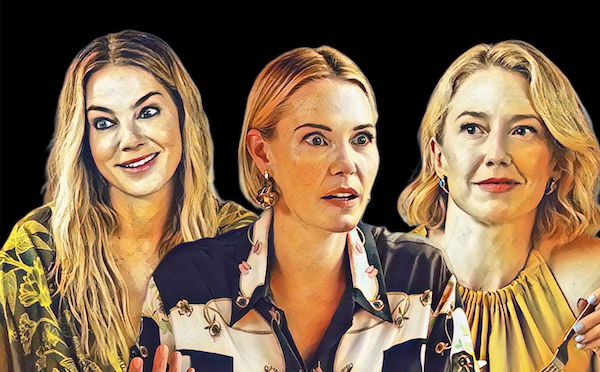


What makes these three characters so intriguing is the fact that their relationships are not based on a genuine and deep connection, but rather on a constant search for something that they are not sure what it is. Their friendship, although intense at times, is always permeated by a game of masks, where each one tries to fit into the expectations of the other, without being able to completely free themselves from their own insecurities. Laurie exposes the flaws of the system with her brutal honesty, while Kate tries to maintain control over her image and Jaclyn tries to sustain a perfect life that, deep down, suffocates her.
Each friend represents an archetype
Laurie, played by Carrie Coon, who will also be in The Gilded Age in 2025, emerges as one of the most fascinating and ambiguous characters of the season. Psychologically, Laurie is the representation of a woman who is in a transitional phase in her life, dealing with aging, with the erosion of her youthful expectations, and with a deep dissatisfaction with her identity. She seems to be searching for something to fulfill her, be it validation from others, momentary pleasure, or, more viscerally, an attempt to regain power over her own narrative, which seems to have been lost over the years. Her authenticity, sometimes brutal, is a way of masking her deepest insecurities.
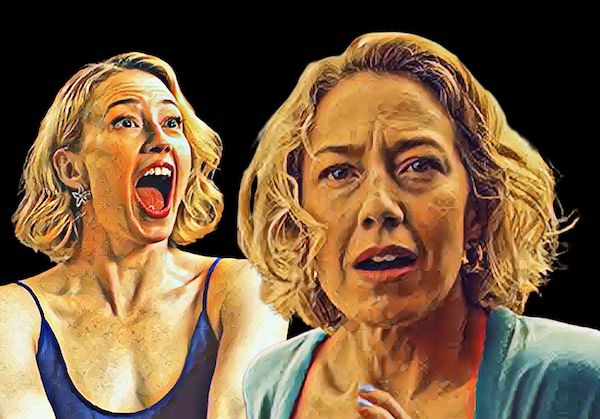
Laurie’s final monologue, where she exposes her vulnerability and frustrations, is a cry of self-liberation and, at the same time, of resignation. She realizes that, despite her attempts, society no longer sees her in the same way, and she can no longer fit into the mold she had tried to follow. It is as impactful and important as America Ferrera’s monologue in Barbie, with the need for it to be saved for TV History as well as the film.
Laurie’s psyche can be analyzed through the lens of a person who lives a constant internal struggle between the desire to fit into social standards and the need to free herself from imposed expectations. Her incessant search for pleasure and recognition is an attempt to fill the void left by her own existential dissatisfaction. Her interactions with other friends reveal the way she sees herself in the mirror of society: an aging woman, without full control over her narrative, and desperately trying to find a way to reconnect with a world that no longer sees her as it once did. “I just feel like my expectations were too high or I just feel like as you get older, you have to justify your life and your choices. And when I’m with you guys, it’s so transparent what my choices and my mistakes were.
“I just feel like my expectations were too high or I just feel like as you get older, you have to justify your life and your choices. And when I’m with you guys, it’s just so transparent what my choices were and my mistakes.
I have no belief system. Well, I mean, I’ve had a lot of them. I mean, work was my religion for forever, but I definitely lost my belief there. And then I tried love and that was just a painful religion just made everything worse. And then even for me, just like being a mother, that didn’t save me either. But I had this epiphany today: I don’t need religion or God to give my life meaning, because time gives it meaning.
We started this life together. I mean, we’re going through it apart, but we’re still together. And I look at you guys and it feels meaningful and I can’t explain it, but even when we’re just sitting around the pool talking about whatever and name shit, it still feels very fucking deep. I am glad you have a beautiful face and I’m glad that you have a beautiful life. I am just happy to be at the table.”

Kate, played by Leslie Bibb, brings to the plot the figure of a woman who, unlike Laurie, tries to control her image and maintain a facade of stability. Kate’s character is immersed in the expectations of what is socially acceptable: a woman who is Politically conservative, married, religious, and, to a certain extent, conforms to the traditional roles that society expects of her. However, like much of society, she also carries the burden of dissonance between what she appears to be and what she feels. At various times, Kate finds herself confronted with questions about her own beliefs, values and the pressure to be seen as “adequate”. Psychologically, she is a character who tries to fit in, but who is constantly challenged by her own internal contradictions.
Her conservative political stance, which becomes a point of friction in interactions with her friends, reflects a desire to remain rooted in certainties, perhaps as a defense against the internal chaos that she cannot control. The way Kate deals with the tensions in her circle of friends is a manifestation of her difficulty in dealing with the complexities of her own identity and autonomy.
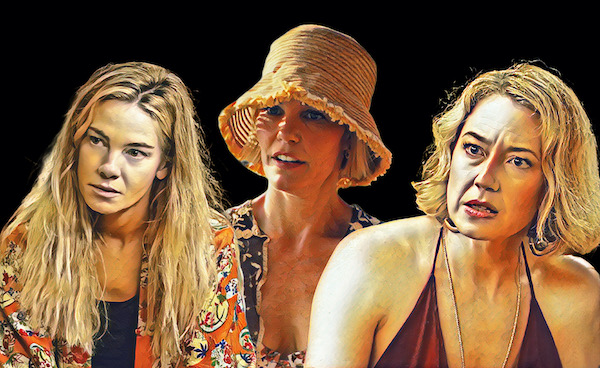
By taking a stand on issues such as politics, religion, and morality, she tries to reaffirm her place in the group, seeking security in a world that, at the same time, seems to reject her. Her friendship with Laurie, especially, becomes a kind of mirror that confronts her with the fragility of her own identity construction.
Jaclyn, played by Michele Monaghan, represents a woman who tries to remain firm in a life of appearances, but who is also aware of her own weaknesses and flaws. Her psyche reveals a person who strives to maintain an idealized image, not only for others but also for herself. In her relationship with Laurie and Kate, Jaclyn seems to want to maintain control, perhaps a need to be accepted within a standard that she considers to be the only valid one. Her relationship with others is permeated by moments of searching for validation and, at the same time, an attempt to escape her own dissatisfaction.

Her interaction with Laurie, as she encourages her friendship with Valentin, reveals that Jaclyn is projecting her own unfulfilled desires and frustrations onto others. She is trying to fill a void that is inevitably hers, but which is disguised by a facade of “perfect life.” This dynamic with Laurie, in particular, reveals how much she is also searching for something, even if, at times, she refuses to admit it to herself.
The dynamic between Laurie, Kate, and Jaclyn is a game of masks and unspoken needs. Each of them is dealing with their own insecurities and trying to find their place in the world but without the willingness to deeply confront what they truly want. Despite their appearance of being united, each is, in fact, on a solitary search for something deeper, something that perhaps even they do not know what it is.


In psychoanalytic terms, the relationship between these characters reflects the constant struggle between the desire for external acceptance and the search for internal authenticity. They try to conform to the roles that society imposes on them, but this comes at a significant emotional cost. The tensions between these three women are not just matters of rivalry or superficial misunderstandings, but rather a reflection of their own internal struggles to find a balance between who they are and what the world expects of them.
Ultimately, the conclusion of the three friends’ story can be seen as a metaphor for the complex relationships between women in contemporary society. They are always in a process of adaptation, of searching for belonging and acceptance, but at the same time, each of them carries the weight of their own internal contradictions. Their friendship, marked by moments of affection, but also of frustration and incomprehension, is a reflection of the constant struggle between the desire to connect genuinely and the imposition of social roles that limit this connection.
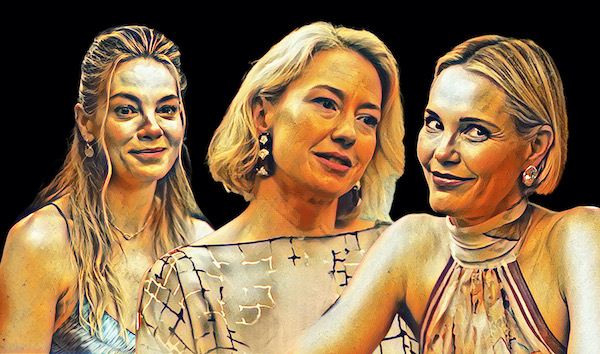
Thus, the reconnection of the three suggests an acceptance of each other’s flaws and imperfections, a tacit recognition that, although the system and external expectations try to shape them, they are ultimately responsible for their own narratives. This becomes an important point to reflect on: although the women in the series seek happiness and fulfillment, they do so within a social context that constantly limits their options and their possibilities to be fully themselves.
This internal struggle is what makes The White Lotus such a fascinating series, because through these complex relationships and dynamics, Mike White manages to create an accurate and colorful portrait of women in contemporary society, who, even when they come together in search of connection and leisure, find themselves confronted with their own unresolved issues and the expectations that the world insists on imposing on them.
Descubra mais sobre
Assine para receber nossas notícias mais recentes por e-mail.
 miscelana.com