
I’ve never hidden the fact that I’ve always been a passionate fan of Jean Smart and since Hacks premiered on MAX in 2021, she has been winning all the acting awards with all due merit. The series was somewhat blocked by the fever of The Bear (in the wrong category), but in recent years it has changed its course and today it is the most awarded comedy series in production. Yes, it is more dramatic than comedic, but spectacular.
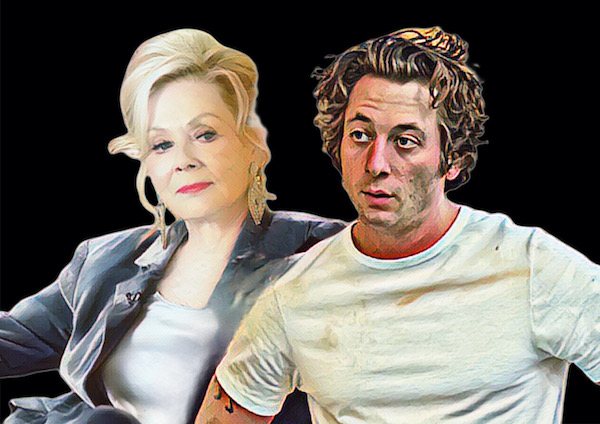
There is a lot to praise in Hacks. Made by young showrunners who dared to put an actress over 60 to lead the cast, it is a series about comedy, but also about power, aging, adaptation, and the dynamics between two women from different generations, both struggling to remain relevant in the entertainment industry. Lucía Aniello, Paul W. Downs, and Jen Statsky balance nostalgia, depth, and comedy in a complex and humorous vision of show business, with an emphasis on human relationships, especially those of Deborah Vance (Jean Smart) and Ava Daniels (Hannah Einbinder), the two protagonists.
At the beginning of this journey, Deborah was already a veteran comedian, famous for her stand-up show in Las Vegas, with a career that had its peaks of success and is now in decline. Throughout the seasons we see that she is a pragmatic woman and, at the same time, deeply insecure about her relevance and her age, which is seen as an obstacle in the industry. She has a strong and controlling personality, but there is also a fragility behind this facade. Narcissistic, insufferable, and talented, it is difficult to say that we “love” Deborah Vance. But we do.
The character is inspired by a combination of female comedy figures from the 60s, 70s and 80s, such as Joan Rivers, who struggled with ageism in the industry, and Phyllis Diller, known for her self-deprecating and irreverent humor. Joan Rivers, in particular, had a similar career: a pioneer in female stand-up who faced enormous challenges related to her aging and the space women occupied in the comedy world.

Meanwhile, Ava is a young and ambitious comedy writer who, after being canceled for a problematic tweet, finds her career stalled. She is hired to work with Deborah, which creates immediate tension, as Ava represents the new world of comedy and pop culture — more inclusive and conscious — while Deborah is a veteran who has no patience for these “new values.” Throughout the series, Ava goes through an emotional evolution, going from an immature and selfish young woman to a woman who somehow finds a way to mature in the industry.
Ava’s composition is also based on real people, especially contemporary comedians and writers such as Amy Schumer and Tig Notaro, who represent a new generation of comedians with a more raw and self-ironic approach. They challenged norms and renewed the space for women in comedy, just as Ava tries to “revolutionize” Deborah’s show, proposing a more “modern” humor.
There is a lot of drama in each of their personal lives, but what drives the series is the love-hate that they feel for each other. The tension is the dynamic between the two, in a relationship of antagonism that evolves into a complex partnership, with a touch of friendship.
Of course, the main fuel revolves around the clash of generations. While Deborah represents a classic comedy, focused on the styles of humor from past decades, Ava tries to modernize and renew Deborah’s material for today’s audience. This clash of approaches brings to light questions of relevance in comedy and the difficulty of adapting over time. Deborah doesn’t understand what’s wrong with her style, which makes her a star, and Ava, on the other hand, sees the potential to modernize her approach so that she can survive.

And whenever we think the two are getting along, we have confusion that drives them apart. The fourth season alternates the power dynamics between them. One of Deborah’s obsessions was to break the prevailing machismo on TV and host a talk show. That’s why she doesn’t trust that Ava, even though she’s talented, could be the ideal person to lead the show’s editorial team. But Ava, already trained in the star dynamics, plays her card (good old blackmail) and imposes herself on the position, obviously creating extra and unnecessary tension for everyone.
If there’s one thing Deborah loves, it’s being challenged, and when we meet her again, we see that she still enjoys sabotaging Ava. But her extra complex personality for today’s times also puts her in trouble. I love that my personal friend, reporter Stacey Wilson Hunt, is the journalist who gets on Deborah’s nerves at the press conference. Stacey would never ask the question the way the show did, but the question about ageism and sexism was valid. And predictable, as Ava warned.

But it’s just the beginning of the season, Deborah usually gets a head start in the fight and it’s Ava who continues in the spiral of suffering. The comedian’s blow comes when she receives news she doesn’t want to hear (like Marcus leaving her), which feeds her already exaggerated sense of paranoia. I won’t give any more spoilers, but it’s clear that the two give off Tom and Jerry vibes, the fight is never the end and there’s always a twist for a new round. As long as both end up on top: I’m in!
Descubra mais sobre
Assine para receber nossas notícias mais recentes por e-mail.
 miscelana.com