
With the premiere of the second season of Andor, we will have an unexpectedly human, dramatic, and complex story centered on two antagonists: Syril Karn (Kyle Soller) and Dedra Meero (Denise Gough).
What makes the relationship between Syril and Dedra unique is precisely the fact that it is not heroic, nor redemptive, nor idealized. It is not a “forbidden love” like that of Anakin and Padmé, nor a moral spark like that of Kylo and Rey. It is a romance between two villains who remain villains, and who live a story full of power, obsession, and emotional dependence.
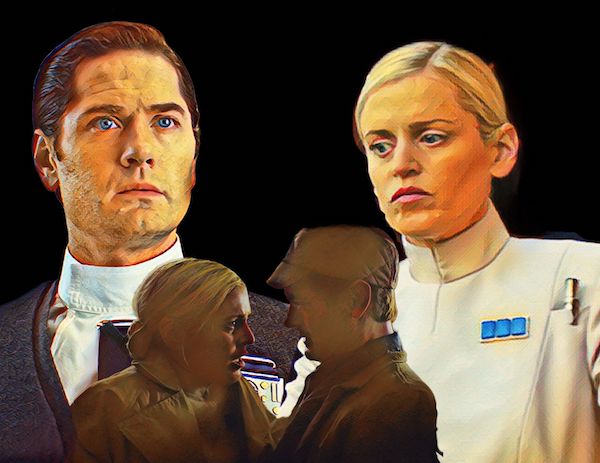
Syril begins his journey as a zealous subordinate of corporate security, an anonymous employee with a tight uniform and a suffocating moral rigidity. Obsessed with rules, structure, and the idea of justice—not in the sense of fairness, but rather of order and control—he deeply believes in the value of authority and the chain of command. At the same time, he is a displaced, insecure character, deeply affected by his mother’s constant disappointment and the lack of professional recognition. He represents the subject who has no power but deeply yearns for it. His desire for order borders on fanaticism, which makes him dangerous, not out of malice, but out of conviction.
His obsession with Cassian Andor (Diego Luna) begins when he sees him escape punishment after killing two agents of the Pre-Mor Authority. It consumes him. Syril does not pursue Andor out of personal revenge or heroism—he pursues him because he believes that allowing him freedom threatens the entire fabric of the order he idolizes. Andor represents, for him, the collapse of the structure, the systemic error, the “out of place” that needs to be corrected. It is an almost religious fixation.

When he is humiliated, fired, and forced to return to live with his controlling mother on Coruscant, Syril clings to this obsession as his only source of purpose. In parallel, he develops a disturbing fascination with Dedra Meero, an Imperial Intelligence agent who seems everything he wants to be: cold, competent, feared.
Dedra is meticulous, ambitious, and extremely intelligent. A woman who has risen within the brutal, patriarchal structure of the Empire through her competence and analytical skills. However, her quest for “coherence in data” reveals a dark side: she sees the population as pawns to be controlled and punished.
Dedra is the most refined and powerful version of the fanaticism that Syril represents. While he dreams of order, she executes it with coldness and determination. Throughout the season, she becomes a feared and respected figure in the ISB. He watches her, approaches her, tries to connect. Dedra initially treats him as a nuisance—a stray dog, barking too loudly.

But something changes at the end of the first season, when Syril saves Dedra from the angry mob in Ferrix. The scene, tense and silent, marks a subtle turning point. For the first time, Dedra is vulnerable. For the first time, Syril is needed. From that moment on, the relationship between the two takes an unexpected turn.
In the second season, they get together. It is not an idyllic romance — it is an alliance between accomplices. Dedra, with her strategic coldness, sees in Syril a useful devotee. He idolizes her, and she, in a gesture of dominance that borders on affection, confronts Syril’s abusive mother, imposing limits that her own son never managed. It is a gesture of possession as much as of protection. She takes her place as partner and as commander.
However, this union is doomed from the start. Genuine love is something foreign to both of them — especially to Dedra.
SPOILER ALERT
Dedra respects Syril for his usefulness, perhaps even for his fidelity, but she never abandons the pragmatism of the position she holds. When confronted by her own obsession—to rise in the Empire—she knows how to use his (finding Cassian) to her advantage. To Syril’s detriment. The impact is devastating.

Nowadays, Syril’s fixation on Cassian Andor is no longer an impulse for correction, but rather for revenge. Bereft of everything, Syril sees Cassian as the last living piece of an equation that has fallen apart. By following Cassian, he inserts himself into the center of the insurgency, not as a rebel, but as a symbol of the collapse of the Empire’s faith in itself. His trajectory becomes tragic, almost mythological: the man who sought order but found chaos within himself. And the price—brace yourselves—is very high and deeply sad.
Dedra, for her part, follows the course of every authoritarian who believes himself immune to the system’s flaws. By betraying Syril, she is paving the way for her own decline, emotional and institutional. Her downfall is not only spectacular, but also symbolic: the woman who thought she had everything under control loses the only person who ever challenged her — and perhaps the only one who saw through the armor. And when her time comes, it is an irony that is not tragic only because, more than Syril, she has always been in control.

Together, Dedra and Syril form one of Andor’s darkest and most fascinating nexuses. Their romance is a cruel distortion of affection, shaped by obsession, ambition, and an insatiable desire for control. And their inevitable downfall echoes that of the Empire itself: a structure built not on trust or human bonds, but on fear, hierarchy, and isolation.
If love has the power to redeem, Andor shows us that it can also corrupt. In the end, Dedra and Syril are not just victims of an authoritarian regime—they are complicit in their own destruction. And it is this moral, intimate, and unsettling complexity that elevates the series to a new level within the galaxy far, far away.
Descubra mais sobre
Assine para receber nossas notícias mais recentes por e-mail.
 miscelana.com
1 comentário Adicione o seu