
In the first season of Andor, the plot gave a lot of prominence to Senator Mon Mothma, who, for those uninitiated in the entire Star Wars universe, would only remember her in the decision-making meetings of the Rebels in the films of the saga created by George Lucas. She has always been as relevant in the fight against the Empire as Padmé Amidala. That’s right. Mega relevant.
And in this second season, she is, alongside Cassian Andor, one of the protagonists. Her involvement in the rebellion is reluctant like the pilot, in a mirror where she is at the top of the pyramid, but she has empathy for the rest of the galaxy and opposes the Empire.
Originally played by Caroline Blakiston (in Return of the Jedi), since Revenge of the Sith she has been with the Canadian Genevieve O’Reilly, who returned in Rogue One, Ahsoka, and Andor. And after the now-iconic scene of the senator dancing and drinking her grief at her daughter’s wedding party, you’ll certainly want to know more about her. That’s why I’m here.
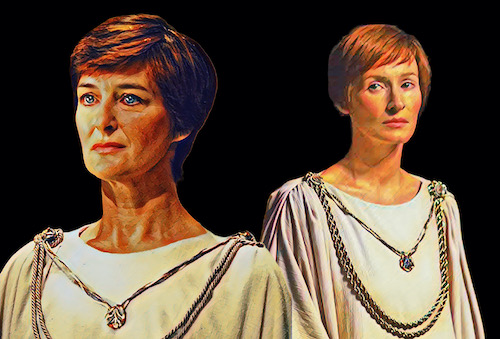
Political Trajectory
A native of the planet Chandrila, Mon’s political affiliations throughout the saga include the Galactic Republic Senate, the Imperial Senate, the Rebel Alliance, and the New Republic Transitional Government.
In the Republic, Mon Mothma was elected senator of Chandrila at a young age and was considered a political prodigy. From the beginning, she showed herself to be a moderate idealist, but a staunch defender of democracy. During the last decades of the Republic, she questioned the corruption of the Senate and opposed Chancellor Palpatine’s rise to power.
When Palpatine proclaimed himself Emperor, Mothma remained a senator, now of the Imperial Senate, but secretly worked to weaken the regime. In Andor, we see the beginning of her dilemma: reconciling her privileged position with her growing involvement with dissent.

The turning point and the total involvement with the rebellion are the heart of this new and final season of Andor. In the end, Mon Mothma emerges as one of the most tragic figures in the galaxy. She wins wars, changes regimes, and inaugurates a new order. But when she lies down, she knows that she has lost something that cannot be rebuilt: the bond with her daughter and several friends she left behind. The rebellion triumphs. The Republic resurfaces. But on Chandrila, there is a girl who carries her name — and who may never forgive the woman behind the legend.
Before talking about Mon’s future in the saga, it is necessary to highlight her greatest sacrifice, which is “losing” her only daughter, Leida Fertha.
There is something devastatingly silent in the relationship between Mon Mothma and Leida. A cutting stillness, an abyss that does not manifest itself in screams or confrontations — but in glances that do not meet, in presences that are nullified within the same house, in an intimacy corroded by absence. It is in the domestic sphere—where, ironically, the Empire does not enter—that Mon Mothma experiences her most intimate defeat.

While the Star Wars universe is known for epic blood ties—parents who become tyrants, children who redeem themselves at the last moment, siblings who recognize each other in war—Mon and Leida’s story is banal and earthly. And that is precisely why it cuts so deeply: there are no lightsabers, but oppressive traditions. There are no cosmic confrontations, but arranged marriage ceremonies. Mon Mothma’s motherhood is a political tragedy disguised as a normal life.
Tradition, duty, and a daughter who rejects her mother
Mon Mothma is a woman who, by vocation, sacrifices. She sacrifices her name, her freedom, her fortune, her marriage—and, ultimately, her daughter. But what makes this decision particularly cruel is not the political gesture itself, but the fact that Leida seems to willingly accept the fate that her mother would like to spare her. Leida takes refuge in exactly what Mon fights against: the orthodox Chandrilan rituals, the doctrines that restrict female autonomy, the ideas of honor, duty, and submission.
Leida, still a teenager, gets involved with a circle of girls who recite chants and practice obedience as a virtue. For Mon, it is like watching her daughter drown with a smile on her face.
This inversion is the tragic driving force behind the character. The daughter is not the victim of direct oppression — she chooses it. And, in choosing, she rejects not only her mother’s values, but her very figure. Mon Mothma, who fights against a galactic empire, cannot win a battle at home. Her eloquence on the political stage turns into silence in the family. Her public courage contrasts with her emotional impotence. Instead of dialogue, what we see between mother and daughter is concessions. And silence.

A sacrifice without redemption
In one of the most crucial moments in the Andor series, Mon finds herself cornered. Her funds have been traced. The Empire is approaching. The rebellion, still clandestine, needs means to continue. And she, with no way out, decides to accept a deal from a criminal banker: her daughter will be presented to his son, according to Chandrilan customs, paving the way for o for a future marriage.
A gesture that Mon has always despised. A ritual that she has always rejected for herself — but that she now accepts, like someone who offers a lamb in sacrifice to ensure the crossing of the people.
Mon does not force her daughter. She does not need to. Leida is already there, veiled and head held high, fulfilling a role that she believes is hers. What Mon sacrifices, in truth, is not her daughter’s future — it is the hope that Leida will one day understand her. She kills the emotional bridge. And she does so with dry eyes, with the composure of someone leading a revolution. Her face at that moment is not that of a mother, but that of a martyr who has already lost everything before even winning.
The mother who remains — and fails
Mon Mothma’s motherhood contrasts sharply with other figures in the Star Wars canon. Shmi Skywalker delivers her son to freedom, but sees the emergence of Darth Vader. Padmé, pregnant, dies believing that there is still good in Anakin, and leaves Leia and Luke the legacy of hope. Leia, in turn, lives with he dilemma of seeing her own son, Ben Solo, become Kylo Ren. All these mothers are victims of greater forces.
Mon Mothma, on the other hand, is a victim of her own silence.

She is the only mother in Star Wars who raises her son. Who is there. Who shares the same roof, the same meals. But it is as if they live in different galaxies. What Leida rejects is her mother’s plan for the future. She rejects her coldness, her distance, and her constant emotional evasion. Mon has no time for parties, nor for advice, nor for consolation. And perhaps she never learned to show affection without control. In a house where everything is measured — words, steps, gestures —love becomes a risk.
The price of the new republic
Mon Mothma loves Leida. But her love is heavy, measured in costs and consequences. It is not the love that Leida wants. And it is in this imbalance that the relationship breaks down: not because of a great tragedy, but because of slow erosion. Like a dam that leaks little by little until it bursts.
Psychology and Dramatic Layers
Mon Mothma is often associated with the figure of the political martyr. Her strength lies not on the battlefield, but in the control of information, strategic alliances, and the ability to move pieces in a deadly game — even when it costs her everything.
She is a character of constant sacrifice: she gives up her family, comfort, love, and even freedom. Andor deepens this dimension by showing a woman who needs to hide her true mission even from those she loves. The weight of moral and political responsibility silently consumes her.

The Future
I won’t give spoilers about how Mon Mothma’s personal drama is resolved, but it is moving. The series delicately explores the character’s emotional and political isolation, including within her own home, with an alienated husband and a daughter trapped in the conservative traditions of Chandrila.
As one of the architects of the Rebel Alliance, her high point went down in history as the “Chandrilla Speech,” which only happens when the plot about the planet Ghorman reaches its peak and, finally, the senator publicly denounces Palpatine, becoming a political criminal and an open rebel. In hiding, she is vital to uniting scattered rebel factions, including Saw Gerrera, Bail Organa, and Luthen Rael.
Because of Rogue One and Star Wars: A New Hope, we know that the rebels overthrew the Empire. This is Mon Mothma, who leads the interim government of the New Republic, being the first Chancellor. Her political project is to demilitarize the galaxy — an ethical decision, but one that will prove dangerous with the rise of the First Order.
Legacy
Mon Mothma is, in essence, the peaceful and strategic counterpart of figures like Leia and Cassian. If Leia is fire, Mothma is ice — serene, but sharp. If Cassian is action, she is reason. And where Saw Gerrera blows everything up, Mothma quietly builds fragile alliances based on trust and sacrifice.
Her trajectory is reminiscent of historical figures like Eleanor Roosevelt, as well as fictional characters like Lady Macbeth in reverse: power comes through self-control, not ambition. And we are already her fans.
Descubra mais sobre
Assine para receber nossas notícias mais recentes por e-mail.
 miscelana.com