
In plain English, Syril Karn (Kyle Soller) is the prototype of the “sad little man”, a tragic product of a loveless home and a cold empire, and he doesn’t even fit into the villain category. He would probably like to be one, even though, in his distorted view, he is on the “right side” of History (the Empire). His trajectory in Andor is tragic and sad like Cassian’s (Diego Luna) — or, in some aspects, even worse. After all, if the Galaxy and the Rebellion had a chance to defeat the Imperial forces, it was thanks to the sacrifice of Cassian and Jyn Erso (Felicity Jones). But Syril? Not even the Empire recognizes the value of his obsession, and the Rebels don’t even know him enough to fear him. He is, in fact, a poor guy.
But sad little men can be dangerous.
The frustrating thing about Syril is that he is right to want to capture Cassian and make him pay for his “crimes.” His “stupidity” — the crime he wants to see punished is insignificant compared to what Cassian has already done or will do, preventing him from understanding how to prove he is right. Even his “girlfriend,” Dedra Meero (Denise Gough), underestimates him and uses him for her own ends. Syril’s weakness is enough to break our hearts.

How is a sad little man born?
Since his first appearance in Andor, Syril presents himself as a rigid character, obsessed with order and discipline, but, above all, lacking a sense of belonging. His psychological profile reveals someone who not only values hierarchy, he needs it to exist. Structure, protocols, and regulations are not just professional tools: they are shields against internal chaos.
And it is precisely in his relationship with his mother, Eedy Karn (Kathryn Hunter), that this emotional fissure becomes evident. Eedy is invasive, controlling, and critical — a maternal figure who uses humiliation as a method of domination. She reinforces in Syril a constant feeling of inadequacy: he is never enough, never right, never does enough. Her passive-aggressive tone and manipulative advances cause her son to internalize chronic guilt.
Syril did not learn affection — he learned demands. And, to please, he began to mold himself to the ideals of order that his mother extols — and which, not by chance, reflect the principles of the Empire: control, appearance, reputation. His identity is a defensive construction: the impeccable suit, the meticulously combed hair, the obsession with positions, rules, and punishments. None of this is vanity — it is a desperate effort for approval and belonging.

He is not a psychopath. Nor a sadist. He is repressed. Someone whose emotional compass was broken in childhood and who, instead of affection, learned to measure value in terms of obedience.
Syril and his mother: a case of obsessive neurosis in the Freudian style
Eedy Karn embodies the classic figure of the castrating and narcissistic mother, shaped by frustration and projection. She is critical, invasive, and hyper-controlling. In Freud, figures like her tend to generate in their children a hypertrophy of the superego — an inflated and rigid moral conscience that paralyzes emotionally and condemns them to constant guilt.
From the beginning of the series, we see how Syril is incapable of acting without maternal judgment. He tries to please her — even when she reinforces his inadequacy. When he is fired, Eedy receives him with contempt disguised as “concern,” and subjects him to a series of veiled humiliations: she criticizes his clothes, his behavior, even what he eats. All under the guise of “motherly love.”

From a Freudian point of view, this suggests an unresolved maternal complex: Syril has never been able to separate himself psychologically from his mother figure. His identity is built on a desire that is not his — her desire, which is never satisfied, but also never lets him go.
Psychoanalytic profile of Eedy Karn
Eedy is the portrait of a narcissistic and frustrated mother. According to Freud, she invested all her libido (psychic energy of desire) in her son, not to love him, but to live through him. She treats him as an extension of herself and, simultaneously, as a receptacle for her frustrations. She destroys his self-esteem to maintain control.
Her speech is performative: “You need to have ambition”, “Look at your cousin”, “You are not doing enough”. The goal is always the same: to generate guilt, inadequacy, and eternal debt. In this way, the mother maintains power — if Syril feels eternally in debt, he will never leave her orbit.
The Emotional Bridge to Dedra Meero
When Syril meets Dedra Meero, something sparks in him—but it’s not exactly love, nor sexual desire. Dedra represents the idealized authority, everything he wants to be: cold, respected, ruthless, powerful. More than that, Dedra is the idealized mother. Unlike the real one, who belittles him, Dedra is the figure of power he can worship.
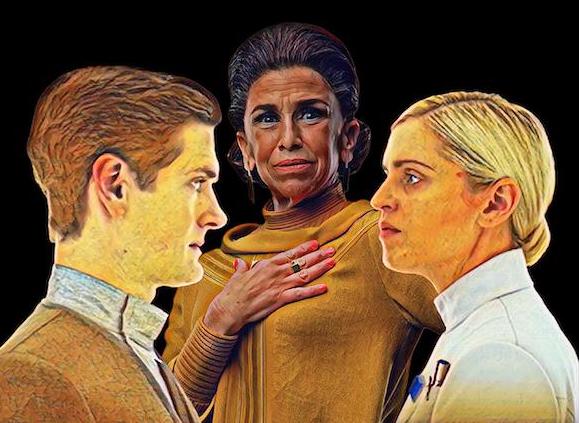
This relationship carries clear traces of emotional transference: Syril projects onto her the desire for recognition and submission that he never had with Eedy. His insistence on seeking her out, his almost religious devotion—all echo the story of the family’s motto: “If I do enough, she’ll see me.” But Dedra is not affectionate. She responds to the logic of the Empire: utility and efficiency.
And therein lies the tragedy: Syril loves like someone who has never been loved properly — and therefore loves wrongly.
From mother to lover: repression, desire, and ruin
The fixation on Dedra is a displacement of the unresolved Oedipal dynamic. Instead of freeing himself from the maternal figure, Syril finds a new woman with the same structural traits of power, coldness, and control. Dedra becomes a symbolic substitute for Eedy: a woman who despises him, but whom he wants to please; who rejects him, but whom he pursues; who dominates, and whom he idolizes.
The attempt to get closer to Dedra is, deep down, an effort to make sense of the trauma. But what arises between them is not love — it is complicity in control, domination, repression. It is a sick romance — and perfectly consistent with the authoritarian universe in which they live.

In the end, Syril doesn’t just want to serve the Empire. He wants the Empire to love him. And since neither the Empire nor Dedra can offer that, all that’s left is emotional ruin. A man who sought structure to find himself, and ends up torn apart by the very structures he idolized.
And so, when his journey comes to an end, we feel sorry for him. Syril’s tragedy is that he is never recognized, even when, on some level, he was right. This makes him one of the most tragic characters in Andor, because his villainy is not born of ambition or cruelty, but of neediness and the internalization of emotional abuse.
A sad little man—and a most dangerous one.
Descubra mais sobre
Assine para receber nossas notícias mais recentes por e-mail.
 miscelana.com
1 comentário Adicione o seu