
The Last of Us has been hailed as one of the most successful adaptations in recent television history and had an excellent debut in 2021. With Pedro Pascal in the role of Joel and Bella Ramsey as Ellie, the series sensitively balanced action, drama, and moments of humanity during the apocalypse.
Fans were anxious for the second season, but those who knew how faithfulness to the game meant that Pascal, the biggest name in the cast, would leave the series at the beginning of the second season were already wondering how it would emotionally anchor the narrative without him. Now that it has happened, The Last of Us faces an even greater challenge than the infected: surviving without its main pillar. Spoiler Alert: I don’t think it’s possible.

The revenge narrative: a well-worn path
The sequel to the game, the basis for the new season, is centered on a story of revenge — a classic theme in post-apocalyptic narratives. However, what could be a deep dive into the complexities of pain and loss runs the risk of becoming a tiresome repetition. Series like The Walking Dead have explored this territory for years, expanding their universe with discussions about social reconstruction, community ethics, and complex moral dilemmas. Even though this is the alternative for the series to differentiate itself from the games, The Last of Us tends to focus almost exclusively on Ellie’s thirst for revenge, and thus leaves aside the emotional plurality that gave breath to the first season. In three episodes, this has already become clear that this is the way forward.
There is no shortage of examples: The Walking Dead transformed Rick Grimes from a leader to a near-tyrant, exploring nuances of leadership in extreme times; spin-offs like World Beyond discussed the future of civilization. In comparison, the new phase of The Last of Us seems to be limited to the open wound of loss, with no room for rebirth.

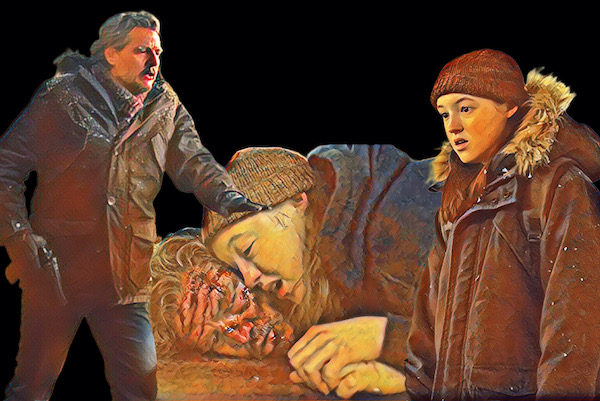
Furthermore, Joel’s death in The Last of Us is intended to have the same impact as Ned Stark’s death in Game of Thrones: a shock that redefines the course of the story. However, while Ned’s downfall opened the narrative to a complex battle for thrones, full of new protagonists and multiple lines of political tension, Joel’s death has the opposite effect: instead of expanding the universe, it narrows the story around Ellie’s personal pain and her desire for revenge. The saga ceases to be a broad reflection on human survival in a devastated world and becomes an intimate — and repetitive — portrait of loss and hatred, limiting the narrative possibilities that could keep the series vibrant for longer.
From humanity to hatred: a dangerous imbalance
The first season went beyond the main story by building small portraits of hope and humanity: the episode with Bill and Frank, the story of Ellie’s mother, and even moments of tenderness between Joel and Ellie left their mark on the audience. Without these narrative breaks, the series runs the risk of spiraling into violence without emotional counterpoint, making the chaos more empty and less impactful.

What set The Last of Us apart from other dystopias was precisely the space given to empathy. Without this, all that remains is brutality, and this alone will hardly sustain the audience’s interest for more seasons.
The soundtrack loses strength
Another element that contributed to the series’ initial success was the music. Unforgettable moments were set to carefully chosen tracks, such as the cover of Take On Me or when Just Like Heaven illuminated Ellie’s romantic night before she was infected.

In the new season, the initial soundtrack already demonstrates less emotional impact, with less striking choices and the absence of themes that immediately evoke the connection between the audience and the characters.
This loss, although subtle, weakens the experience and reduces the narrative’s emotional fixation power.
Without Pedro Pascal, who holds the series together?
Pedro Pascal wasn’t just the protagonist: he was the charismatic face that took the series beyond the game’s fans. With his definitive departure, the remaining cast doesn’t seem to have the same media clout.
Other well-known names, such as Jeffrey Wright, are expected to make appearances, but they aren’t present enough to carry the responsibility that now falls entirely on Bella Ramsey.
Bella Ramsey: the weight of carrying the series — and the growing criticism
Although praised in Game of Thrones as the fearless Lyanna Mormont, Bella Ramsey faces resistance in the role of Ellie. Her performance has been criticized for lacking emotional range and expressiveness — something that, added to the character’s constant aggressiveness, creates a protagonist that is difficult to connect with. Without Pedro Pascal‘s emotional counterpart to balance her performance, Ramsey needs to win over the audience practically on her own — a difficult task in an already less generous scenario.
Survival is for the few
In the post-apocalyptic universe of The Last of Us, survival has never been guaranteed. Now, outside of fiction, the series faces its own battle and risks losing what made it transcend the simple adaptation of a game: the human heart behind the apocalypse.
When the series premiered in 2021, the world was still experiencing the profound effects of the COVID-19 pandemic. Isolation, fear of contamination, and the feeling of collective vulnerability made the dystopian universe of The Last of Us frighteningly close to our reality. However, in 2025, this context has already changed. The threat of cordyceps — so symbolic at that time — now seems distant, almost abstract. The series needs to deal not only with internal challenges, but also with an audience that no longer identifies itself so intensely with that fear.

The failure, in this sense, is not exclusively the series’, but the original material itself. Since the TV adaptation has been extremely faithful to the second game, there is little hope that the narrative structure will change significantly enough to rekindle interest. Without Pedro Pascal, without a broader narrative, and without the same emotional impact that once came from both the global context and the characters, The Last of Us risks becoming just another story of violence in a world saturated with dystopias.
If The Last of Us wants to remain relevant, it will have to find new paths — because survival, after all, was never just about brute force.
Descubra mais sobre
Assine para receber nossas notícias mais recentes por e-mail.
 miscelana.com