
Released by Hulu and available in Brazil on Disney+, Good American Family is a dramatization inspired by one of the most bizarre and controversial cases of the last decade: the story of Natalia Grace, a Ukrainian girl with dwarfism adopted by an American family who, a few years later, would accuse her of being an adult woman disguised as a child. The plot, which had already been explored in documentary format in the series The Curious Case of Natalia Grace, was given a dramatized treatment with Ellen Pompeo and Mark Duplass as the girl’s parents.
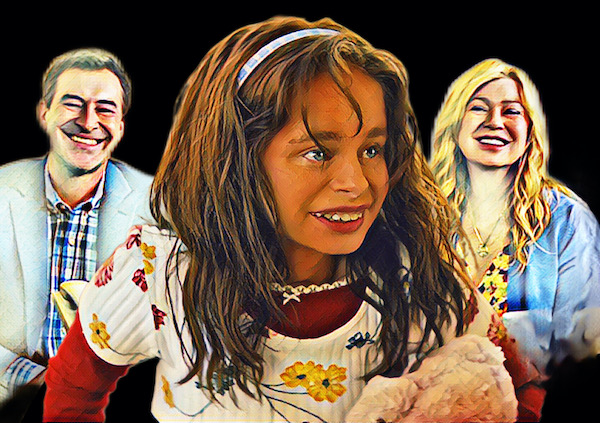
Divided into eight dense and well-scripted episodes, the series abandons the sensationalist tone of the original documentary and delves into the psychological nuances of the case, focusing on the degradation of the relationship between the adoptive parents and Natalia, and the tragic consequences of a collective paranoia fueled by prejudice and misinformation. The narrative structure alternates points of view, especially between Kristine, the adoptive mother, and Natalia, allowing the audience to navigate through multiple versions of the truth without offering a simple or definitive answer.
Ellen Pompeo takes on the role of Kristine Barnett with an intensity that surprises even the most loyal fans of Grey’s Anatomy. Far from the serenity of Meredith Grey, here she plays a woman who initially seems well-intentioned, but who gradually becomes increasingly paranoid, obsessed, and unbalanced. Pompeo’s performance is magnetic: she conveys the mental fragility and moral rigidity of a mother who believes she is protecting her family, at the cost of destroying the daughter she adopted. Mark Duplass, as Michael Barnett, delivers a more restrained performance, creating an ambiguous and weak character who hesitates between supporting his wife and seeing the absurdity of the situation. Christina Hendricks, as Cynthia Mans — the woman who later takes Natalia in — lends warmth and empathy to the plot, providing a human and sensitive counterpoint to the Barnetts’ toxicity.
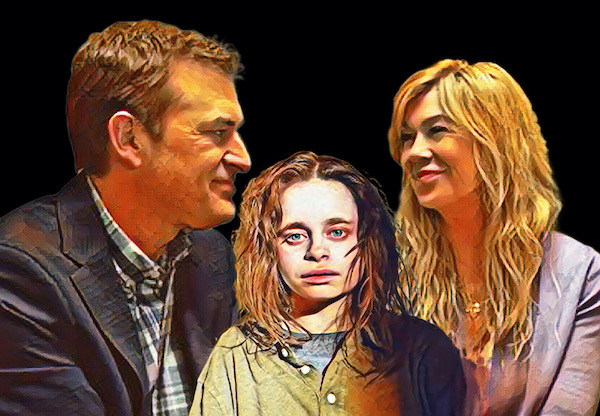
The highlight, however, is Imogen Faith Reid as Natalia Grace. The young actress delivers a moving performance, without falling into easy sentimentality. She conveys the confusion, loneliness, and trauma of a girl who is constantly doubted, rejected, and blamed, even when she is simply trying to be accepted as a daughter. The series succeeds in giving space to her subjectivity, even amidst the collective delirium that surrounds her. Dulé Hill, as the detective in charge of the investigation, represents the rational dimension of the story, investigating the absurd with eyes of skepticism and empathy. Sarayu Blue rounds out the cast as Valika, a woman from Kristine’s community, and provides small but significant moments of tension and moral conflict.
The production is careful to reconstruct the environment that allowed the tragedy to take shape. In the United States, Natalia Grace was adopted in 2010 by the Barnetts, who initially believed she was 6 years old. Shortly thereafter, Kristine began accusing her of adult and disturbing behavior — a narrative that echoed the plot of the film Orphan, in which an adult woman pretends to be a child to manipulate a family. In 2012, a judge granted the Barnetts’ request to legally change Natalia’s age from 8 to 22, based on questionable and inconsistent tests. Soon after, the couple moved to Canada with their biological children, leaving Natalia alone in an apartment in Lafayette, Indiana. She was later taken in by other families, including the Mans and the DePauls.

Subsequent medical examinations and testimony indicated that Natalia was, in fact, a child at the time of her adoption. The case led to charges of child neglect against the Barnetts. Michael was taken to trial and, in 2022, was acquitted due to a lack of conclusive evidence. Kristine Barnett, on the other hand, never stood trial: the case against her was dropped, amid protests from children’s rights groups and people with disabilities. Authorities said they did not have enough evidence to prove “criminal intent,” even though they acknowledged extreme neglect.
Today, Natalia lives with the DePaul family in Indiana. The family publicly defends her, and Natalia has given interviews in which she says she wants to lead a normal life, get an education, and be independent. Currently in her early 20s (although legal records still state she is older), she clearly expresses the profound psychological impact of years of being accused, abandoned, and labeled. In 2023, she participated in the documentary Natalia Speaks, in which she attempts to tell her own side of the story for the first time.
Kristine Barnett, on the other hand, has remained out of the spotlight, avoiding interviews. She lives anonymously with relatives, and there are unconfirmed reports that she is writing a book. Michael Barnett also disappeared. I left public life and would be living with the support of family members in another state, far from Indiana. Neither of them has resumed contact with Natalia.

The case, contrary to what many expected, did not end with a clear resolution or a sense of justice. Natalia’s legal age change was never officially reversed. Even today, she lives in legal and identity limbo, with documents that do not match her physical and psychological reality.
Good American Family stands out precisely for avoiding Manichaeism and caricature, even with some stumbles in more melodramatic moments. The series is openly in favor of Natalia and reflects the absurdity of a society that did not know how — or did not want to — protect a different child. It presents the viewer with moral, legal, and emotional questions that still resonate: how can justice be so deeply wrong? How is prejudice against people with disabilities still legitimized by institutions? And what does it mean, after all, to be “a good family”?
Even slipping into the final message of guilt – which is far from what happened – the series proposes a reflection: Natalia was not only a victim of a dysfunctional family, but of a culture that prefers to transform real pain into a spectacle. And at this point, fiction does more justice than reality.
Descubra mais sobre
Assine para receber nossas notícias mais recentes por e-mail.
 miscelana.com