
In the year of the 420th anniversary of Cervantes’ original work, it is worth remembering the most popular adaptation of the classic, which will be 60 years old in 2025. The musical Man of La Mancha.
Written by Dale Wasserman, with music by Mitch Leigh and lyrics by Joe Darion, the production premiered in 1965 at the Goodspeed Opera House in Connecticut, with Richard Kiley in the role of Don Quixote. The production was an immediate success, leading to its Broadway debut in 1968, where it ran for 2,328 performances, becoming one of the longest-running musicals in Broadway history.
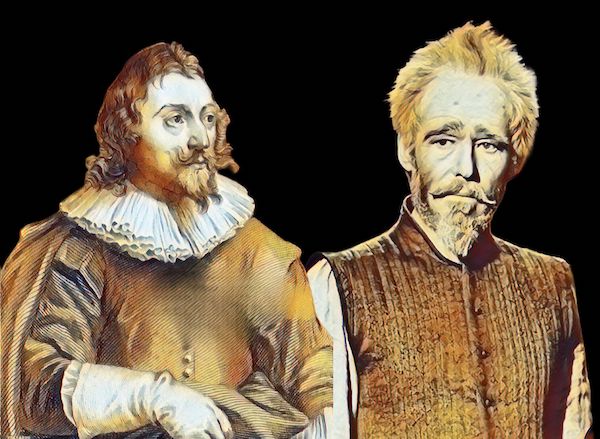
When it first appeared in the 1960s as a theatrical reinvention of the classic, the musical was born from a bold idea to transform not only the novel but also the figure of Cervantes himself into a dramatic character. The author Dale Wasserman initially wrote a television play, entitled I, Don Quixote, shown in 1959, which mixed the biography of the writer with excerpts from the book. The success of the production led Wasserman to adapt it for the stage as a musical, with music composed by Mitch Leigh and lyrics by Joe Darion. Thanks to the power of the song The Impossible Dream, which took on a life of its own offstage and became a hymn to perseverance and idealism, Man of La Mancha became a huge success.
The musical has a metatheatrical structure: Cervantes is imprisoned during the Inquisition and, to defend himself to the other prisoners, he acts out the story of Don Quixote using the objects and characters around him. The play, therefore, takes place both in the real world and in the imagination of Cervantes, who takes on the role of the knight errant in search of justice and beauty in a cruel world. This double layer of reality and fiction gave the musical an emotional depth that won over audiences and earned it several awards.
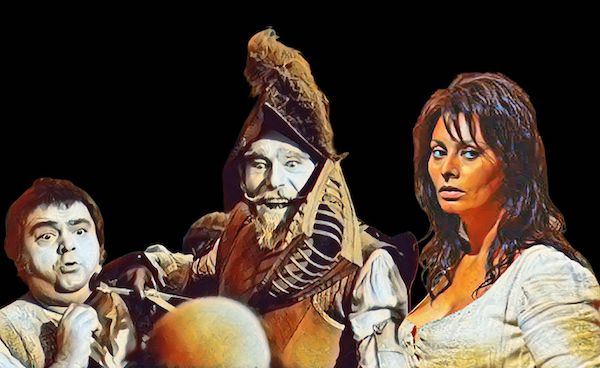
In 1972, The Man of La Mancha hit theaters, in a production directed by Arthur Hiller and starring Peter O’Toole as Cervantes/Quixote, Sophia Loren as Aldonza/Dulcinea, and James Coco as Sancho Panza. The production, however, faced several challenges and failed to replicate the success of the play. From the beginning, the choice of the cast generated controversy. Peter O’Toole was recognized as a prestigious actor, but he did not have a singing voice and had his songs dubbed by Simon Gilbert, which compromised the authenticity of his performance. On the other hand, Sophia Loren, who insisted on singing her own songs, was criticized for not having enough vocal range for the role, even though her presence on stage was intense.
Arthur Hiller‘s direction attempted to give the film a realistic atmosphere, filming on location in Spain and Italy. However, this choice ended up taking away the dreamlike theatricality that was so essential on stage. Many critics pointed out that, by moving away from the theatrical aesthetic, the film lost some of its charm, becoming dark and heavy. In addition, the script was mutilated in several parts: some scenes and songs were cut in the final edit, which made the narrative less fluid and hindered the development of the characters.
The film’s reception was lukewarm. Although it received a Golden Globe nomination for Best Motion Picture (Comedy or Musical), and Sophia Loren was nominated for Best Actress, the adaptation was considered a failed attempt to bring the magic that happened on stage to the big screen. Even so, the work maintained its symbolic value, especially because of Don Quixote‘s central message — that of fighting for an impossible dream even in the face of ridicule, failure, and rejection. This idea resonated strongly off-screen, and “The Impossible Dream” continued to be reinterpreted in diverse political and social contexts, being sung by figures such as Martin Luther King Jr. and used in presidential campaigns.

Although it was not a critical or box office success, the film remains an interesting document of a time when Hollywood tried to adapt great Broadway musicals to the big screen, not always with the same results. Between mistakes and successes, the 1972 production remains as a portrait of the difficulty of transforming theater into cinema without losing the soul of the original work — and as a lasting reminder that, sometimes, the value lies less in the result and more in the persistence of dreaming.
The musical premiered in Brazil on August 15, 1972, at the Teatro Municipal de Santo André. It was translated by Paulo Pontes and Flávio Rangel and directed by Flávio Rangel. The Brazilian version featured Paulo Autran as Don Quixote, Bibi Ferreira as Dulcinea, and Dante Rui as Sancho Pança. In 1973, the show was staged in Rio de Janeiro, with Grande Otelo replacing Dante Rui as Sancho Pança.
In the musical, one of the most emblematic moments is the monologue known as “Life as It Is”. In this speech, So, the character Don Quixote, or rather, Miguel de Cervantes, embodying his idealistic knight, expresses a blunt rejection of reality as it presents itself: cruel, absurd, and meaningless. Instead, he chooses to live according to an ideal, even if it seems insane to the eyes of the world. From the perspective of psychoanalysis, this theatrical moment is not only a manifestation of madness but also a dive into the deep mechanisms of the human psyche: the denial of reality, the construction of an ideal of the self, and the sublimation of suffering in the name of a higher purpose. In this analysis, we will see how the monologue represents not only a delirium but a psychic strategy for survival in the face of the absurdity of existence.

The rejection of reality: madness or lucidity?
Right at the beginning of the monologue, Don Quixote declares: “I have lived almost fifty years and I have seen life as it is. Pain, misery, hunger… unbelievable cruelty”, a raw observation of reality that serves as a starting point for a radical denial. Psychoanalysis, especially Freud, points out that denial is a defense mechanism that allows the subject to remove painful or unacceptable content from the field of consciousness. Don Quixote recognizes the brutality of the world, but decides not to accept it as the only possible horizon. He sees that reality is often insane, and so he proposes another form of madness — the madness that chooses to dream.
As he says: “Too much sanity can be madness — and the craziest of all: seeing life as it is, and not as it should be!” This inversion calls into question what we consider “lucid”. For Lacanian psychoanalysis, this is close to foreclosure: the rejection of fundamental elements of the symbolic (the structure of social reality), which gives way to the creation of one’s own universe. For Quixote, it is not he who is delirious, but rather the world that has lost its mind by accepting pain and cruelty as natural.
The Ego Ideal: the search for the unattainable star
What guides Don Quixote, more than any practical logic, is an ideal of nobility, justice, and purity. In the words: “Abandoning dreams — that may be madness,” there is an acknowledgement that giving up on dreams is a form of inner death. According to Freud, the Ego Ideal is the instance that is formed from the demands of the superego, representing what the subject would like to be. Quixote builds his identity around this lofty ideal, even if it distances him from objective reality.
In Lacanian language, we could say that he is captured by the desire of the Other, that is, by a desire that is never completely fulfilled, but that moves the subject towards the impossible. The “impossible dream,” therefore, becomes the structuring axis of his existence.

Sublimation: transforming pain into meaning
Quixote’s anguish in the face of human pain also reveals a desire to transform suffering into something meaningful. He says, “I held them in my arms at the final moment… only their eyes filled with confusion, whimpering the question: ‘Why?’”
This image directly refers to the experience of existential emptiness, of what Lacan would call “the real”—that which cannot be symbolized. Instead of being consumed by this abyss, Quixote resignifies it through action: fighting, loving, protecting, and dreaming.
This is where the Freudian concept of sublimation comes in—the redirection of impulses (such as aggression or sexual desire) toward higher ends, such as art, ethics, or heroism. By fighting for Dulcinea, by facing “giants,” by maintaining his honor, Quixote transforms the inner and outer chaos into an epic narrative.
At the end of the monologue, when Quixote states that “seeing life as it is, and not as it should be” is the greatest folly, he is not just declaring his worldview—he is holding up a mirror to the viewer. Through the lens of psychoanalysis, we see that his denial of reality is more than delirium: it is a gesture of symbolic survival. Don Quixote is not just a madman; he is the symbol of a deeply human desire — to give meaning to existence, even if that meaning only exists in fantasy. And perhaps, as he suggests, it is this “necessary madness” that keeps us truly alive.
In light of important dates – and the times we live in – it becomes irresistible to want to watch the film again, don’t you think?
Descubra mais sobre
Assine para receber nossas notícias mais recentes por e-mail.
 miscelana.com