
We’re one week away from saying goodbye forever to Andor, and the final three episodes promise surprises and twists — stay tuned. Nothing, however, will top the brilliance of episodes 8 and 9, as spectacular as they were iconic. Just as I shared an early analysis of Syril Karn (Kyle Soller) before he died in episode 8, shall we now talk about Dedra Meero? One spoiler: it will be delicious to watch her pay for her wrongdoings — but I won’t reveal how.
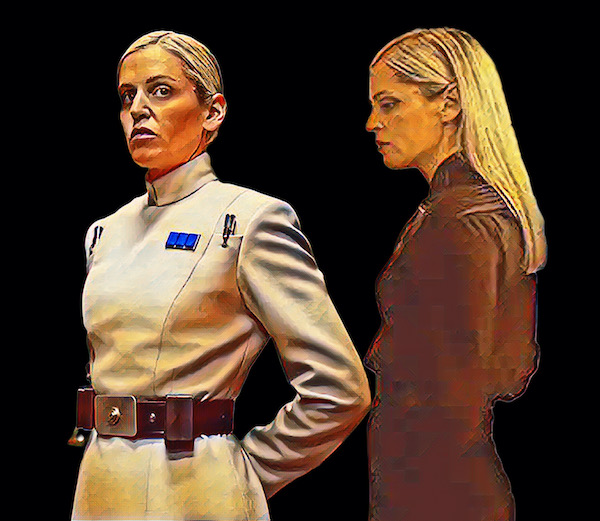
Dedra Meero is not just an employee of the Galactic Empire. She is its modern embodiment — the rational face of oppression, with her organized intelligence weaponized in service of control. Introduced as a marginal officer within the ISB (Imperial Security Bureau), Dedra quickly asserts herself as a silent, determined force, driven not by vanity but by conviction. Her arc in Andor follows her rise within the Imperial repressive apparatus and exposes the inner workings of a regime built on technical competence, surveillance, and legalized brutality.
Ambition as Method
Unlike many Imperial characters in Star Wars, Dedra is neither cartoonish nor megalomaniacal. Her ambition is methodical. From her first scene, we see she’s out of place — a woman in a male environment, young among veterans, a strategic and ethical minority. But she’s not just climbing the hierarchy: she wants to impose order. Dedra doesn’t view the Empire as a machine of domination, but as a necessary system to prevent chaos. Her perfectionism is fueled by a moral worldview in which disobedience is a threat and discipline a virtue.
Fascination with Control
What makes Dedra so disturbing is her absolute conviction. She doesn’t just want to capture rebels — she wants to understand them, anticipate them, dismantle them. When she identifies the first signs of a coordinated resistance network (which Cassian Andor (Diego Luna) unknowingly helps fuel), Dedra goes beyond protocols: she connects loose ends, crosses jurisdictions, and defies her colleagues. Her reasoning is sharp, her behavior obsessive. And the most unsettling part? She’s almost always right. The Empire rewards results, and Dedra delivers.
Institutionalized Violence
In the second half of season one, Dedra shifts from cold analyst to sanctioned torturer. During the interrogation of Bix Caleen (Adria Arjona), we see her move from logic to brutality: she doesn’t just allow torture — she rationalizes it. Yet Dedra doesn’t see herself as a villain. She believes she’s saving the galactic order. Her coldness is the armor of a totalitarian ideology sustained by bureaucracy and dehumanization. In her eyes, there’s always calculation — never pleasure — and that makes her even more dangerous.

Distorted Human Relationships
Her connection with Syril Karn, another character obsessed with order, reveals Dedra’s emotional limitations. She rejects his admiration not out of disdain, but discomfort. Dedra doesn’t know how to handle affection, vulnerability, or emotional chaos. To her, bonds must be functional. This inability to form human connections suggests her devotion to the Empire is also a form of escape — a way to avoid the emotional instability she cannot name.
Authoritarianism as Choice and Mirror
Dedra Meero is the modern face of functional fascism: disciplined, intelligent, efficient, and devoid of empathy. She hasn’t been corrupted by power — she was shaped by it. Andor constructs her as a warning: totalitarianism doesn’t spread only by force, but also by bureaucracy, logic, and competence. Dedra believes in the Imperial machine because she is a perfectly tuned cog in it. And as we watch her succeed — often deservedly — we feel the heavy weight of the series’ question: what if the villains are the brightest?

Dedra Meero, played by Denise Gough, lives one of the darkest and most complex Imperial journeys in Andor. In season two, she becomes entangled in a manipulation and massacre plot in Ghorman — the same planet mentioned in Rogue One as the spark of rebellion. Initially, Dedra warns Orson Krennic (Ben Mendelsohn) about the risks of his propaganda strategy to control the local population and proposes an even more cynical plan: to incite an uprising that would justify a crackdown and allow the Empire to exploit kalkite, a key mineral for the construction of the Death Star. From there, the plan unfolds into a deadly trap, and Dedra’s personal involvement — especially using Syril Karn as bait — turns the campaign into a personal and emotional disaster.
In an interview with The Hollywood Reporter, Denise Gough revealed that Dedra did not foresee the catastrophic outcome of episode eight, despite being praised for her ability to anticipate movements. According to the actress, the character believed she could control the situation, including manipulating Syril without consequences. Dedra knew he was the ideal pawn to stir up the Ghorman Front without realizing he was aiding genocide, but she underestimated the emotional impact of that discovery — and especially her connection to him. Dedra’s greatest fear, says Gough, isn’t the massacre itself, but the loss of control — and that becomes clear when Syril discovers the truth, and she, in desperation, tries to take him back to Coruscant to restore a shattered routine.
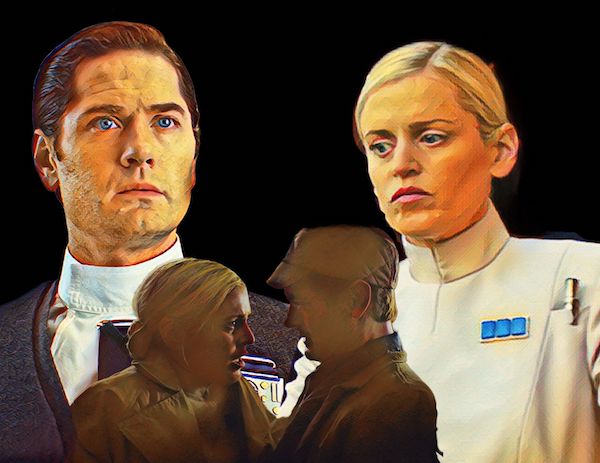
Dedra grew up in an Imperial indoctrination block, without affection, limits, or emotional support, which prevents her from understanding feelings like love or compassion. Her relationship with Syril, who has lived with her since before season two, represents an attempt to keep close the only person who has seen her vulnerable. Gough compares this dynamic to what happens between Cassian and Maarva in season one, when Maarva teaches him that worry is a form of love — something Dedra never learned. That’s why, when she tells Syril it’s nice to see him happy, she says it coldly, automatically, without understanding the weight of those words. Were it not for that unresolved emotional bond, Dedra would have used another agent for the Ghorman mission mechanically. The problem, according to Gough, is that she’s emotionally compromised — even if she doesn’t know what she’s feeling.
Beyond the emotional collapse and operational failure, Dedra experiences one of the season’s standout scenes when she confronts Eedy Karn, Syril’s mother. The scene, initially written as direct intimidation, turns into a kind of “negotiation” when Eedy, rather than retreating, shows respect and fascination for Dedra’s coldness. Gough celebrates the chance to perform with Kathryn Hunter, a veteran of British theatre, and points to this scene as a highlight of her career. The power play between these two women redefines the emotional hierarchies around Syril, who lies in the background like a “broken bird,” helplessly witnessing the duel.
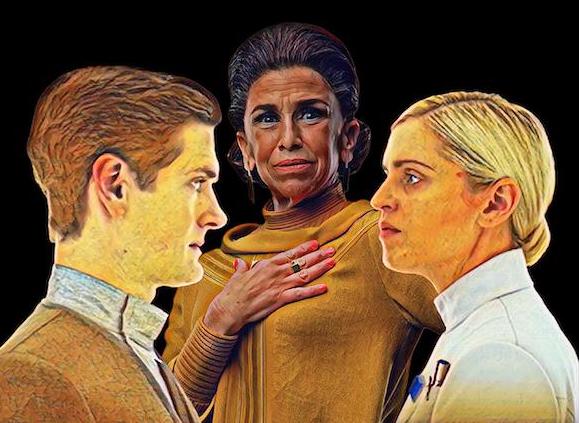
In her obsessive pursuit of control and her mission to capture Axis (Luthen Rael (Stellan Skarsgård)), Dedra not only loses control of the Ghorman operation — she loses the only connection that could have humanized her. And, as Denise Gough suggests, that is what truly destroys her.
In practice, Dedra used Syril as an instrument — even as a scapegoat in Ghorman — but she doesn’t suffer because he died or because thousands of innocents were massacred. She suffers because she lost control over the one person who made her feel close to any kind of human bond. She wanted to keep Syril nearby, not to love him freely, but to ensure he wouldn’t hurt her or escape her sphere of influence.
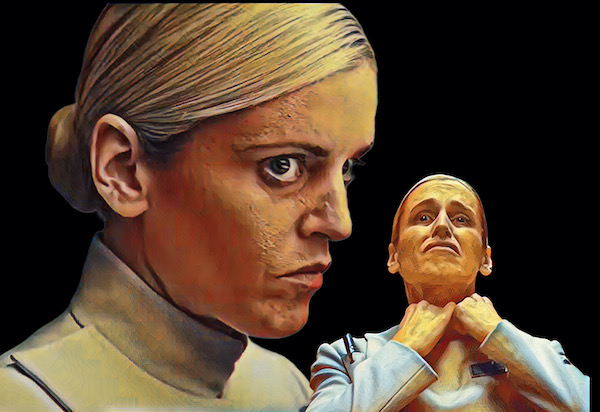
In short, Dedra didn’t love Syril the way we understand love. She was emotionally involved, yes — but trapped in a logic of manipulation, fear of loss, and psychological self-protection. The most tragic part? Not even she knew exactly what she was feeling.
In a tragic parallel within the series, just as Cassian was a mirror for Syril, Dedra’s obsession with “Axis” (Luthen Rael) mirrors Syril’s need to find and arrest Cassian Andor. More than a strategic target, Axis symbolizes for her the last puzzle piece that failed on Ferrix and stained her record. Capturing him is as much a professional mission as a personal one. She even asks, unsuccessfully, to be removed from the Ghorman mission because she senses she will lose control if taken off the Axis case. But she’s ignored — and that leads to her downfall.

Part of what united Syril and Dedra was exactly this shared pursuit of their adversaries — a mutual, dysfunctional, tense, and deeply unsettling reason to live. I’ll give this SPOILER: we will see a confrontation between her and Luthen — but not the way you might expect. It will be a turning point that delivers a devastating twist — so stay tuned — and one that will alter the fate of many.
Among the villains of the Star Wars universe, Dedra Meero’s story echoes other tragic figures like Anakin Skywalker — but with an even more bitter flavor, because Dedra truly believes she’s on the right side. Her tragedy is not just the loss of power or love — it’s the emptiness of never having known another way of life. She wasn’t corrupted — she was molded this way. And her devotion will be repaid in the only way the Empire knows. And she deserves what’s coming.
Descubra mais sobre
Assine para receber nossas notícias mais recentes por e-mail.
 miscelana.com