
Today, I pay tribute to the birthday honoree, one of the few names in the history of entertainment that shines with the same brilliance through time: Fred Astaire. Considered by many the greatest dancer of the golden age of American cinema, Astaire reinvented dance on screen with lightness, elegance, and an almost obsessive perfectionism that masked the technical complexity of each step. His career, which spanned theater, film, television, and music, is a testament to talent, discipline, and constant reinvention.
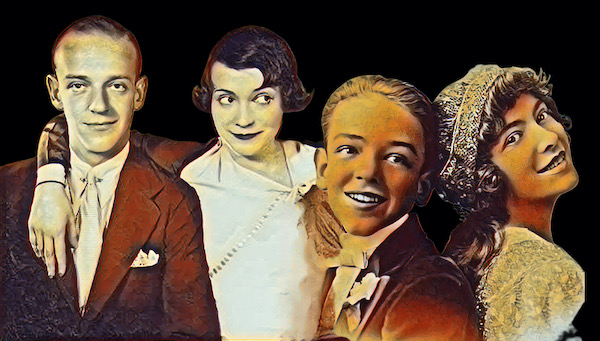
Born Frederick Austerlitz on May 10, 1899, in Omaha, Nebraska, Astaire began dancing as a child alongside his sister Adele. The duo quickly stood out on the vaudeville circuit and later on Broadway and the London West End. Adele was initially considered the star of the pair, but after her marriage and early retirement from the stage, Fred had to prove his worth as an artist on his own. The transition was not simple: when testing for the movies, an evaluator infamously noted that he “couldn’t act, couldn’t sing, and could only dance a little.” Ironically, he would become the gold standard of excellence precisely because of his ability to merge dance, music, and acting harmoniously and fluidly.
Sound helped Fred. His first sound film came in 1933, and by 1968, he had starred in over 30 musicals — eleven of them alongside Ginger Rogers, his most enduring partner. The songs they danced to were composed by the elite of the popular music world, including Cole Porter, Irving Berlin, Jerome Kern, and George and Ira Gershwin. It was one of the most iconic partnerships in film history, with classics like Top Hat (1935), Swing Time (1936), and Shall We Dance (1937), among others. Rogers brought charm, strength, and naturalness to the screen, matching Astaire’s technical virtuosity with grace and charisma. As the now-famous phrase goes: “Ginger Rogers did everything Fred did — only backwards and in high heels.”
Astaire’s style was marked by a unique combination of lightness and precision. He made it look easy, what was meticulously rehearsed. He preferred long takes and few cuts during dance numbers, insisting that the audience should see the dancers from head to toe, with no interruptions that could mask mistakes or use editing tricks. His work was choreography for the camera as well, shaping the way dance would be filmed from then on. Influenced by tap, classical ballet, and ballroom dancing, he was also an innovator: experimenting with objects, sets, and sounds (such as the scene with clogs in Royal Wedding or the hat rack choreography in Funny Face).
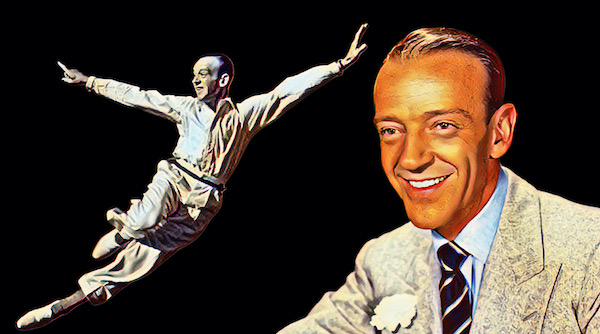
Fred also had a deep relationship with music. A singer with a soft, rhythmic voice, he introduced many songs into the American popular repertoire. Songs like Cheek to Cheek, The Way You Look Tonight, and They Can’t Take That Away from Me. When he moved to MGM, he shone in more lavish productions like Easter Parade (1948), alongside Judy Garland, and The Band Wagon (1953), with Cyd Charisse — another of his great partners, with whom he performed perhaps the most sophisticated choreographies of his career. In Royal Wedding (1951), he performed one of the most iconic scenes in film history: he literally danced on the walls and ceiling, thanks to an elaborate camera trick.
Even after temporarily retiring from dance in the 1950s, Astaire remained active as an actor and presenter. Toward the end of his life, he explored dramatic roles, such as in The Towering Inferno (1974), which earned him an Oscar nomination. He was also one of the first film stars to excel on television, with specials choreographed by him and awarded multiple Emmys.

Discreet in his personal life, Fred Astaire was married twice and had two children. He avoided scandals, was known for his professional ethics, and maintained a close-knit circle of friends. He always resisted being turned into a myth during his lifetime — perhaps because he knew how hard he worked to appear light, when everything in his career was built on precision, self-demand, and resistance to empty stardom.
Fred Astaire died on June 22, 1987, at 88, leaving behind an unmatched legacy. His influence spans generations and styles: Gene Kelly revered him, Michael Jackson studied him, and even contemporary dancers still cite his inventiveness. He transformed the movie musical into choreographic art, turning gesture into a natural extension of emotion. A biopic project has been announced, but it has yet to materialize. As critic John Mueller said, “Astaire didn’t just elevate dance in film — he created it.”
Descubra mais sobre
Assine para receber nossas notícias mais recentes por e-mail.
 miscelana.com