
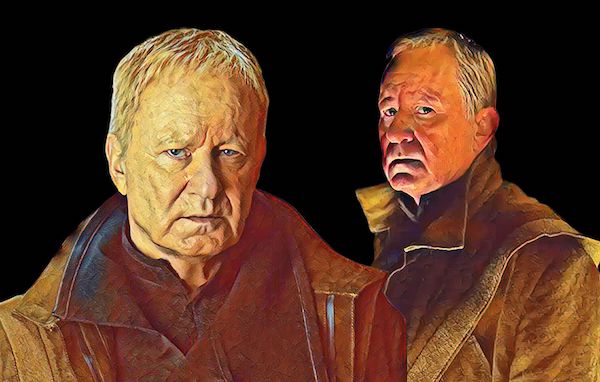
In a galaxy where heroes are often reluctant, martyred, or idealistic, Luthen Rael emerges as a brutal exception: a man who consciously chose to sacrifice everything—including his soul—to build something greater than himself.
Masterfully portrayed by Stellan Skarsgård, Luthen is the invisible engine behind the birth of the Rebel Alliance, an elegant, cold, meticulous, and ruthless schemer. Unlike figures like Cassian Andor, Leia Organa, or even Mon Mothma, who deal with moral dilemmas and emotional connections, Luthen operates in the underground of the revolution. He is a detestable—and detested—hero. But the rebellion owes everything to him.
A new archetype in an old galaxy
Since its earliest films, Star Wars has been built on universal archetypes: the chosen young man, the wise mentor, the noble knight, and the larger-than-life villains. But in Andor, a figure emerges who defies all these categories, perhaps the most ethically complex character ever introduced in the franchise: Luthen Rael.
Luthen is not just a mastermind or a conspirator. He is an architect of rebellion who sacrifices his own soul to ensure that others may one day walk free under the sun. And he does so in silence, despised, isolated, like a cynical martyr who believes not in personal salvation, but only in results.
The Man Behind the Disguise
Luthen Rael lives between two worlds: he is the elegant antiques dealer of Coruscant, wearing wigs, jewels, and wry smiles for the Imperial elite—and, at the same time, the hidden maestro of a network of saboteurs, spies, and martyrs. He orchestrates deaths, manipulates allies, ignites revolts—and never hesitates. This duplicity is made all the more palpable by Skarsgård’s performance, who literally dresses two characters in one: the sophisticated artifact dealer and the hardened revolutionary.
We will see Luthen, who assumed his new identity after having been a sergeant in the Empire, and was revolted by what he saw and had to do. Cold, calculating, paranoid, he uses and discards people, and all this for one reason: he knows what is at stake. He knows that a rebellion made of good intentions is doomed to failure. He is the one who anticipates what others will only understand too late. He is the one who sees the Empire from the inside and realizes that only dirt can defeat dirt.
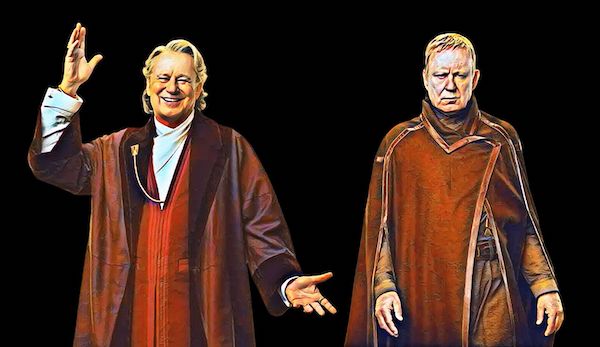
In his performance, Skarsgård does not play a villain, but a man who has abandoned any desire to be loved. His face does not seek compassion. His voice does not plead for understanding. He does not want to be saved. And what makes him devastating is that he is right.
The actor revealed that he accepted the role because he trusted creator Tony Gilroy. The Swedish actor was fascinated by the fact that Luthen is a character with a “conflict between doing the right thing and being willing to kill for it.” For him, Luthen is reminiscent of ambiguous figures such as Che Guevara, members of the RAF (Rote Armee Fraktion), and even George Washington. The greatness of the character lies precisely in this moral tension.
A revolutionary without a face or forgiveness
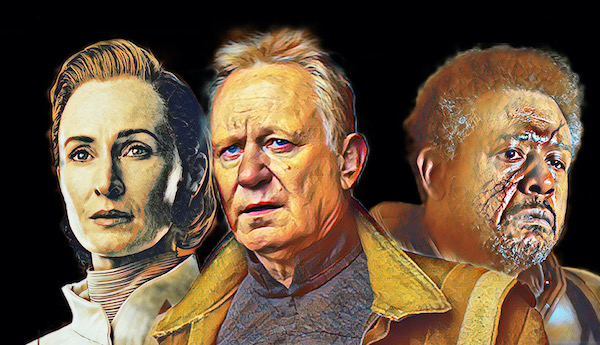
Unlike Cassian Andor, who is still following his path of conscience, Luthen has already crossed all limits. There is no purity in his cause, nor is there any consolation. He is willing to do anything — including sacrificing hundreds of allies to preserve an undercover spy. He manipulates Saw Gerrera, uses Mon Mothma, recruits Cassian under threat of death, and sends young idealists like Karis Nemik to their deaths with calculated coldness.
Luthen does not seek glory. He does not see himself as a hero, and everything that grows from the seed he planted and watered with blood has brought freedom to people.
“I burned my life for a sunrise I’ll never see.”
The most iconic moment of Andor’s first season — and one of the greatest moments in the entire Star Wars saga — is Luthen’s monologue in episode 10. When Luthen is confronted about what he sacrificed for the cause, he responds.
“I burned my life for a sunrise I know I’ll never see. I made my mind a lonely place of hate. I condemn my heart to cold. I share my dreams with ghosts.”
It’s Shakespeare inside Star Wars.
This speech isn’t just a confession — it’s an autopsy in real time. Luthen falls apart right there in front of us. He knows he’ll never be remembered, he’ll never be redeemed, and that the world he fights for has no room for someone like him. But he fights anyway.
Skarsgård said in an interview that he repeated this monologue ten times in a row until he reached the tension he was looking for. “Let’s do it again,” he would say to the director. He knew it was the most important moment of the entire season, and he delivered. The result is a scene that resonates like an anticipated epitaph — not only for Luthen, but for all those who die before victory.
Kleya: Accomplice, Heiress, or Jailer?
At Luthen’s side, almost always in the shadows, is Kleya Marki — his assistant at the antiques gallery and, as we gradually discover, his true ally and possible successor. Kleya is enigmatic, cold, and ruthless. But there is something intimate and intimate about the relationship between the two. She does not fear him, but she does not challenge him either. She seems to know him better than anyone else. This is because, as an orphan, she was found and saved by Luthen and later trained by him to achieve their common goal of destroying the Empire.
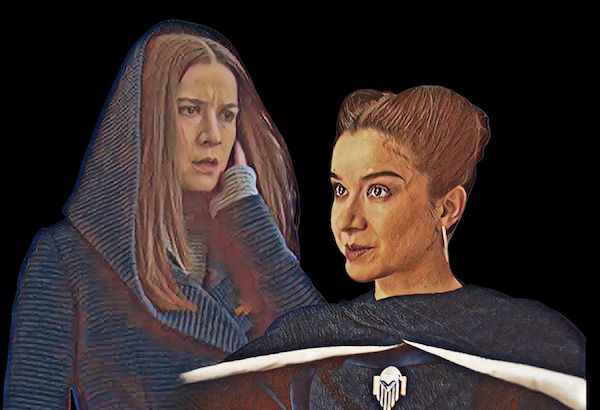
In revealing scenes from the final episodes of Andor, Kleya acts with more authority than one would expect from a subordinate. She handles logistics, executes plans, and even gives orders to Luthen. The series suggests that she may be both his protégé and his jailer—the only person who, deep down, knows how far he has lost and keeps him running like a machine. When Cassian enters Luthen’s orbit, it is Kleya who determines his next steps. They form an alliance that borders on mutual fanaticism.
A detestable hero, a necessary symbol
Luthen is the kind of character we would never see in the classic films of the franchise. In a universe where good and evil used to be clearly defined, he emerges as a stain, a necessary error. That is why Andor is so revolutionary: it places at the center of the plot not the knights or the chosen ones, but those who operate in the mud, those who build bridges that will never be crossed.
Luthen is hated. By the rebel elite, by allies who do not know him, by spies he manipulates like disposable parts. He is cold, calculating, paranoid. And all of this for one reason: he knows what is at stake. He knows that a rebellion built on good intentions is doomed to failure. He is the one who anticipates what others will only understand too late. He is the one who sees the Empire from within and realizes that only dirt can defeat dirt.

Skarsgård’s dark brilliance
Stellan Skarsgård, at 72, had already shone in big franchises like Thor and Dune, but it is in Andor that he delivers perhaps his densest performance. His Luthen doesn’t scream, doesn’t rage. He weighs it. His every word carries the weight of an impossible choice. Every gesture is restrained, wounded, precise.
The series built real sets, like the city of Ferrix, and even gave Skarsgård his own ship — “That was missing from my career,” he joked. But nothing shines more than his emotional delivery. He plays Luthen as a man who has already died, but keeps walking because no one else can do what he does.
Oblivion or redemption?
With the conclusion of Andor‘s second season, we see the great sacrifice of Luthen, the former Imperial sergeant who turned against Palpatine. Because he did the rebellion’s dirty work, there are no mentions or tributes to him. But perhaps this is the series’ greatest fidelity to the character himself: allowing him to disappear, as he wanted, without a trace, like a shadow in the basement of history.

If Rogue One is the chapter in which Cassian Andor becomes a hero, Andor is the story of how Luthen shaped that path. It is he who finds Cassian, who awakens his conscience, who challenges him to stop surviving and start fighting. The rebellion is not born of a collective ideal — it is born of the mind of a single man, who acts without hope, but with purpose.
The greatest irony of Luthen is that he may not be remembered. He is the ghost that the rebellion pretends did not exist — but without whom it would never have been born. His heroism is silent. Dirty. Necessary. And, above all, tragic.
He will not see the sunrise. But everyone else will only see it because he chose to burn.
Descubra mais sobre
Assine para receber nossas notícias mais recentes por e-mail.
 miscelana.com