
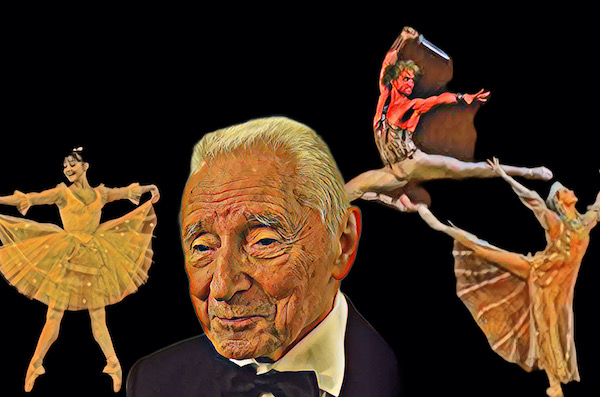
Yuri Grigorovich was one of the most influential choreographers in the history of Russian ballet, shaping the artistic identity of the Bolshoi Theatre for over three decades, especially during the Soviet company’s peak. His style is marked by a blend of epic monumentality, athletic physicality, and dramatic psychology.
Grigorovich redefined narrative ballet by prioritizing internal coherence in storytelling and giving male protagonists an active role, often portraying them as tragic heroes. Among his most emblematic works are Spartacus (1968), an ode to freedom set to music by Aram Khachaturian, centered on a revolutionary hero; Ivan the Terrible (1975), an intense and somber portrait of the Russian tsar with music by Prokofiev; his reinterpretation of Romeo and Juliet (1979), which emphasizes sociopolitical conflict and the fate of oppressed youth; the symbolic and introspective version of Swan Lake (1969); and The Stone Flower (1959). With these ballets, Grigorovich built a choreographic language that combines rigorous technique, theatrical expressiveness, and epic values, turning the Bolshoi into a synonym for grand ballet.
The Stone Flower
In Russia, even more than Spartacus, it is The Stone Flower that is considered Yuri Grigorovich’s masterpiece. He brought both ballets to Brazil when the Bolshoi visited the country for the first time in 1986.
Based on a Ural folk tale written by Pavel Bazhov, with music by Sergei Prokofiev in his last major ballet score, Grigorovich created his choreographic version in 1959. He shaped the male lead as a craftsman who seeks not only to carve precious stones but to achieve artistic perfection—even if that means breaking the boundaries of the earthly world. There are clear elements of Russian folk dances woven into classical technique, which explains the ballet’s lasting popularity in its homeland.
The ballet places Danila, the craftsman, before a choice: to surrender to the Mountain Queen and her promise of creative perfection, or to return to the real world, where love awaits him in the form of Katerina—his simple and faithful fiancée.
Here are three iconic moments from The Stone Flower: first, Danila’s solo danced by one of Soviet ballet’s most enigmatic stars, Yuri Soloviev, who was the epitome of the lyrical-heroic dancer—with impeccable aerial technique, almost supernatural landings, and a sensitivity that radiated from his eyes to the tips of his toes. His virtuosity was not merely physical—there was a silent melancholy in him, an inner delicacy that made him unmistakable. He died under suspicious circumstances at only 36, but that’s another story. Soloviev embodied Danila like no other, representing the soul of the Russian people and the pursuit of beauty and earthly love.
Although years later, the legendary Maya Plisetskaya would have a falling-out with Grigorovich, in 1959 she was one of the stars of The Stone Flower. In fact, she danced both female roles—the Mountain Queen and Katia—but she became especially known for originating the Queen’s role in productions by Mikhail Lavrovsky (1954) and Grigorovich (1959).
Below, under Grigorovich’s direction, Nina Semizorova, Nadezhda Gracheva, and Andrey Kondratov perform other scenes from the ballet.
Spartacus
Few ballets so thoroughly encapsulate the epic grandeur of the Soviet ballet school as Spartacus, composed by Aram Khachaturian and choreographed in its most celebrated version by Yuri Grigorovich for the Bolshoi in 1968. The story of the Thracian gladiator who leads a revolt against Rome takes on monumental dimensions onstage, with scenes charged with drama, duets full of lyrical beauty, and ensemble choreography that emphasizes weight, virility, and physical tension, subverting the ethereal lightness usually associated with classical ballet.
In the title role, Vladimir Vasiliev made history by redefining the ideal of the male dancer, combining athletic strength, musicality, and visceral expressiveness, earning the nickname “god of dance.” His video recordings, alongside Ekaterina Maximova and other Bolshoi stars, remain the definitive reference for later performers like Irek Mukhamedov (who danced the role in Brazil in 1986) and Carlos Acosta, each bringing new layers to this tragic figure of freedom and sacrifice. Below are some of the ballet’s most iconic moments across generations.
Ivan the Terrible
For me, Ivan the Terrible is Grigorovich’s masterpiece—and the Giselle of male dancers. Perhaps the darkest and most psychologically complex ballet Grigorovich ever created, Ivan the Terrible features a powerful score by Sergei Prokofiev, originally composed for Eisenstein’s film of the same name.
Premiered by the Bolshoi Ballet in 1975, the production dramatizes the rise and fall of Russia’s first tsar through choreography marked by tension, theatricality, and inner turmoil. More than portraying a historical monarch, Grigorovich composed a tragic portrait of power and paranoia, turning the protagonist into a figure torn between glory and guilt.
In the role of Ivan, Yuri Vladimirov was the first to embody this tormented presence, but it was Mikhail Lavrovsky who delivered one of the most iconic interpretations, alongside the delicate and intense Natalia Bessmertnova as Anastasia. The ballet became a showcase for Grigorovich’s choreographic style: masculine, symbolic, grandiose, and deeply ideological. To this day, later productions featuring artists like Denis Rodkin keep this work alive as one of the high points of Soviet ballet dramaturgy. Below is a selection of videos featuring different generations of dancers who have worn Ivan’s heavy crown.
And what can be said of the unforgettable solo Grigorovich created for Bessmertnova?
Romeo and Juliet
Yuri Grigorovich’s version of Romeo and Juliet for the Bolshoi Ballet is a powerful and stylized retelling of Shakespeare’s classic tragedy, set to Sergei Prokofiev’s unforgettable score.
Premiered in 1979, this production departs from more lyrical versions by emphasizing the political conflict between the Capulets and Montagues, creating a dark, almost ritualistic backdrop for the lovers’ drama. Grigorovich leaves his aesthetic signature throughout the choreography, with expansive movements, tense diagonals, and bodywork that privileges heroic expressiveness, especially in the male figures.
At the same time, he does not abandon the tragic lyricism of the female protagonist, offering Juliet a journey that moves from innocence to desperate courage. This production cemented the stardom of Bolshoi icons like Natalia Bessmertnova and Irek Mukhamedov, whose performances have become global benchmarks. Rather than simply illustrating Shakespeare’s text, this version draws from Prokofiev’s music a choreography of moral and emotional tensions, where each gesture seems to carry the weight of an inescapable fate. Below, videos with different casts showcase how this version remains central in the Bolshoi’s repertoire and continues to resonate symbolically.
Grigorovich also created a beautiful version of the ballet using Tchaikovsky’s music.
Swan Lake
Unlike traditional romantic versions, Grigorovich offers a more psychological and symbolic approach, centering the narrative on Prince Siegfried as a tragic protagonist. In his reading, the lake and the swans represent not only enchantment and impossible love but also the hero’s inner world—his desires, doubts, and illusions.
The character of Rothbart, the villain, is transformed into a demonic figure acting as a force of fate or repression, often dancing with unprecedented prominence. The duality between Odette and Odile is heightened with dramatic intensity, reinforced by grand scenography and the athletic, theatrical style typical of the Bolshoi.
Instead of a conciliatory or redemptive ending, Grigorovich delivers an ambiguous and somber conclusion, where sacrifice is inevitable and reality triumphs over dreams. Great stars such as Natalia Bessmertnova and Irek Mukhamedov marked an era in this production, which continues to be performed as a signature of the Soviet ballet style: grand, expressive, and deeply tragic.
Descubra mais sobre
Assine para receber nossas notícias mais recentes por e-mail.
 miscelana.com