
It only took Meghan Markle quoting “we were together and I forget the rest” by poet Walt Whitman for the best pretext to emerge to remember the 170 years of Leaves of Grass, the American poet’s collection of poems, re-edited throughout his life and a kind of continuously evolving work — a portrait of the author himself and his vision of America across the decades.
And that’s the point: some books change literature. Few, however, also change the way people perceive, express, and imagine themselves. Leaves of Grass is one of those. First published in 1855, in an edition of just 795 copies funded and typeset by Whitman himself, the book didn’t arrive as an imposing work but as a subterranean explosion — a radical poetic gesture that, defying Victorian conventions and European taste, founded a new voice: expansive, deeply American.
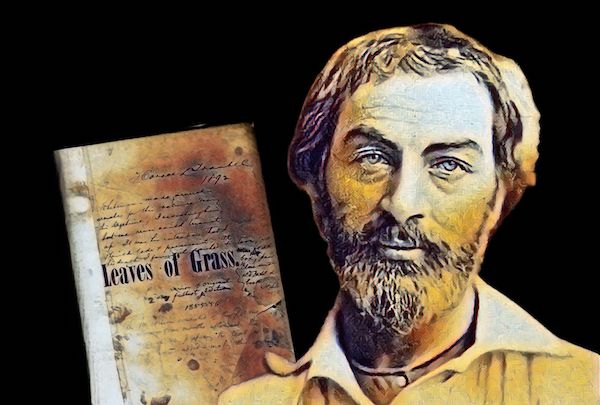
Walt Whitman was a printer, journalist, essayist, and wanderer. He had a visceral passion for ordinary life: the streets, the bodies, the crowds. That passion permeates every line of Leaves of Grass, which he rewrote and expanded over nearly four decades in nine successive editions. He described it as “a living book.” Unlike poets who sealed their works into a “finished” form, Whitman treated his poems as growing organisms.
With each edition, he added new verses, new chapters, new contradictions — and embraced them all. In “Song of Myself”, he writes: “Do I contradict myself? / Very well then I contradict myself, / (I am large, I contain multitudes.)” — a declaration of inner vastness that has become, over time, one of the most famous quotes in world literature.
Do I contradict myself? / Very well then I contradict myself, / (I am large, I contain multitudes.)
Walt Whitman, “Song of Myself”
The first edition of Leaves of Grass contained only 12 poems (though some were long and divided into sections), all untitled. The most famous of them would eventually be titled “Song of Myself”, a hedonistic, mystical, and deeply sensory celebration of the self, not a closed-off ego, but a porous “I,” open to the other, to the world, to the totality of human experience. “I celebrate myself, and sing myself,” the poem announces. But soon the self merges with the collective: “For every atom belonging to me as good belongs to you.”
Whitman’s language was equally innovative. He employed free verse — almost nonexistent in English poetry at the time — to create a rhythm close to speech: fluid, pulsating. His vocabulary was both simple and lyrical. He wrote about farmers, laborers, sailors, and prostitutes with the same reverence he gave to nature or metaphysics. His eroticism was explicit but always anchored in the spirituality of the body. Carnal communion was also cosmic communion. This shocked conservative critics and led to censorship. Some publishers refused to print his texts; libraries banned the book; a government employee was even fired for recommending it. And yet, from its initial publication, Leaves of Grass found illustrious admirers, such as Ralph Waldo Emerson, who wrote a famous letter to the author acknowledging the emergence of a new and powerful poetic voice.
Among the most often repeated lines are:
“I sound my barbaric yawp over the roofs of the world.”
“Be curious, not judgmental.” – (attributed to Whitman, but in truth a modern paraphrase with no exact origin in the original text)

“I am not contained between my hat and my boots.”
“I have learned that to be with those I like is enough.”
And, of course, the famous phrase that went viral in contemporary pop culture: “We were together. I forget the rest.” This quote — constantly reproduced in films, tattoos, t-shirts, and social media — is actually a modern simplification of a longer and more beautiful passage from the poem “Song of Myself”. In the original, we read:
“Day by day and night by night we were together—
All else has long been forgotten by me.”
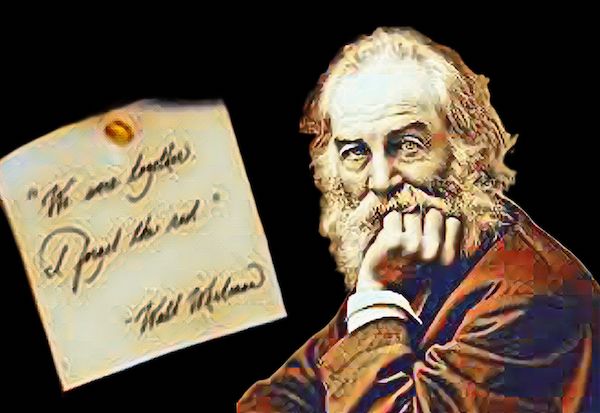
In this passage, Whitman describes an experience of intimacy so profound it erases the edges of memory. All that matters, says the poet, is the time shared with the other. The rest — the noise of the world, the dates, the obligations — fades away. The essence of the moment lived together remains almost sacred. This fragment has become one of the most underrated verses in his work, but its emotional force has turned it into a contemporary symbol of absolute, silent, and whole love.
Leaves of Grass also holds an undeniable historical role. By incorporating the body and homoerotic desire as legitimate poetic material, Whitman became a pioneer of queer literature — though he never identified himself in those terms. By praising the American landscape and the working classes, he contributed to the construction of a democratic and inclusive — if idealized — imagination. And by refusing to domesticate his feelings into rigid forms, he paved the way for 20th-century avant-gardes, influencing writers like Allen Ginsberg, Langston Hughes, Federico García Lorca, Pablo Neruda, Bob Dylan, Patti Smith, Bruce Springsteen, and more recently, Ocean Vuong and Jericho Brown.
Whitman lived through the American Civil War as a volunteer nurse, witnessed his country’s collapse, and felt the weight of historical violence. His poetry, however, never succumbs to despair. There’s always a spark of hope — not religious, but existential, almost biological. For him, living itself is a form of praise. Breathing is a hymn. Loving, a form of eternity.

The famous passage from the poem “O Captain! My Captain!”, which honors Abraham Lincoln, became a symbol of American collective mourning and resurfaced at historical moments, such as after the assassination of Kennedy, and later in the film Dead Poets Society, immortalizing Whitman for new generations. In fact, the 1989 film used another key passage — “I sound my barbaric yawp over the roofs of the world” — with Robin Williams urging a shy Ethan Hawke to overcome his creative and social block, in a deeply emotional scene.
Speaking of cinema, the poem “I Sing the Body Electric” is also part of the first edition of Leaves of Grass, and is one of the book’s most iconic poems. Whitman wrote it as a radical ode to the physical body at a time when themes like sexuality, racial equality, and bodily dignity were treated with shame or repression. The poem blends the spiritual with the carnal and affirms the sacredness of the body in its multiple forms, regardless of gender, color, or age.

The phrase “I sing the body electric” became famous and inspired later titles and works, including an episode of The Twilight Zone (written by Ray Bradbury) and an album by the band Weather Report. It also appears in songs, such as the homonymous one in the film Fame (1980), closing the movie. The origin is entirely Whitmanian: a poetic and political exaltation of the body as temple and symbol of individual freedom.
I sing the body electric,
The armies of those I love engirth me and I engirth them
And if the body does not do fully as much as the soul?
And if the body were not the soul, what is the soul?

Today, Leaves of Grass is considered one of the greatest books ever written in the English language. But its greatness lies not only in its form, content, or influence — it lies above all in its courage. The courage to say “I am all that is” in a time of repression. The courage to include love as a political substance. The courage to affirm that everybody is sacred, every moment, sufficient. In times of fragmentation, haste, and disbelief, returning to Whitman is returning to a kind of origin, where the poem was not merely an aesthetic exercise, but a form of full existence. And, as he wrote:
The question remains: what will your verse be? (Yes, recalling that aforementioned scene from Dead Poets Society).
Descubra mais sobre
Assine para receber nossas notícias mais recentes por e-mail.
 miscelana.com