
I make no secret of my dissatisfaction with the pop-hysterical adaptation of The Buccaneers on Apple TV+, released in 2023 and returning this June for its second season. In the final trailer, several subplots are teased.
We see how the Duchess of Tintagel, Nan (Kristine Frøseth), faces the consequences of her marriage to Theo, a union motivated by the need to save her sister Jinny. She feels torn between her role as a wife and her feelings for Guy, her true love. To make matters worse, her mother-in-law reinforces the social pressures of being an obedient spouse.
Jinny (Imogen Waterhouse), now pregnant, is on the run after escaping an abusive marriage, aided by Guy. The relationship between Mabel (Josie Totah) and Honoria (Mia Threapleton) also gains prominence, with the two reaffirming their love amid a society that refuses to accept their union.
And perhaps most importantly, Leighton Meester joins the cast in a yet-undisclosed role. The second season promises to delve deeply into themes of identity, female freedom, and the boundaries of social convention, all while maintaining a focus on the friendship among the leading women and their struggles for autonomy in a world determined to control them. And yet, none of this is in Edith Wharton’s book. Wouldn’t it have been easier to create an original series, as Julian Fellowes did with The Gilded Age?

The Buccaneers series, launched by Apple TV+ in 2023, was intended to be an adaptation of the eponymous novel left unfinished by Edith Wharton in 1938 and completed posthumously by Marion Mainwaring in 1993. But it’s a very loose adaptation. While both works share the same starting point—young American heiresses traveling to England in search of aristocratic husbands—the series and the novel head in radically different directions. The show’s approach is deliberately revisionist: instead of attempting to replicate Wharton’s style or critical vision, the series updates characters, situations, and conflicts to resonate with contemporary audiences. The result is a work far more aligned with the pop-feminist tone of Bridgerton than with the bitter elegance and deep ambiguity that mark Wharton’s prose.
In the novel, Nan St. George is the youngest of the group of “buccaneers,” somewhat rebellious, but still within the social bounds imposed on women of her class and era. Her story is marked by a growing tension between desire and duty. After an intense relationship with Guy Thwarte—a ruined British aristocrat who falls in love with her—Nan ultimately marries the Duke of Trevenick. The marriage is socially advantageous but leaves her deeply unhappy, trapped in the institution of marriage like other Whartonian heroines such as Ellen Olenska in The Age of Innocence or Lily Bart in The House of Mirth. Wharton’s critique of the social system that crushes women is delivered with subtle irony and a melancholic sense of the impossibility of personal fulfillment within conventional structures.
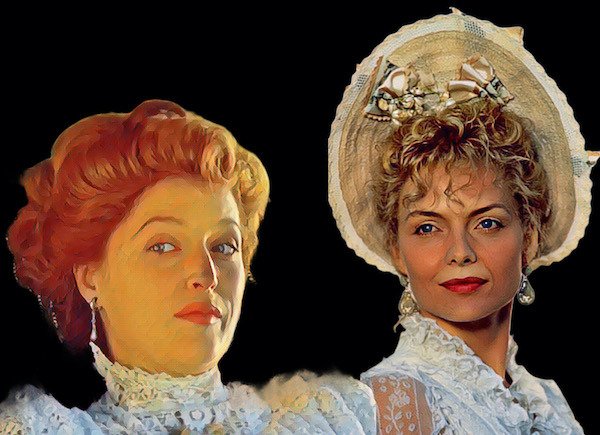
In the series, however, Nan is presented from the outset as an unruly figure who questions the rules of the game and challenges both American and British societies. The choice to give her an adoptive background—and the later revelation that her biological mother is a working-class woman—not only has no basis in the book but represents a dramatic shift that centers the narrative around identity. While the novel’s critique focuses on the entrapment of women in marriage and the aristocracy, the series reframes it as a drama of belonging, individual freedom, and emotional emancipation. The revelation of Nan’s adoption functions as a metaphor for her refusal to accept the role assigned to her—that of a decorative wife—and propels her to abandon the duke and run off with Guy, something unthinkable within Wharton’s logic.
Another key difference is the transformation of Mabel Elmsworth and Honoria Marable into a couple. In the novel, both are secondary characters involved in parallel stories of marriage and disillusionment. In the series, their queer relationship is portrayed with warmth, depth, and respect, becoming one of the most prominent threads of the plot. It’s a completely new approach, placing The Buccaneers firmly among contemporary works concerned with representation and diversity. While Edith Wharton knew members of the LGBTQ+ community and even subtly hinted at ambiguous characters in her work, she never wrote explicitly about same-sex relationships. By doing so, the series modernizes the original material dramatically, even at the cost of losing important nuances of the indirect social critique that defines Wharton’s voice.
Conchita Closson’s arc is equally telling. In the novel, she is an impulsive young woman who marries a British lord only to discover she is unwelcome in English aristocratic circles. Abandoned and isolated, she is yet another silent victim of the system. In the series, Conchita is vibrant, assertive, charismatic, and perhaps the character who best embodies the adaptation’s libertarian spirit. Her failed marriage does not define her: she confronts her in-laws, retains custody of her daughter, and refuses to diminish herself to fit the mold of British nobility. At various moments, she serves as the group’s emotional anchor, reinforcing themes of sisterhood and mutual support among the women—something far more present in the show than in the novel.
There are also fundamental stylistic differences. Wharton’s prose—even as completed by Mainwaring—maintains the rhythm, vocabulary, and moral structure of late 19th-century novels. The adaptation, by contrast, features a pop soundtrack, modern slang, and an overtly emotional tone. The show’s aesthetic, though carefully crafted, does not aim to faithfully reconstruct Victorian England—it stylizes, distorts, and updates it. It’s a project that bets on immediate identification with today’s viewers, even if that means abandoning the more restrained, introspective, and ambivalent tone of the original work.

Ultimately, the biggest rift between the series and the novel may be philosophical. For Edith Wharton, the tragedy of wealthy women in the Gilded Age was not simply the lack of personal freedom, but the clash between desire and structure, between passion and convention, between modernity and tradition. Her characters often surrender—not out of weakness, but because society inevitably consumes them. In Apple TV+’s The Buccaneers, that logic is reversed: the heroines resist, scream, run, love who they want, and build a new idea of happiness, however fleeting, together. Wharton’s elegant pessimism gives way to a revolutionary optimism that transforms oppression into adventure and disappointment into personal growth.
In short, The Buccaneers (2023) is not a faithful adaptation, nor does it aim to be. It’s a free, bold, and politically engaged retelling that uses Edith Wharton’s sketches as a springboard to imagine a story of young women confronting old worlds—and winning, at least for a while. For those familiar with the novel, the experience may feel alien. For those unfamiliar, it may simply seem like another period drama with gorgeous costumes and romantic rebellion. But for both audiences, the same fascination may linger: watching these “buccaneers” sail against the tide, rewriting the rules, and challenging—on their own terms—the social pacts still trying to tame them.
Descubra mais sobre
Assine para receber nossas notícias mais recentes por e-mail.
 miscelana.com
I Think Kristine Froseth would be great choice as Jean Grey/Phoenix Force In MCU
CurtirCurtido por 1 pessoa
I Think Imogen Waterhouse would be great choice as Crystalia Amaquelin In MCU
CurtirCurtir
I Think Aubri Ibrag would be great choice as Betsy Braddock In MCU
CurtirCurtir