
After 25 years with American Ballet Theatre, Misty Copeland is officially retiring. While the announcement marks a pivotal moment in the history of American ballet, it also serves as a natural closure to a journey that has, in many ways, already transitioned. At 42, Copeland has spent the past five years off the stage at Lincoln Center, raising her son with her husband, attorney Olu Evans, and dedicating herself to the Misty Copeland Foundation, which focuses on promoting diversity, equity, and inclusion in the dance world — a mission that, in today’s political climate, faces renewed challenges.
Copeland will bid farewell with a final performance this fall, bringing to a close a career that was not only groundbreaking but once considered nearly impossible. Born in Kansas City and raised in California in an environment marked by instability and poverty, she discovered dance at 13 — unusually late for a ballerina. In ballet’s rigid and predominantly white institutions, her ascent was improbable. And yet, she joined ABT in 2001 and, after a long climb, made history in 2015 as the first Black woman ever promoted to principal dancer in the company.

Reflecting on her decision, Copeland admits she has long been preparing for this moment. “Honestly, I wanted to fade into the background,” she said in a recent interview. “But that’s not really possible. The legacy I carry and the stories of the Black dancers who came before me demand a formal conclusion. ABT has meant everything to me.”
In fact, she began to feel that sense of closure in 2019, during a performance of Swan Lake at Wolf Trap in Virginia. “It was the first time in my career I felt complete. I let go of the critics, of the constant questioning about whether I deserved my place — criticism that often came with racial undertones. That night, I felt free.”
Copeland has always rejected the idea that her story is about individual triumph. “It was never supposed to be about me,” she said. “It should have been about the broader understanding that people from Black and brown communities want to be part of these spaces. They just need to feel invited. Representation isn’t about exceptionalism — it’s about visibility and access.”


As debates around DEI rage in the political sphere, Copeland remains focused on the ground-level work. “We’re not shouting from the rooftops,” she said. “We’re doing the real work — intentionally, consistently. Art is the most incredible way to build bridges, no matter your political beliefs. And when young Black and brown people saw my face at Lincoln Center, they realized that space could belong to them too.”
Her time at ABT was not without conflict. As dancer Gabe Stone Shayer once noted, dancers of color were often cast in caricatured or villainous roles — a reflection of subtle biases still present in classical ballet. Copeland confirms this: “When I joined, I was always the ‘earthy’ character. I fought to be cast in classical roles. I had to be intentional, brave, and diplomatic. I remember being in my early 20s, going into my director’s office, terrified but determined to say: I’m here, I’m the only one here, and I deserve a chance.”

In contrast to many dancers who lose their sense of self in the rigors of ballet, Copeland found herself. “Ballet gave me structure in a life that had none,” she recalled. “As a child, I never knew where we’d sleep or if we’d eat. But I could walk into a studio and know I’d do pliés, tendus, dégagés. That routine was my sanctuary. It gave me a sense of identity and belonging.”
Now, as a mother, she views her own upbringing — and her relationship with her mother — with deeper empathy. “When I was eight, I couldn’t understand why we didn’t have a home. But now, I see it through a different lens. My mom never had a childhood. She became a mother very young and wasn’t ready. I understand her more now.”
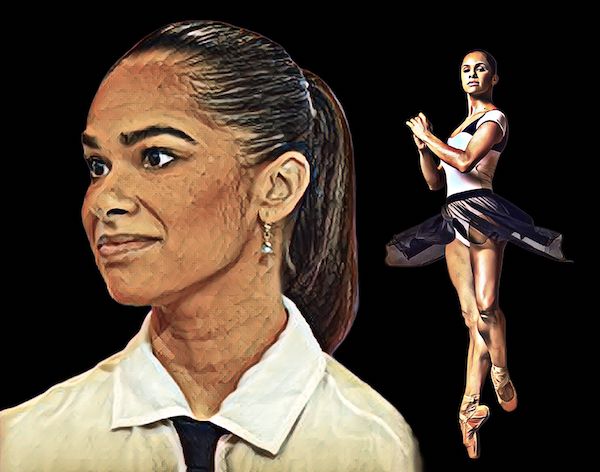
Copeland leaves the stage not as a ballerina seeking the spotlight, but as an icon who reshaped the image of what a ballerina can be. She became a symbol — not just of success, but of transformation. Her impact will not fade with her final curtain call.
“I’ve done what I came to do,” she said. “And now, it’s time for others to step forward — to take ballet even further into the future.”
Descubra mais sobre
Assine para receber nossas notícias mais recentes por e-mail.
 miscelana.com