
“I am big. It’s the pictures that got small.”
Few lines encapsulate an era as powerfully as this one, spoken by Norma Desmond, the silent film star who refuses to accept her obsolescence in Sunset Boulevard (1950), directed by Billy Wilder. What seemed at first a grim portrait of 1950s Hollywood has, over time, become a merciless mirror reflecting the transformations of fame, the desire to remain in the spotlight — and the devastating price it exacts. From cinematic masterpiece to grand and controversial stage adaptation, Sunset Boulevard endures as a fascinating fable of celebrity, delusion, and decline.

Origins and behind-the-scenes: the tomb of an era
Sunset Boulevard emerged in a Hollywood already mourning its own “golden age.” In 1949, Billy Wilder — already celebrated for films like Double Indemnity and The Lost Weekend — set out to write a scathing critique of the industry that had made him famous. The goal was to expose the inner workings of a system that discarded its idols and corrupted its dreamers — a Hollywood where glamour died slowly, but no one dared turn off the lights.
The plot follows Joe Gillis, a failed screenwriter played by William Holden, who stumbles into the decaying mansion of Norma Desmond, a former silent film goddess living in seclusion, convinced that the public still adores her. She hires him to revise a script she believes will mark her triumphant return to the screen — and gradually, the roles of prisoner and jailer become blurred in a suffocating relationship.
Wilder drew inspiration from real-life figures. Norma is partly a fusion of forgotten silent-era actresses like Mae Murray and Clara Bow, but she also echoes Gloria Swanson herself — who would play her, ironically, as a silent-era star trying to reinvent herself in talkies.
Casting Swanson was initially controversial. She had been virtually out of the spotlight, seen by many as a relic. But Wilder saw this as the project’s strength. Alongside her, Erich von Stroheim — a former director of Swanson’s in the 1920s — would play Max, the butler, adding a layer of meta-commentary and cruel irony. The reveal that Max was once Norma’s director and first husband is a direct allusion to Stroheim and Swanson’s real-life collaboration on Queen Kelly (1929), an unfinished film that even appears within Sunset Boulevard, projected as a ghostly memory of lost glory.
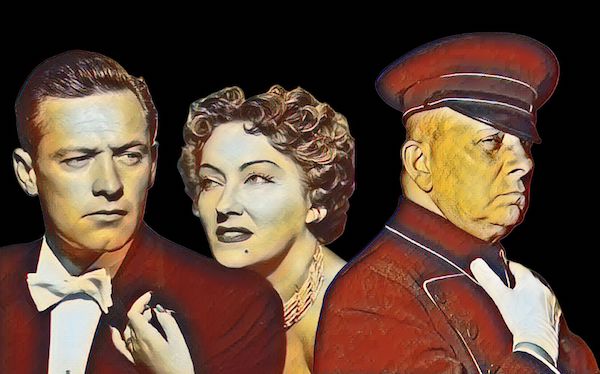
The film’s sets are a spectacle in themselves. Norma’s gothic mansion — built in the 1920s with Moorish inspiration — is portrayed as a living mausoleum, with heavy drapes, forgotten chandeliers, vintage portraits, and a drained swimming pool soon to become a crime scene. Real-life locations included the Getty mansion on Wilshire Boulevard, demolished a few years later. Paramount Studios appears in near-documentary-style scenes, such as Norma’s visit to Cecil B. DeMille (playing himself) on the Samson and Delilah set — one of several notable cameos. Alongside DeMille, the film includes appearances by Buster Keaton, Anna Q. Nilsson, and H.B. Warner — all playing Norma’s former colleagues in a somber, silent card game. What could have been nostalgic becomes an obituary for the silent era.
Immortal scenes and reception
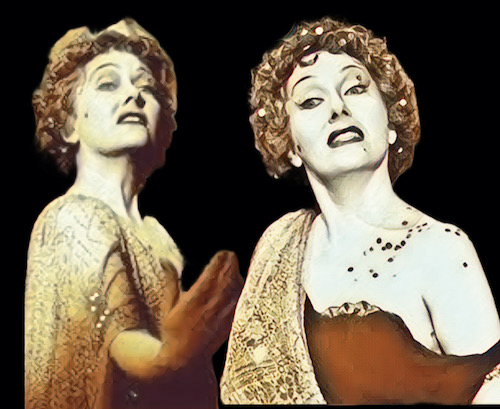
The film is punctuated by scenes that have become iconic. Norma descending the staircase for the climactic moment, believing she is about to reclaim her fame, is perhaps one of the most powerful images in film history. The narration by a dead protagonist, the near-expressionist use of the shadowy mansion, and Franz Waxman’s oppressive score — all contribute to an operatic tragedy.
Upon release, the film was both a critical and commercial success. It received 11 Oscar nominations and won three: Best Screenplay, Art Direction, and Score. But it was not without controversy: Louis B. Mayer of MGM called Wilder a traitor for “biting the hand that fed him.” Critics, in general, praised the film’s audacity and Swanson’s magnificent performance — though she lost the Oscar to Judy Holliday, one of the most debated and regretted decisions in Academy history.
Relevance and legacy
Over seventy years later, Sunset Boulevard remains as relevant as ever. In an age of social media, “cancellations,” and obsession with youth, Norma Desmond reemerges as a symbol of those who cannot accept the end of their time — or who refuse to be discarded. She is tragic, yes, but also ferociously human. And her story reverberates in countless other works: of cinema, of stardom, of desperation.
The musical: Andrew Lloyd Webber meets Norma Desmond
The idea of turning Sunset Boulevard into a musical arose in the late 1980s, when Andrew Lloyd Webber — creator of hits like The Phantom of the Opera and Evita — sought a new project combining theatricality, tragedy, and stardom. Few characters offered as much potential as Norma Desmond — literally larger than life.
With lyrics by Don Black and Christopher Hampton, the musical premiered in London in 1993, starring Patti LuPone. Her powerful voice and commanding stage presence gave the character new depth. But the production was marred by backstage drama: LuPone had been promised the Broadway lead, only to be replaced by Glenn Close after a Los Angeles run. LuPone sued Lloyd Webber and received a substantial settlement. The resentment, it seems, still lingers.

Close, in turn, became the definitive Norma in the U.S. She debuted at the Shubert Theatre in Los Angeles in 1993, then on Broadway in 1994, amid lavish costumes and a massive 13-ton rotating mansion set. Her performance earned her the Tony Award for Best Actress in a Musical, along with near-unanimous acclaim. (I was at one of those performances, and I still have my signed program to prove it. Unforgettable.)
Success, failure, and survival
Despite the praise for Close’s performance, critics were divided on the musical overall. Some argued that Webber’s score lacked boldness and that the show relied too heavily on its spectacle. New York Magazine even called it “a musical without a soul.”
Nonetheless, Sunset Boulevard was a commercial hit — at least at first. Lawsuits with LuPone and Faye Dunaway (who rehearsed the role but was fired before opening) generated bad press. The production was also prohibitively expensive. The original Broadway run closed in 1997 with an estimated $20 million loss — one of the biggest at the time.

The film that never was
Glenn Close longed to bring her Norma Desmond to the screen. For years, she and Lloyd Webber tried to launch a film adaptation, with a script by Tom MacRae and Rob Ashford slated to direct. Paramount even announced the project around 2017, but it never materialized. Rumors suggest that the box-office disaster of Cats cooled the studio’s enthusiasm for adapting Webber’s musicals.
The 2016 revival and today’s renaissance
In 2016, Close returned to the role in London in a stripped-down production where the orchestra occupied the stage. It transferred to Broadway in 2017, enjoying strong ticket sales despite mixed reviews.
But the true revival of Sunset Boulevard as a musical came with Jamie Lloyd’s 2023 West End production, starring Nicole Scherzinger. Known as a former Pussycat Doll, Scherzinger stunned audiences and critics with an emotionally devastating performance full of nuance — far from the caricatured glamour of previous versions.

This minimalist, dark, symbolic staging introduced Norma to a new generation. Using screens, live cameras, and a digital noir aesthetic, Lloyd radically reimagined the piece as a meditation on identity, image, and isolation. The production won the Olivier Award for Best Revival, and Scherzinger took home Best Actress in a Musical.
Now, in 2025, that version has arrived on Broadway, with Scherzinger reprising the role and finally fulfilling the tragic potential of the source material — no excess, no fake gold, just the raw flesh of Norma Desmond. She triumphed at the Tony Awards as Best Actress in a Musical — a richly deserved win for her and for Norma.

Why Sunset Boulevard still matters
Norma Desmond is more than a portrait of decline: she is an emblem of all those discarded by a system that loves with fury and abandons with indifference. Her face lit by illusion, her gaze crazed by a fame that no longer exists, is a cruel portrait of celebrity. But also of anyone who has ever felt the world move on without them.
From the immortal 1950 film to a musical in constant reinvention, Sunset Boulevard remains timeless because the hunger to be seen, loved, and remembered never goes out of style. As long as someone is facing a camera, there will be a Norma waiting in the wings for her next scene.
“All right, Mr. DeMille, I’m ready for my close-up.”
Descubra mais sobre
Assine para receber nossas notícias mais recentes por e-mail.
 miscelana.com