
People, we need to talk about Aidan Shaw. For years, he’s been seen as the “perfect man Carrie left for Mr. Big.” But was he ever truly “perfect”?
Aidan Shaw entered the Sex and the City universe in the show’s third season, presented as the complete opposite of Mr. Big. A charming carpenter, calm, friendly, supposedly mature, and emotionally available — everything that, at first glance, would seem ideal for Carrie Bradshaw. He was almost a manufactured dream: the man who builds furniture, loves dogs, wants to get married, have kids, and live a “normal” life. But the package, wrapped like a prize of emotional stability, hid more complex — and, for many fans, deeply problematic — layers.

Aidan owned a handmade rustic furniture store, had his own business, a dog (Pete), and an earthy, almost “granola” vibe that contrasted with Carrie’s neurotic glamour. He was the guy who wanted to get out of the city noise, live far from the New York madness, and put down roots — literally. And that’s where the problems begin: Aidan didn’t love Carrie as she was. He loved the idea of her. Or rather, he wanted a version of Carrie that he could “improve.” More on that pattern soon, but take note: just as Carrie once wanted to change Big, Aidan wanted to change Carrie. Why?
The Archetype of the Man Who Wants to Mold the Woman
From the start, Aidan imposes changes: she has to quit smoking, accept his dog, and want a white-picket-fence life in the countryside. He positions himself as the “healthy man” in contrast to the “toxic Mr. Big,” but in practice, he’s controlling, passive-aggressive, and emotionally manipulative. His speech is one of love and safety, but his behavior is that of a subtle moralist who tries to reshape the woman he claims to love.
There’s a human side where he is coherent. When he finds out Carrie cheated on him with Big, the resentment never really goes away — even after he forgives her, the relationship turns into a minefield of emotional traps: he comes back, but he keeps score; he says he trusts her, but he punishes her. It gets to the point where he makes Carrie sign a contract to guarantee she won’t cheat again. He proposes marriage as a way to consolidate control, not as an act of loving freedom. She says yes, and soon after returns the ring.
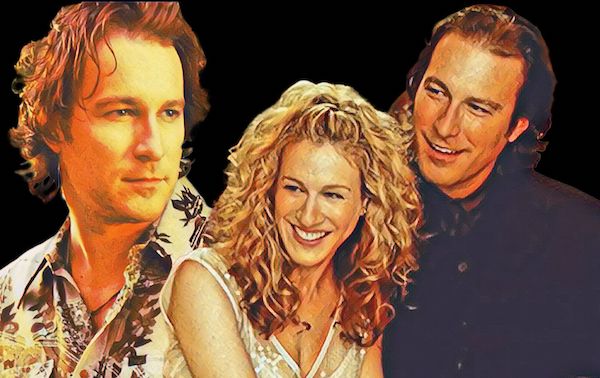
Fan Reactions: The “Nice Guy” Who’s Not So Nice
For years, Aidan split fans: to some, he was “the right man at the wrong time”; to others (like us, and a growing number of contemporary feminist critics), he was always a wolf in sheep’s clothing. He was idealized as the “nice guy,” but behind that facade was someone who couldn’t accept Carrie’s complexity, independence, or ambition. In comparison, Big — with all his flaws — never tried to change her. He loved her in her entirety, and his evolution was visible: he grew from an emotionally unavailable narcissist to a committed partner who, in the end, stood by her exactly as she was.
Whether that arc is incoherent or unrealistic is another story. But there, at least, we have a romantic ideal that’s been sold for centuries: the impossible love that demands essential personality changes. It’s the toxicity behind that famous Sex and the City line when Carrie asks him to say she’s “the one.” It’s what breaks them up in season one, and it’s what he finally says at the end of the series. I won’t lie — I rooted for it, and I liked the finale. But now, with more life behind me, I understand that it was part of a cultural moment that no longer represents what we want for women today or in the future. And in that context, Aidan isn’t the alternative either.

The Return in And Just Like That: Worse Than Before
If Aidan’s arc was already questionable in the original series, his return in And Just Like That is almost a narrative disaster. Now in his sixties, divorced, and father of three, he reconnects with Carrie and immediately jumps into yet another emotional cycle with her. But what could have been a mature reunion between two people who had lived, suffered, and evolved turns into an adolescent self-help script.
First, he refuses to set foot in her apartment because it brings back painful memories. And it’s not figurative — he literally won’t step inside, which leads Carrie to sell the only place where she’s always felt safe and whole. And what does she do? She sells the apartment to find another place to live with Aidan. He contributes nothing financially, not even in choosing the new place. Isn’t that a red flag? And there’s more.

After Carrie makes this change, Aidan’s life takes a turn. For all the complaints I have about him in the Carrie dynamic, it’s undeniable that he’s a devoted, caring father — and his youngest son is going through serious issues. He wants to be present until the boy becomes an adult. I won’t throw stones at that choice. But still…
From there, Aidan proposes a relationship with no sleepovers because of the kids, then sets a bizarre five-year no-contact rule. Yes, no calls, no visits — supposedly because Wyatt, his son, doesn’t accept Carrie. We could analyze how wrong that is in terms of parenting, but let’s focus on Carrie. Worse: Carrie — a millionaire, a widow, an independent woman — accepts all of it, as if still chasing the approval of a man who never really understood her.
The man who claimed to love Carrie still doesn’t listen to her. And the show seems oblivious to how grotesque this portrait is: Aidan is now forever the “poor guy,” paternal, wounded, and yet still presented as a valid romantic option. His ex-wife calls Carrie to ask for favors. He sets limits, disappears, returns. And Carrie, stripped of her intelligence and life experience, accepts every crumb like she’s still clinging to an illusion from the past.

John Corbett: The Actor Behind the Illusion
John Corbett has always been charismatic. With his seductive voice, relaxed smile, and “approachable man” image, he charmed audiences in Northern Exposure and My Big Fat Greek Wedding. His portrayal of Aidan was, at the time, that of a sweet, almost-too-gentle man — and it’s precisely this softness that masks the character’s deeper problem. Corbett returned in AJLT with the same “good guy” aura, but without the depth that age should have brought. He may look older, but the character doesn’t seem wiser — just more indecisive, more disconnected, more weak.
That Aidan is still repeating the same problems with Carrie says something — but even more telling is that she is still repeating the same relationship patterns at 60, after everything she’s lived through. I’ve revisited her worst boyfriends, but Aidan shares their worst trait.

Jack Berger: The Insecure Guy Disguised as Funny
At first, Berger seemed like a perfect match for Carrie: writer, witty, sarcastic, charming. But the lightness quickly gave way to toxic competitiveness. He couldn’t handle Carrie’s success, her accomplishments, her autonomy. He was the guy threatened by a woman outshining him — and he hid behind jokes, passive digs, and a cowardly post-it (“I’m sorry. I can’t. Don’t hate me.”).
At that stage, Carrie was thriving as a writer, confident in her career and herself. Berger was an emotional setback — and she quickly realized it.
Mr. Big: The Narcissist Who Grew
Big was Carrie’s first and most enduring love — complex, immature, sometimes cruel, but ultimately transformed over time. He started as the emotionally unavailable control freak who kept Carrie at arm’s length. But he evolved. When he finally committed, it was with conviction and acceptance. He never tried to change Carrie. He just wanted to be with her, exactly as she was.
Carrie, throughout her journey with Big, went through many versions of herself — from lovestruck and insecure to mature and self-aware. By the time they reunite in Paris, she knows what she wants — and surprisingly, so does he.

Aleksandr Petrovsky: The Artist Who Can’t Share Space
The Russian was worldly, sophisticated, elegant — and utterly self-centered. He offered Carrie the glamour of an artistic, international life, but constantly excluded her from decisions, circles, and even emotions. He didn’t want a partner — he wanted a spectator. It was a relationship that dissolved her identity.
Carrie was dazzled but drained. Willing to start over in Paris, she gave up everything for him — and quickly realized the mistake. That moment of realization remains one of the most dignified in the original series.
The Central Difference with Aidan
Aidan, unlike Berger, Big, or Petrovsky, wasn’t driven by ego or intellectual pride. His toxicity is more insidious: he wants a partner molded to fit. Berger felt threatened. Big was emotionally hesitant. Petrovsky was egocentric. Aidan is the “good guy” archetype who only works if you fit perfectly into his mold — and Carrie, at every stage, was exactly the opposite. She wanted to be accepted, not redesigned.
The Myth of the Good Man, Dismantled
So, to all Sex and the City fans: Aidan Shaw represents a dangerous archetype — the “good man” who is only good as long as you follow his script. He doesn’t shout, cheat, or explode — but he slowly erodes his partner’s individuality.
And Just Like That makes a major mistake by bringing him back as a serious romantic option, without exploring what that relationship actually means for a woman like Carrie. Deep down, in her grief after losing Big, Carrie sought comfort in a painful relationship that stops her from facing the present — and even more so, the future. It’s no surprise that she now seems unrecognizable, diminished.
In the end, what we see is not love — it’s nostalgia. And as the show itself proves, living in nostalgia rarely brings anything truly good.
Descubra mais sobre
Assine para receber nossas notícias mais recentes por e-mail.
 miscelana.com