
In 1924, new editions of Jane Austen’s six classics were published, and none other than Virginia Woolf — still working on Mrs. Dalloway, which would be released the following year — wrote a review about the relevance of the writer’s work, which had long been the target of criticism and commentary from (male) writers debating her genius.
Precise and moving as always, Woolf, with elegance and irony, responds to this history of condescending or limiting criticism directed at Jane Austen by 19th- and early 20th-century male writers and scholars. Right from the start, she points to a male literary club that “protects” Austen, but from a conservative, paternalistic, and almost domestic place — as if she were merely a charming, correct, delicate author and therefore “safe.”

In the essay, she refutes the idea — which still echoes today — that Austen only wrote about domestic life, marriage, small towns, “feminine” and “minor” matters. Many critics of the time claimed her books were elegant but trivial.
Woolf also highlights the overvaluation of her “style” at the expense of her worldview because — even today — Austen is often celebrated as “the perfect stylist,” without due recognition of the irony, critical subtext, and the depth of her social and emotional insight.
Of course, there is also the misogyny inherent in the condescending or protective tone of many male critics, who treated Austen as a “talented lady,” a domesticated genius who fit neatly into the Victorian ideal of femininity: restrained, intelligent, but without danger, passion, or daring.
Even more: Woolf intelligently mocks the unfavorable comparison to “serious” authors like George Eliot, who were seen as more philosophical or profound for dealing with broader or tragic themes. Woolf ironizes this by saying that “it would be interesting to investigate the problem of George Eliot’s nose” — ridiculing how even a woman’s physical appearance influenced the literary judgment of her work.

She subverts all of this by asserting that Austen, had she lived longer, would have become an even deeper writer, perhaps comparable to Henry James or Proust. That is, she was only at the beginning of a creative process that time did not allow to blossom. Woolf transforms that “graceful writer of marriage novels” into an author who was already showing signs of wanting to speak of suffering, of the unspoken, of the complexity of interior life — precisely the themes regarded as “nobler.”
Here lies the seed of another topic I will explore at another time: the influence — or revelation — of the theme of Mrs. Dalloway, the work Woolf was writing in 1924 and which also addressed questions found in Persuasion, as she makes clear when imagining “what might have been” had Jane Austen lived a longer life. Yes, because the review (which I will present in translation further ahead) is not merely a literary critique, but a meeting of two feminine sensibilities across time — one recognizing in the other what is most profound, most restrained, most intimate, and yet universal.
Yes, Virginia Woolf says beautiful things about Jane Austen — and with astonishing sensitivity. Although the text has ironic touches (such as the bit about the “twenty-five elderly gentlemen who defend her honor as if it were their aunts’”), the essay is deeply admiring and reveals a sharp eye for the subtlety of Austen’s work.
In Virginia Woolf’s reading, the emotional shift in Persuasion suggests that Austen was opening herself to broader emotional and existential dimensions — almost saying that here, finally, was a vulnerable, mature, deeply human Jane Austen. “She would have created a new method, as clear and composed as ever, but deeper and more suggestive, to convey not merely what people say, but what they leave unsaid; not merely what they are, but […] what life is,” she wrote. That sentence is a true tribute. Woolf is saying that Austen, had she lived longer, would have become even greater — capable of describing not only the visible but the unspeakable, what pulses beneath human behavior. An artistic assessment rarely carries such generosity.

But her life was cut short at 42, and “she died just when she was beginning to feel confidence in her own success,’” Woolf laments. Here , there is pain and recognition. Her judgment is that it is devastating that Austen died young, just when she was beginning to assert herself as an author, when critics and readers were finally turning their attention to her. It’s a note of loss — not only of a woman, but of a masterpiece the world will never know.
At its core, the entire text is a great praise of Austen’s intelligence and restrained artistry, and an emotional tribute to all she could have still contributed to literature. Woolf manages to speak of Austen’s lightness and irony without ever diminishing her — on the contrary, she acknowledges how much complexity and worldview lay behind her discreet prose.
And the entire piece is moving because it says as much about Jane Austen as it does about Virginia Woolf, even when the latter pretends to only observe. The passage in which she writes that “experience, when serious, had to be deeply matured and disinfected by the passage of time before she allowed herself to treat it in fiction” is almost an indirect confession from Virginia herself — about the painful process of transmuting life into art, especially as a woman, especially as someone too intelligent in a world that didn’t always tolerate it.
Woolf’s essay — which is not long — is not just a reading of Persuasion, it is a reading of female silence, of the delicacy of empathy, of the pain that observes but does not scream — and precisely for that reason, leaves a mark. “She is seen, during much of the book, through the eyes of a woman who, being unhappy, has a special sympathy for the happiness and unhappiness of others — about which, until nearly the end, she is forced to be silent,” she notes.
What Woolf does here is to sketch the mature Jane Austen the world lost — but also to offer a perspective that only another brilliant writer, a woman shaped by her own restraint and sensitivity, could offer. It is not just Woolf explaining Austen — it is Woolf recognizing Austen as a possible mirror, a soul sister, and fellow craftswoman.
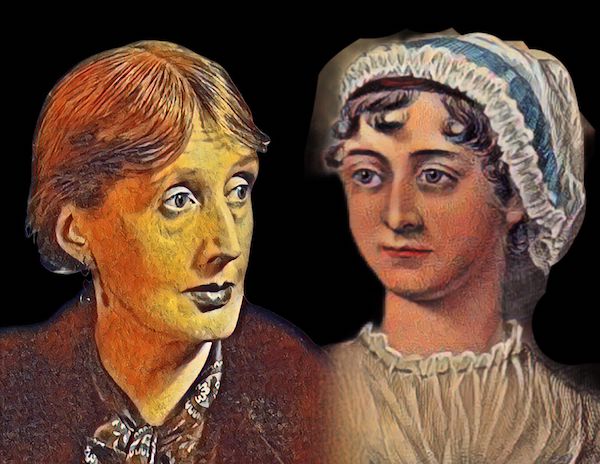
And perhaps that is why criticism becomes, here, something rarer: a form of love.
Here is the text by Virginia Woolf.
“Anybody who has had the temerity to write about Jane Austen is aware of two facts: First, that of all great writers she is the most difficult to catch in the act of greatness; second, that there are 25 elderly gentlemen living in the neighborhood of London who resent any slight upon her genius as if it were an insult offered to the chastity of their aunts.
It would be interesting, indeed, to inquire how much of her present celebrity Jane Austen owes to masculine sensibility; to the fact that her dress was becoming, her eyes bright, and her age the antithesis in all matters of female charm to our own. A companion inquiry might investigate the problem of George Eliot’s nose; and decide how long it will be before the equine profile is once again in favor, and the Oxford Press celebrates the genius of the author of Middlemarch in an edition as splendid, as authoritative, and as exquisitely illustrated as this.
But it is not mere cowardice that prompts us to say nothing of the six novels of the new edition. It is impossible to say too much about the novels that Jane Austen did write; but enough attention perhaps has never yet been paid to the novels that Jane Austen did not write. Owing to the peculiar finish and perfection of her art, we tend to forget that she died at 42, at the height of her powers, still subject to all those changes which often make the final period of a writer’s career the most interesting of all. Let us take Persuasion, the last completed book, and look by its light at the novels that she might have written had she lived to be 60-years-old. We do not grudge it him, but her brother the Admiral lived to be ninety-one.
There is a peculiar dullness and a peculiar beauty in Persuasion. The dullness is that which so often marks the transition stage between two different periods. The writer is a little bored. She has grown too familiar with the ways of her world. There is an asperity in her comedy which suggests that she has almost ceased to be amused by the vanities of a Sir Walter or the snobbery of a Miss Elliott. The satire is harsh, and the comedy crude. She is no longer so freshly aware of the amusements of daily life. Her mind is not altogether on the subject. But, while we feel that Jane Austen has done this before, and done it better, we also feel that she is trying to do something which she has never yet attempted. There is a new element in Persuasion, a quality, perhaps, that made Dr. Whewell fire up and insist that it was “the most beautiful of her works.”
She is beginning to discover that the world is larger, more mysterious, and more romantic than she had supposed. We feel it to be true of herself when she says of Anne: “She had been forced into prudence in her youth, she learned romance as she grew older—the natural sequel of an unnatural beginning.” She dwells frequently upon the beauty and the melancholy of nature. She talks of the “influence so sweet and so sad of autumnal months in the country.” She marks “the tawny leaves and withered hedges.”
“One does not love a place the less because one has suffered in it,” she observes. But it is not only in a new sensibility to nature that we detect the change.
Her attitude to life itself is altered. She is seeing it, for the greater part of the book, through the eyes of a woman who, unhappy herself, has a special sympathy for the happiness and unhappiness of others, which, until the very end, she is forced to comment upon in silence. Therefore the observation is less of facts and more of feelings than is usual. There is an expressed emotion in the scene at the concert and in the famous talk about woman’s constancy which proves not merely the biographical fact that Jane Austen had loved, but the aesthetic fact that she was no longer afraid to say so. Experience, when it was of a serious kind, had to sink very deep, and to be thoroughly disinfected by the passage of time, before she allowed herself to deal with it in fiction. But now, in 1817, she was ready. Outwardly, too, in her circumstances, a change was imminent. Her fame had grown very slowly. “I doubt,” wrote Mr. Austen Leigh, “whether it would be possible to mention any other author of note whose personal obscurity was so complete.” Had she lived a few more years only, all that would have been altered.
She would have stayed in London, dined out, lunched out, met famous people, made new friends, read, travelled, and carried back to the quiet country cottage a hoard of observations to feast upon at leisure. And what effect would all this have had upon the six novels that Jane Austen did not write? She would not have written of crime, of passion, or of adventure. She would not have been rushed by the importunity of publishers or the Battery of friends into slovenliness or insincerity. But she would have known more. Her sense of security would have been shaken. Her comedy would have suffered. She would have trusted less (this is already perceptible in Persuasion) to dialogue and more to reflection to give us a knowledge of her characters. Those marvelous little speeches which sum up in a few minutes’ chatter all that we need in order to know an Admiral Croft or a Mrs. Musgrove forever, that shorthand, hit-or-miss method which contains chapters of analysis and psychology, would have become too crude to hold all that she now perceived of the complexity of human nature. She would have devised a method, clear and composed as ever, but deeper and more suggestive, for conveying not only what people say, but what they leave unsaid; not only what they are, but (if we may be pardoned the vagueness of the expression) what life is. She would have stood further away from her characters, and seen them more as a group, less as individuals. Her satire, while it played less incessantly, would have been more stringent and severe. She would have been the forerunner of Henry James and of Proust—but enough. Vain are these speculations: she died “just as she was beginning to feel confidence in her own success.”
Descubra mais sobre
Assine para receber nossas notícias mais recentes por e-mail.
 miscelana.com