
You know something’s off when Julianne Moore mounts a horse and Sydney Sweeney arrives covered in blood at a remote farm… and still, what’s missing is dramatic weight. Echo Valley, the new dramatic thriller from Apple TV+, has everything to be an intense film — family pain, unresolved trauma, addiction, blood, guilt, death — but stumbles exactly where it couldn’t: in the script.
Written by Brad Ingelsby, the same name behind the solid and successful Mare of Easttown, the film tries to revisit similar territory: an emotionally devastated woman in a rural Pennsylvania setting, with family secrets and violence on the horizon. The formula is there, but this time without narrative consistency or emotional substance. Echo Valley seems to want to be two films at once: a psychological drama about grief and wounded motherhood, and a survival thriller with drug dealers invading barns in the middle of the night. The problem is that it fails to be either with conviction.
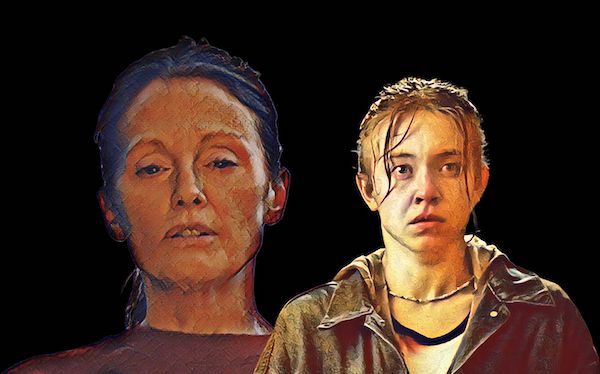
Julianne Moore is, as expected, a pillar. Her Kate Garrett carries on her body all the pain of someone who has lost a wife, been abandoned by her daughter, and is struggling to keep a farm alive while holding onto a shred of dignity. Michael Pearce’s direction understands that Moore’s face is enough — and sometimes it truly is. There are silences where the actress says everything, even when the script seems to say nothing. She delivers a kind of emotional minimalism that requires surgical precision, and she nails it.
Sydney Sweeney, in turn, appears as Claire, the troubled daughter who erupts into her mother’s routine covered in blood, bringing with her a trail of destruction. Her performance is more intense and unstable, which suits the character’s profile: a young woman on the verge of collapse, trapped between addiction and a toxic relationship with a local drug dealer. Sweeney has grown as an actress, and here she shows a range that goes beyond the type that made her famous in Euphoria. She’s raw, fragmented, at times exhausting — in a good way.
But, no matter how good the performances are, neither can save a script that seems to be pieced together from generic expectations of what a “prestige thriller” should contain. The introduction of Domhnall Gleeson as Jackie Lawson — the threatening, somewhat mysterious drug dealer — doesn’t work either as a realistic villain or as a symbol of the surrounding decay. He feels out of place, as if he belongs to another film, or worse, a Netflix series pilot that never made it past the concept stage.
The film moves towards a predictable climax: Kate and Claire are forced to kill to survive, literally. The farm invasion and the subsequent barn confrontation are well-filmed, there’s tension, there’s urgency, but there’s also a sense of déjà-vu. What could have been a moment of emotional and moral rupture becomes almost a genre obligation — as if the violence is there just to justify the “thriller” label. The villain’s death should carry weight, but it feels more like a narrative convention than a catharsis.

In the end, silence remains. A silence between mother and daughter, between two survivors who still don’t know if they will be able to rebuild themselves. That silence, yes, is beautiful. But it’s not enough to fill the void of a film that flirts with the profound but pulls back before diving in.
Echo Valley echoes ideas — pain, guilt, reconciliation, violence — but doesn’t resonate with consistency. It’s a story that always seems on the verge of saying something important but stops short at the outline. In the end, what remains is the memory of two actresses giving high-level performances and the uncomfortable feeling that they deserved more.
Descubra mais sobre
Assine para receber nossas notícias mais recentes por e-mail.
 miscelana.com