
With the premiere of Love Story (originally, American Love Story), Ryan Murphy‘s series about the romance between John F. Kennedy Jr. and Carolyn Bessette-Kennedy, the fascination with her figure returned in full force. More than a style icon, Carolyn has once again become the object of cultural, emotional, and aesthetic investigation—proof that her legacy transcends fashion and inhabits the most unstable territory of American myths.
Carolyn Bessette-Kennedy never gave fashion interviews. She never signed brand collaborations, never did an ad campaign, and never consciously posed for the style cult that formed around her—and yet, she is more relevant today than most contemporary fashion influencers multiplying across social media. The name “Carolyn,” on its own, without a surname, has become shorthand for an ideal: absolute minimalism, discretion, elegance, pure lines, and that rare kind of sophistication that feels instinctive, never manufactured. In times of excess, her silence became a manifesto.
There is something deeply unsettling about the way time has crystallized CBK—not as a person, but as a surface. A blank canvas onto which each generation projects its desires and frustrations. She is an icon whose voice we never heard and who inhabits the realm of imagery: walking the streets of Manhattan, stepping out of yellow cabs, adjusting the collar of a trench coat. No excess. No explanations. Just form.

But in Carolyn, form is content. A quick scroll through social media shows just how much she remains an inescapable visual reference—not as a nostalgic fetish, but as a code. The profiles dedicated to her are not mere tributes; they’re a form of symbolic organization. Between an image of her and a Braun watch, between a tailored trouser look and a photo of a Prouvé armchair, there’s a system of values: quiet sophistication, discretion as power, presence without spectacle. In an era of overexposure and main character energy, Carolyn is the opposite: the woman who refuses to explain her own magnetism. And it’s precisely because of that that we’re drawn to her.
Of course, the return of CBK to the collective imagination is no coincidence. We’re in the midst of a late ’90s revival—a decade that, in fashion terms, was marked by a reaction to the excess of the ’80s and sought, like her, refined simplicity. Just look at the recent collections from brands like The Row, Khaite, Jil Sander, Phoebe Philo (in her Céline era), and even the current Bottega Veneta. All of them, directly or indirectly, trace their lineage back to Carolyn’s wardrobe. The clean cuts, noble and discreet fabrics, chromatic neutrality, disdain for logos—it was all already there, documented in photos of her walking through Tribeca or leaving events alongside John.
But before becoming a street style—or refined street—icon, Carolyn was part of the most symbolic machinery in American fashion. She worked at Calvin Klein. Not as a model, but behind the scenes, in the brand’s public relations. The Calvin Klein of the ’90s was almost an aesthetic extension of what Carolyn would come to represent: whiteness, precision, clean lines, restrained sensuality. The campaigns of the time—with Kate Moss, Christy Turlington, and Mark Wahlberg—defined the iconography of sexy minimalism. And Carolyn was, behind the scenes, one of the faces that represented this idea from within. It’s no exaggeration to say that Calvin Klein shaped CBK’s visual language just as much as she, involuntarily, helped solidify the brand’s image. There was a perfect symbiosis: the woman who wore what she helped sell, without seeming to sell anything at all.
Carolyn was the woman who made a white tailored suit an event. Who wore pencil skirts with sneakers without looking like she was trying. Who could be dressed in leather from head to toe and still seem ethereal?. And she did it with a small wardrobe—as friends and stylists who knew her attest. She wasn’t a clothes horse, as they used to say. She preferred to repeat pieces in different colors rather than multiply options. She shopped vintage and gave carefully chosen gifts, always with a handwritten card. As a close friend, Tony Melillo recalled: “You could see her walking down the street today, dressed as she was in the ’90s, and she would look absolutely current. That’s rare.”
It’s no coincidence, either, that David Fincher recommended actress Rosamund Pike study Carolyn to build the character in Gone Girl. Amy Dunne, with her veneer of cold perfection and knack for manipulating expectations, is a distorted shadow of the woman Carolyn appeared to be. Nor is it a coincidence that Robin Wright, in House of Cards, was visually molded according to the CBK playbook—precise suits, geometric cuts, minimal makeup, hair sculpted like a statue. Something is threatening about this aesthetic: a woman who doesn’t need to raise her voice to dominate a room.

Carolyn became an archetype. And like every female archetype that unsettles us, she is in constant dispute. Part of the fascination around her comes from what we don’t know—who was she, really? What did she feel? What did she want? The absence of answers permits a mythology, and every mythology, as we know, is both revelation and projection. The Carolyn of social media, of magazines, of fashionistas and TV shows, is not a person. She’s an idea.
And yet, when we look at her, we feel something deeply real. CBK’s power lies in her refusal to perform. In a world where famous women were encouraged to be visible, to open up, to confess, she chose to remain hidden—and paid a price for it. The press was cruel, painting her as cold, unfriendly, even arrogant. They said she didn’t smile. That she ignored reporters. That she lacked charisma. They failed to see she was simply protecting herself.
Today, her discretion has become a symbol of aesthetic and emotional integrity. In times of rapid consumption—where outfits last 24 hours and are discarded for clicks—Carolyn represents the value of repetition: of a good cut, of thoughtful dressing, of pieces that last for years. Her pared-down wardrobe, her restraint in shopping, her almost ritual relationship with clothes—all point to a more mindful, sustainable, and conscious way of living.
And perhaps, more revolutionary than it seems.
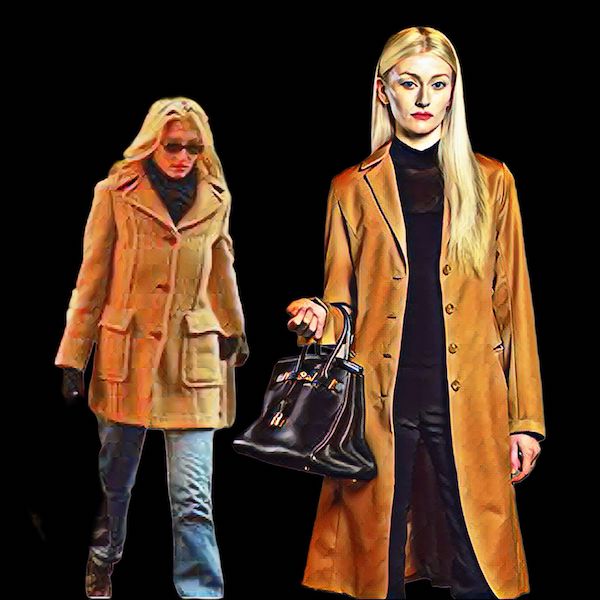

It’s ironic, then, that Ryan Murphy’s new series, Love Story, centered on the relationship between John F. Kennedy Jr. and Carolyn, was immediately criticized, based on just a few images, for failing to capture the spirit of CBK. The first costumes released were judged as pale, lifeless reproductions, like someone had done a “Carolyn costume.” What’s most frustrating is not the error itself, but the superficiality of the recreation—because Bessette-Kennedy was not just about what she wore, but how she wore it. It was in the contained gestures, the quick stride, the way she never carried a handbag as a status symbol but as if it were an extension of her own body. And we have yet to see whether the series will capture any of that.
For her fans, Carolyn cannot be imitated, only intuited. And any attempt to bring her back requires more than a wardrobe, wig, and shallow references. After all, Carolyn never wanted to be a symbol. But she became one. And she still teaches us today that true style isn’t what grabs attention. It’s what remains, even after the person is gone.
Descubra mais sobre
Assine para receber nossas notícias mais recentes por e-mail.
 miscelana.com