
After 45 years in the business, it’s safe to say that Tom Cruise has never feigned humility when it comes to wanting an Oscar. He has pursued the recognition of his peers with the same obsession that drove his stardom: giving everything, without pretending otherwise. After several attempts and snubs, it became clear—at least 20 years ago—that the statuette would only come in honorary form. Now that it’s official, and Hollywood will finally present him with an Oscar in 2025, there still lingers a sense that it’s somehow “lesser.” But is it really?
The Oscar is the symbolic apex of the film industry. For many actors and directors, it represents not just a trophy but an official stamp of artistic value, cultural relevance, and professional prestige. Over the decades, the golden statuette has transformed careers and cemented legacies. However, not all of cinema’s greatest names have won it the traditional way — and the Honorary Oscar, created as a form of belated or supplementary recognition, has become a noble remedy for the Academy’s systemic oversights.
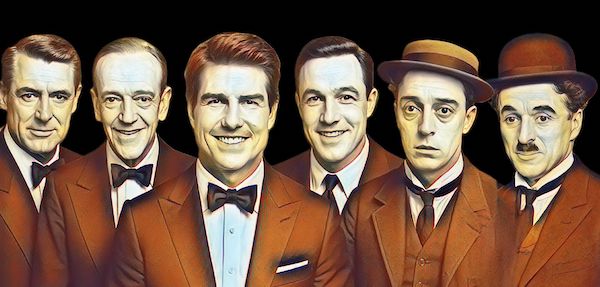
Receiving an Honorary Oscar is, on one hand, a privilege: it’s a tribute from one’s peers, an homage to a body of work, to a career’s lasting impact. On the other hand, it is also an inadvertent confession by the Academy that it failed that artist in due time. In that sense, Tom Cruise finds himself in even better company than his “competition.” The list of those who only received Oscars out of competition is arguably more impressive than the list of competitive winners: Charles Chaplin, Buster Keaton, Cary Grant, Gene Kelly, and Fred Astaire are just a few of the names standing alongside Cruise. Legends — greater than mere “stars” or “actors.”
The Glory of Recognition… With a Bitter Taste
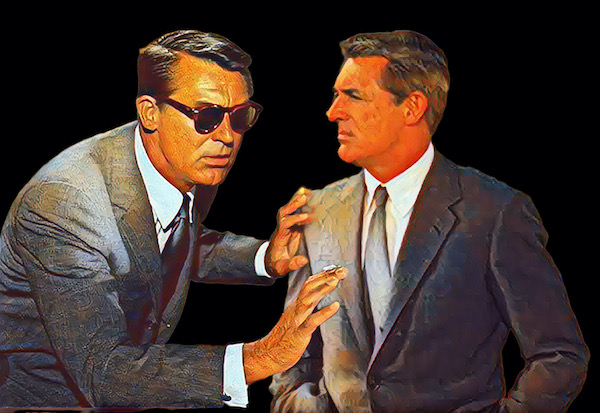
When Cary Grant stepped onstage in 1970 to receive his Honorary Oscar, the Academy wasn’t just correcting a glaring omission, but offering an elegant version of what many saw as a “consolation prize.” Grant, one of the greatest film stars ever, was only nominated twice during his career — and never won. A refined leading man, with impeccable comic timing and a striking presence in films by Alfred Hitchcock, Howard Hawks, and George Cukor, he was routinely overlooked for his subtle versatility. As if what he did seemed “too easy” — something we now understand to be the opposite.
Another emblematic case is Charles Chaplin, whose relationship with the Oscars borders on tragic. Exiled from the U.S. during McCarthyism, Chaplin was kept on the margins of the industry for decades. When he finally received his Honorary Oscar in 1972, he returned to America to a standing ovation. The ceremony, marked by emotion and twelve uninterrupted minutes of applause, was a public act of reparation — but also a belated acknowledgment that Chaplin, one of the pillars of modern cinema, had been neglected while others collected annual trophies.
A similar pattern emerged with Peter O’Toole, star of Lawrence of Arabia, who initially refused his Honorary Oscar in 2002, saying he was still alive and working, and would rather win “the traditional way.” The Academy insisted. O’Toole, nominated eight times without a win, eventually accepted the award graciously — but made the wound clear.
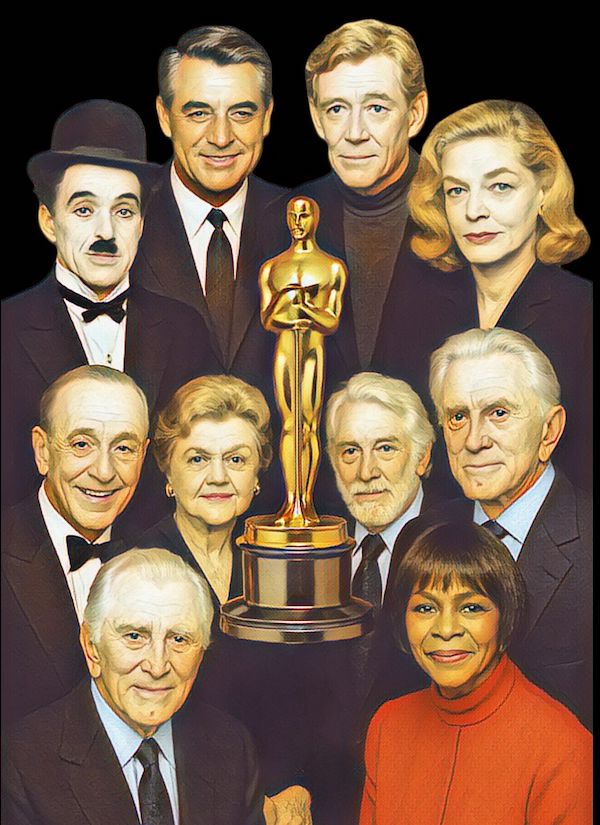
Other names, surprisingly Oscar-less, include Fred Astaire and Gene Kelly, two of the greatest icons of the Golden Age of musicals. Astaire, who revolutionized the cinematic language of dance with his fluid elegance and technical precision, was never even nominated for a competitive Oscar, despite unforgettable performances in Top Hat and Swing Time. He received only an Honorary Oscar in 1950, which many regard as an incomplete reparation for an artist who defined a genre.
Gene Kelly, in turn, also never won a competitive Oscar as an actor or director, despite co-directing and starring in Singin’ in the Rain, one of the most influential films in history. His only Oscar came in the form of a special award in 1952 “for his versatility as an actor, singer, director and dancer, and specifically for his brilliant achievements in the art of choreography on film.” The lack of competitive recognition for both men underscores the Academy’s longstanding bias against musicals and physical performances, which are rarely deemed “serious” enough for the golden statuette. In Cruise’s case, many argue it’s because he was too openly eager. Would it have helped if he’d pretended not to care?
True Value: Lifetime Achievement vs. Yearly Victory
Paradoxically, the Honorary Oscar may endure longer than many competitive awards. Who still remembers who won Best Actor in 2011? But everyone knows Kirk Douglas, Lauren Bacall, and Angela Lansbury were honored for their careers as a whole. The annual win rewards an isolated performance, often shaped by campaigns, marketing, internal politics, and cultural timing. The Honorary Oscar, however, celebrates a trajectory, a body of work, an indelible mark.
Still, there’s an inherent duality in such honors: they represent both ultimate artistic value and institutional failure to recognize it in real time. When Diane Warren, a songwriter nominated over ten times without winning, was finally honored, the Academy acknowledged her talent — but also admitted a cycle of systemic disregard. The same goes for directors like Akira Kurosawa and Satyajit Ray, both revered outside of Hollywood but remembered too late by the Academy.
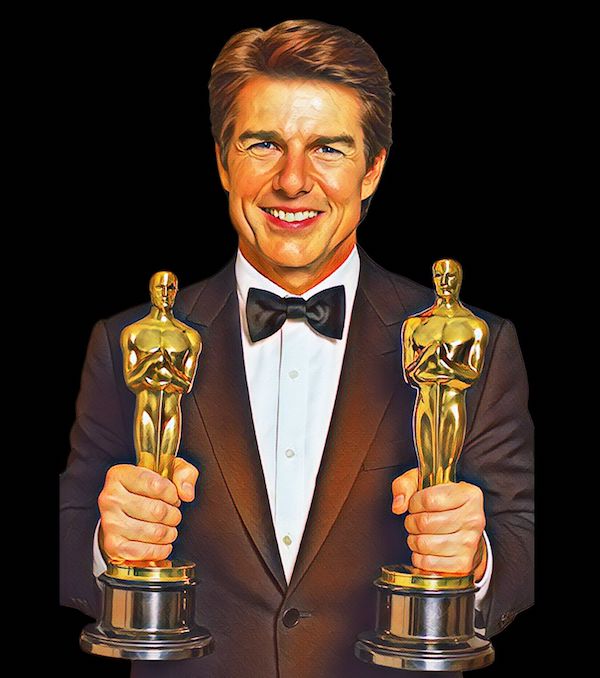
Tom Cruise: Paul Newman’s Heir?
The recent choice to award Tom Cruise an Honorary Oscar in 2025 reopens this debate. A global star, a box office fixture for over three decades, Cruise is also an influential producer and a symbol of resistance to the streaming takeover. His films have defined generations, and with Top Gun: Maverick, he was hailed by many as the savior of movie theaters post-pandemic. From that point, it was only a matter of time before Hollywood made the tribute official.
He’s been nominated three times, but his merits have often been credited to “charm” or “commercial appeal,” while more introspective or daring roles ended up earning others the prize. The Honorary Oscar signals undeniable admiration for his historical relevance — and perhaps, as with Paul Newman, a chance for Cruise to win a competitive Oscar later in his career. That’s my bet.
Newman is the classic model for this path: nominated countless times, he received the Honorary Oscar in 1986 and then won Best Actor in 1987 for The Color of Money — a film inferior to many of his previous ones, but which served as a form of belated compensation. Oh, and who starred alongside him in that film? Yes, Tom Cruise.
Who Was the Greatest Injustice?
Answering this involves both critique and emotion. Cary Grant is a strong candidate, having suffered from prejudice against comedy and physical beauty. Chaplin is inevitable, given his towering legacy and political ostracism. Tom Cruise, still active, may yet reverse his fate — but the fact that his win comes via an honorary award reveals a historical cycle that continues.
Other key names include Peter O’Toole, Deborah Kerr, Glenn Close (still alive, still Oscar-less), and Richard Burton. It’s a long list that exposes how the Oscars, though prestigious, have never been a fully fair system.

Between Tribute and Debt
The Honorary Oscar is both an applause and an apology. It is the crowning of those who survived trends, campaigns, lobbying, and institutional forgetfulness. To the public, it may seem the noblest of victories. But to many artists, it arrives as a distant echo of something that should have come earlier.
In the end, legacy is what remains. And in that sense, many of the greatest names in cinematic art have “won” — with or without a competitive statuette. There’s a subtle difference here: to receive the honorary award, one must already be in the realm of legend — and let’s face it, that’s a far more competitive league. Tom Cruise is already among those who have changed the entertainment industry. He got what he always wanted. Only the Oscar was missing. Let it be the first of more to come.
Descubra mais sobre
Assine para receber nossas notícias mais recentes por e-mail.
 miscelana.com