
Alongside Lizzy, Jane, Lydia, and Kitty, Mary Bennet has always seemed out of place. In Pride and Prejudice, Jane Austen’s 1813 novel, Mary is the middle daughter — and perhaps the most forgotten. Her brief portrayal, often comical and unflattering, reduces her to a pedantic, moralizing, and tone-deaf young woman whose presence exists almost exclusively to highlight her sisters’ charm.
But what happens to the women who are never chosen? Who grows up without the charm to dance through life’s ballrooms? This is the central question of Janice Hadlow‘s 2020 novel, The Other Bennet Sister, which reimagines Mary’s journey with empathy, depth, and newfound protagonism. Now, that reinterpretation is coming to the screen in the highly anticipated BBC series, set to premiere in 2026, starring Ella Bruccoleri in the lead role and a stellar cast including Ruth Jones, Richard E. Grant, Indira Varma, and Richard Coyle.
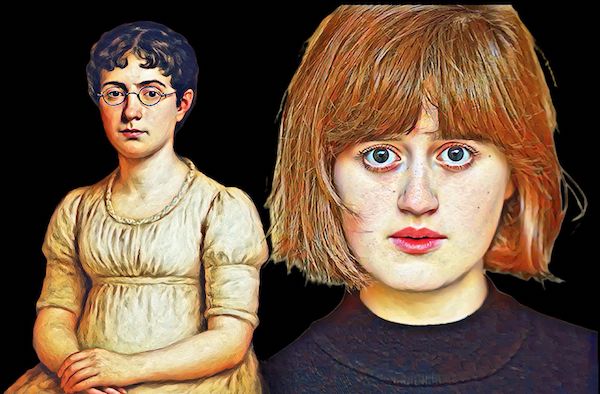
Austen’s Mary: a silhouette on the margins
In the original text, Mary is the opposite of the celebrated Bennet sisters. While Jane dazzles with her beauty and Lizzy with her wit, Mary retreats into books, moral aphorisms, and long musical performances that try everyone’s patience. Austen describes her with gentle irony — she is a sort of “pseudo-scholar,” who believes in the virtue of study but lacks social sensitivity. The character barely moves within the plot: she has no suitors, no memorable lines, no redemption arc. She quite literally stays in the corner of the ballroom.
Yet this lack of brilliance is also an uncomfortable presence. Mary represents a kind of femininity that doesn’t fit in: lacking beauty, charm, or popularity, but still full of desires and wounds no one seems to notice. And it is in this silence that The Other Bennet Sister finds its raw material for reconstruction.
Janice Hadlow’s book: Mary in her own voice
Published in March 2020, The Other Bennet Sister begins with the same events as Pride and Prejudice, but offers a more intimate and melancholic lens. Rather than mock Mary, Janice Hadlow asks: what if she were simply trying, desperately, to find a place in a world that scorns her difference?
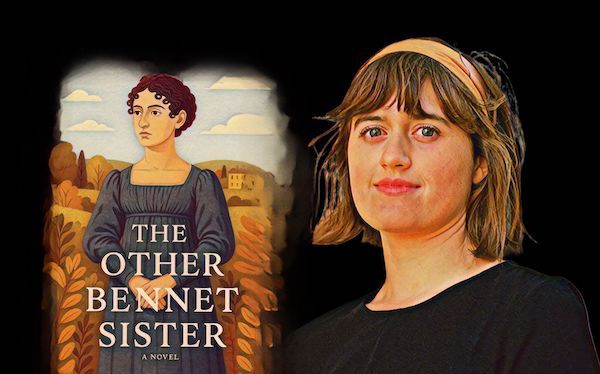
The novel follows Mary from childhood, where she is constantly compared to and faces her own mother’s veiled disdain. Her “choice” of books and rigid virtues isn’t a calling, but a defense: a way to exist when all other paths seem closed. When Lizzy and Jane depart for their happy marriages, Mary stays behind — alone, stifled in Longbourn, denied even the solace of rebellion. This is where Hadlow’s novel stands out: it continues the story, allowing Mary to leave the family home to live, work, suffer, love — and, ultimately, become a whole woman, not merely “the fifth sister.”
The BBC series: expansion and repair
The television adaptation of The Other Bennet Sister, produced by Bad Wolf for the BBC and BritBox, is currently filming in Wales and will air in 2026. Written by Sarah Quintrell and directed by Jennifer Sheridan and Asim Abbasi, the series delves deeper into Austen’s universe, creating new characters and settings to flesh out Mary’s journey.
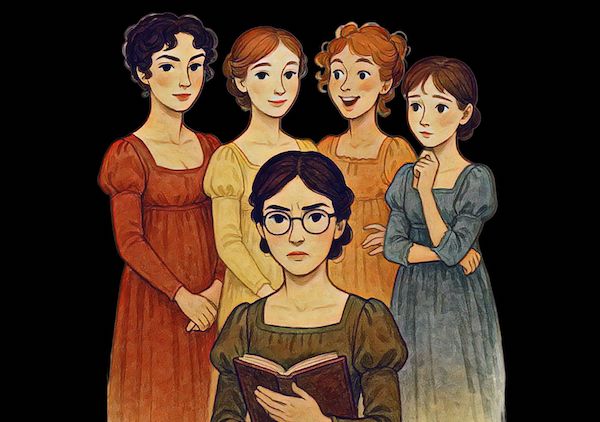
In the story, she becomes the governess of her aunt and uncle Gardiner’s three children (played by Indira Varma and Richard Coyle) and begins to circulate in a more stimulating world, far from Longbourn’s disdain and pressures. There, she meets characters like Mr. Hayward (Dónal Finn), Mr. Ryder (Laurie Davidson), and Ann Baxter (Varada Sethu) — all new to the Austen canon, but designed to broaden Mary’s emotional and intellectual horizons. At last, she is seen, desired, challenged — and, above all, heard.
The cast also features Richard E. Grant and Ruth Jones as Mr. and Mrs. Bennet, with Poppy Gilbert as Lizzy, Maddie Close as Jane, Grace Hogg-Robinson as Lydia, and Molly Wright as Kitty. The series promises to reframe the narrative focus, elevating the perspective of someone who’s always lived in the margins.
Why Mary matters today
The decision to reclaim Mary Bennet in the 21st century is no accident. She embodies the many women who don’t fit traditional ideals of femininity: not beautiful, not rebellious, not easily loved. Her story is one of invisibility, but also of quiet resilience. Mary tries to be worthy of love without ever having learned what it means; she tries to be good in a world that never offered her tenderness.
By rewriting her, both Janice Hadlow and the BBC reveal the transformative power of listening and reinterpretation. Instead of ridiculing the girl who quotes proverbs aloud, they ask what happens after all the weddings are over — and what lies beyond the role of a supporting character. Mary Bennet, at last, ceases to be “the other” and becomes herself.
Descubra mais sobre
Assine para receber nossas notícias mais recentes por e-mail.
 miscelana.com