
For Generation X, stepping into the ocean and thinking of just two musical notes is enough to spark panic. That’s because, 50 years ago, on June 20, 1975, a film hit American theaters that would change everything when Jaws premiered in American theaters. No one expected it to become a landmark. Adapted from Peter Benchley’s novel, published just a year earlier, the film went through a troubled production, plagued by technical issues, a blown schedule, and a young, virtually unknown director. Yet, against all odds, Jaws became the highest-grossing film of its time, ushering in a new era in American cinema: the summer blockbuster. It also catapulted Steven Spielberg into stardom.

The project originated from the book’s rapid success, which caught the attention of Universal Pictures. At just 26, Spielberg had made an impression with Duel (1971), a tense and inventive TV movie about a man being chased by a truck on a deserted highway. Universal executives saw potential in the young director to handle a suspense narrative centered on an unseen predator. Still, Jaws was his first experience with a major studio and ocean-based locations — a logistical challenge that nearly derailed the project.
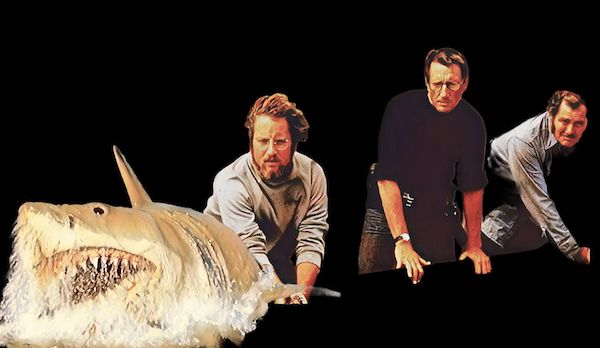
The mechanical shark built for the film, nicknamed “Bruce” by the crew (after Spielberg’s lawyer), malfunctioned constantly and required endless repairs. As a result, Spielberg had to drastically rethink his approach: instead of showing the monster in full, he suggested its presence through camera movements, music, and the characters’ reactions. That limitation became the film’s greatest strength. With a masterful blend of silence and suspense, Spielberg turned the unseen into something terrifying — a technique reminiscent of Hitchcock that redefined psychological horror.
The score, composed by John Williams with its low, repetitive notes, became synonymous with impending danger — essentially giving the shark a “voice.” Williams won an Oscar for the score and began one of the most iconic collaborations in cinema history with Spielberg.
Released in over 400 theaters — an extraordinary number at the time — Jaws was promoted through a nationwide campaign, including prime-time TV commercials. That, combined with explosive word of mouth, led to a global box office take of over $470 million. It dethroned The Godfather as the highest-grossing film ever, a title it held until Star Wars arrived two years later.
More than a commercial success, Jaws had a lasting cultural impact. It created a collective fear of the ocean, popularized the concept of the “event movie,” and became a constant pop culture reference — from The Simpsons to Stranger Things. It spawned several sequels (none of which matched the original) and pioneered the concept of a film franchise, incorporating merchandising, a signature soundtrack, and wide release strategies.

For Spielberg, Jaws was a definitive ticket into Hollywood’s elite. Though he faced some critical snubbing in the following years — like many blockbuster directors — today he’s recognized as one of the greatest filmmakers of all time, and Jaws as his first masterpiece. The film didn’t just define his visual style — using the camera as a subjective presence, capturing childlike wonder in the face of the fantastic, blending scale and humanity during chaos — it also launched a filmography that would reshape American cinema for decades.
Half a century later, Jaws remains frightening, engaging, and technically impressive. It’s a rare case of a work born out of creative constraints and technical mishaps that ended up transforming an entire industry. If summer today is dominated by tentpole releases, if trailers drop months in advance, and if studios bet on global box office as the final word — it all began with a shark that barely worked. And with a young director who saw in invisible fear the perfect opportunity to reinvent suspense — and make history.
Descubra mais sobre
Assine para receber nossas notícias mais recentes por e-mail.
 miscelana.com