
In recent months, two films about music icons premiered with opposite trajectories. Homem com H, a biopic of Ney Matogrosso, became a massive box office success in Brazil, carried by the power of the songs that marked generations and the timeless charisma of its protagonist. Meanwhile, “A Complete Unknown,” about Bob Dylan, directed by James Mangold and starring Timothée Chalamet, continues to receive acclaim and is now available on streaming platforms. Two biopics, two styles, two promises of diving into enigmatic artists — yet both only dip their toes in the water.
The musical biopic has become an autonomous subgenre in recent years. As such, it brings with it recurring pitfalls: lots of music, little substance; an emphasis on the artist’s physical “imitation,” rather than an attempt to reach their soul; scripts increasingly dictated by heirs or the music industry. The result? Flashy films that please fans and award circuits but often fail at the biopic’s simplest and hardest task: telling the truth.

Ney Matogrosso and Bob Dylan never met, nor did they align musically — Ney, a tropicalist and aesthetic libertarian; Dylan, a cryptic folk bard, singer of ambiguous, anti-autobiographical lines. Yet both are figures of mystery and rupture. Divisive. Eccentric. They built themselves in opposition to convention. Perhaps that’s exactly why they’re difficult artists to portray on screen. And Homem com H and A Complete Unknown, each in its own way, show how much easier it is to stage their surfaces than to face their depths.
The film about Ney has the energy of a concert, but the structure of a music video. It is generous with musical numbers — sometimes even excessively so — and succeeds in showing the artist’s impact on Brazil’s cultural scene. But in trying to balance the public persona with the private story, it slips into a superficiality that undermines the whole. The conflict with his repressive father is recurrent but underdeveloped. The arc of his first, tragic, and formative love is left behind. His bold and unconventional musical choices — from Secos & Molhados to his more experimental, androgynous phase — are not explored. Ney moves through cities, artistic phases, and emotional transformations… but the film seems to follow without truly investigating. It’s as if we’re always on the other side of the mirror, admiring the image without daring to shatter it.

The comparison with Cazuza — O Tempo Não Para is inevitable, and it highlights this fragility. There, the portrait of the singer — though shaped by his family’s approval — is more forceful. Cazuza, in the Matogrosso film, appears as contradictory, impulsive, loving and cruel, talented and self-destructive. There is affection and friction. In Homem com H, Ney Matogrosso moves through the years with an almost mythical aura, as if he emerged fully formed. Cazuza appears as a vibrant character, in constant conflict; Ney, as a symbol in perpetual reverence. Even Cazuza’s presence in Homem com H feels perfunctory, shallow. And that weakens not only the portrayal of his peer but the artistic and political environment in which Ney lived and was shaped.
Across the ocean, A Complete Unknown aims to avoid exactly that kind of beatification. By focusing on a single moment in Dylan’s life — his controversial transition from acoustic folk to electric guitar in 1965 — Mangold tries to craft a more impressionistic portrait. The film doesn’t aim to tell Dylan’s entire life story. It wants to understand him at a moment of rupture. It’s a valid, even courageous choice. But it runs into a similar impasse: in avoiding the trap of chronology, it also skips over central aspects of the artist’s personal life. His girlfriend and future wife, Sara Lownds, for example, is either ignored or reduced. The impact of his relationships, his losses, his creative crises — all are left on the sidelines. The songs, once again, take the space that emotion never quite fills.

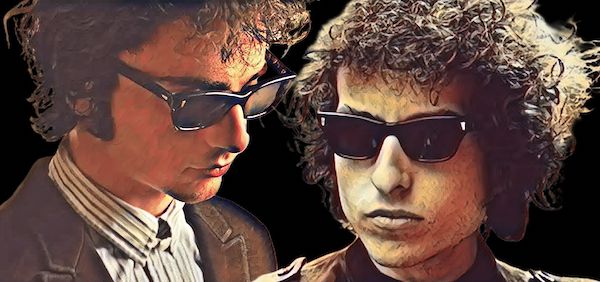
Timothée Chalamet delivers a meticulous performance, but it’s still hard to tell if he found Dylan or merely his silhouette. And perhaps the film didn’t help: by wrapping itself in reverence for the public figure, it avoids touching on the more ambiguous zones. Dylan, after all, always resisted self-definition. But resisting self-definition shouldn’t be an excuse for cinema to resist looking deeper.
That’s why Rocketman (2019) remains the most honest and cinematic example among recent musical biopics. Dexter Fletcher’s film about Elton John wasn’t afraid of excess or pain. It mixed fantasy and trauma, unbound by chronology or documentary fidelity. It was less biographical in the strict sense and more emotionally truthful. The songs didn’t interrupt the narrative — they were part of it. Each musical number was a window into what the protagonist couldn’t verbalize. And Elton wasn’t presented as a hero or victim, but as someone fractured.
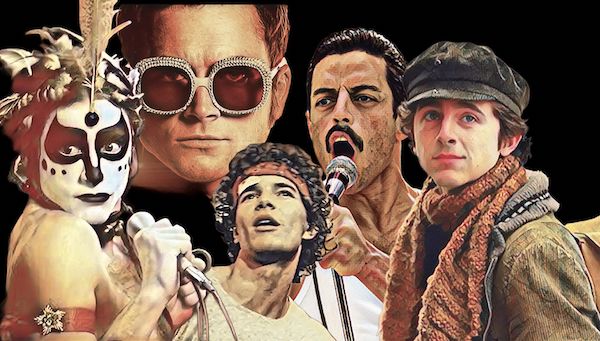
Bohemian Rhapsody, on the other hand, is perhaps the most emblematic example of the subgenre’s contradictions. Award-winning, beloved by audiences, and praised for Rami Malek’s Oscar-winning performance, the film about Freddie Mercury seems more concerned with pleasing than with understanding. The narrative is sanitized, the protagonist’s internal conflicts are softened or displaced, and moments of greatest pain — like the discovery of his AIDS diagnosis or his relationship with his sexuality — are handled with almost commercial caution. The music, once again, is glorious, but it acts as a smokescreen for the story’s silences. Unlike what Freddie used to do on stage, the film refuses to provoke. Instead, it delivers a domesticated portrait, where the myth is packaged for easy consumption — and the real man gets lost in the sound.
Another title impossible to ignore in this context is Elvis, by Baz Luhrmann, which wrapped the biopic of the King of Rock in a lavish visual spectacle — but also a biased one. Austin Butler’s hypnotic performance was widely praised, but the script avoids deeper conflicts, particularly regarding Elvis’s complicity with the structural racism of the American music industry, his substance abuse, and the controlling role of Colonel Tom Parker — who, ironically, narrates the film. The result is another biopic where style overpowers substance, and the staging of legend eclipses the complexity of the man behind the myth.

This fracture — which should be the essence of any biopic — seems to have been avoided in both Homem com H and A Complete Unknown. Ney Matogrosso, with all his intensity, remains an admired enigma. Dylan, with all his opacity, remains a respected enigma. But the films show no cracks. No shadows. And maybe that’s exactly what’s missing: less spectacle, more risk. Less performance, more truth.
In these films, music functions as seduction — but also as a curtain. And when the soundtrack replaces conflict, cinema gives way to hollow celebration. Ney and Dylan are artists who turned pain, repression, and contradiction into art. But their films, out of fear or strategy, seem to turn them into already-digested characters. The audience applauds. Critics admire. But the question remains: what exactly was revealed to us?

For now, we have two films that remind us of the greatness of their subjects — but that lack the courage to peel off their masks. And if biographical cinema truly wishes to illuminate what lies behind legends, it must first shed its fear of disappointing. After all, it’s not just the music that tells the story. It’s the silence between the verses.
Descubra mais sobre
Assine para receber nossas notícias mais recentes por e-mail.
 miscelana.com
1 comentário Adicione o seu