
This week’s recap of And Just Like That could be summarized in just a few lines, but entire paragraphs are needed to address the unraveling of Miranda Hobbes in the Sex and the City universe. Never exactly a fan-favorite character—though brilliantly portrayed by Cynthia Nixon—Miranda has undergone an incomprehensible transformation for years, even before AJLT.

This week’s episode hinted at the next emotional curveballs: Aidan may have some competition with the arrival of Carrie’s new neighbor, a man who perfectly fits the mold of her favorite type—intellectual, rich, famous, and emotionally unavailable. A renowned writer whose biographies include Winston Churchill and Henry VIII, he’s somehow unknown to Carrie, the group’s only journalist. Not knowing him makes us question her talent—or even her intellect. The big clue that she’ll fall for him? He splits his year evenly between New York and London. Why wait five years for the guy from Virginia?
Their “meet-cute” is built around a nuisance: he’s irritated by the sound of Carrie’s heels (another man trying to change her?), and she tries to win him over with a basket of goodies and her usual charm. They’ve already found common ground—besides the literal garden: the books they’re both writing. Aidan doesn’t stand a chance.
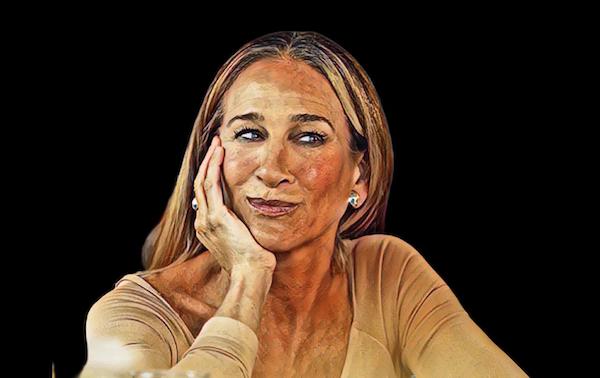

Seema is at a low point after losing her job, but the flirtation-friendship with her gardener may hint at a new personal chapter. Lisa is in a similar peripheral danger, admitting to Charlotte that she has a crush on her new editor.
Speaking of Charlotte, I’m still worried about Harry. After seeing leaked footage of a funeral scene, I panicked at the thought of another widow in the group. Harry assures Charlotte—and us—that the prostate cancer he’s been diagnosed with is treatable, though he seems unconvinced himself. Charlotte’s insensitivity in venting to Carrie that she doesn’t know how to live without her husband—and Carrie’s complete lack of emotion or even mention of Mr. Big—reveal that behind the scenes, the team remains “against” Chris Noth. It’s a shame from a storytelling perspective.


And then there’s Miranda, the most criticized element of the franchise since she took on a larger role—something that began to deteriorate as early as the films. In the original series, Miranda was the successful, rational, independent, and arguably most mature of the four friends. Her arc was about letting her guard down and falling in love with the improbable guy. It was beautiful.
But Miranda has become a walking contradiction: she crushed Steve’s self-esteem out of her own frustrations over giving up her career and life in Manhattan for her family. Instead of sensitively exploring that conflict, the writers turned her into a runaway train. Everything she once found wrong in Steve now mirrors how she treats others. For three seasons, she’s been a nomad crashing in other people’s homes. Seriously? She’s worked at the UN for at least two seasons—she could easily rent, if not buy, her own place.
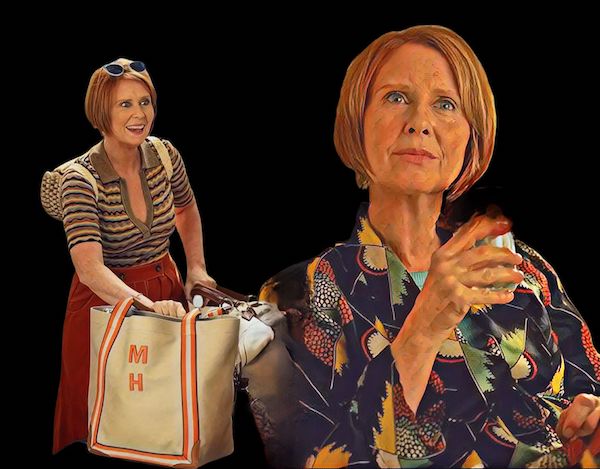
Now she has a decent and interesting girlfriend, but hasn’t moved in fully (where even the dogs rejected her), and was recently staying at an Airbnb, where she felt threatened by a neighbor who listens to heavy metal naked. Then she moves into Carrie’s home, barging in loudly, leaving clothes everywhere, borrowing items, raiding the fridge, treating the expensive new dinner table as both dining room and office—making a mess of it all—and, if that weren’t enough, walking around naked. None of it is endearing. None of it is funny.
Why has Miranda become the most problematic character of all? Carrie remains numb, Charlotte retains a consistency the others lack, and is about to face a somber new personal chapter—but Miranda?
The clearest sign of Miranda’s narrative misfire is that everyone who comes into her orbit is written off: Che, Nya, Steve, and even her son. She’s become a chaotic sixty-something with zero sense of boundaries or manners—the exact opposite of who she was for decades. Honestly, do we still need her?

The current portrayal of Miranda is more than just a writing misstep — it’s a symptom of a broader identity crisis within the series itself. As And Just Like That tries to modernize and reflect contemporary times, it seems to mistake character evolution for the complete dismantling of a character’s essence. Miranda, who for decades stood for rationality, ambition, and even a quiet tenderness, has now become an incoherent caricature — directionless, graceless, and lacking any sense of self-awareness.
What’s truly at stake isn’t just our empathy for her, but the integrity of a narrative that once gave us flawed yet deeply authentic women. If everything Miranda once represented can be discarded in favor of clumsy storytelling choices or poorly integrated agendas, how can we trust the future of any character in this world?
In the end, perhaps the question isn’t whether we still need Miranda. The real question is: do the writers even remember who she was?
Descubra mais sobre
Assine para receber nossas notícias mais recentes por e-mail.
 miscelana.com