
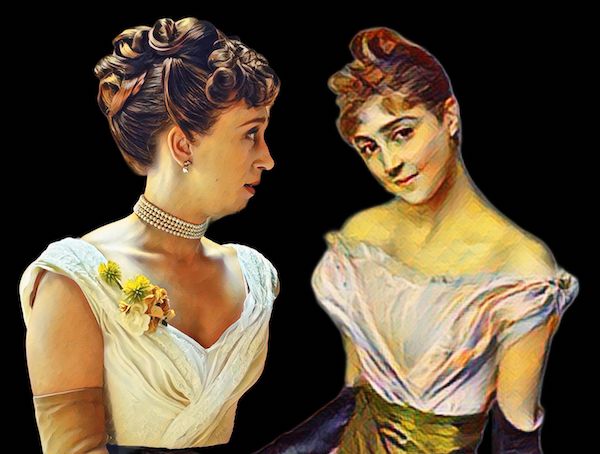
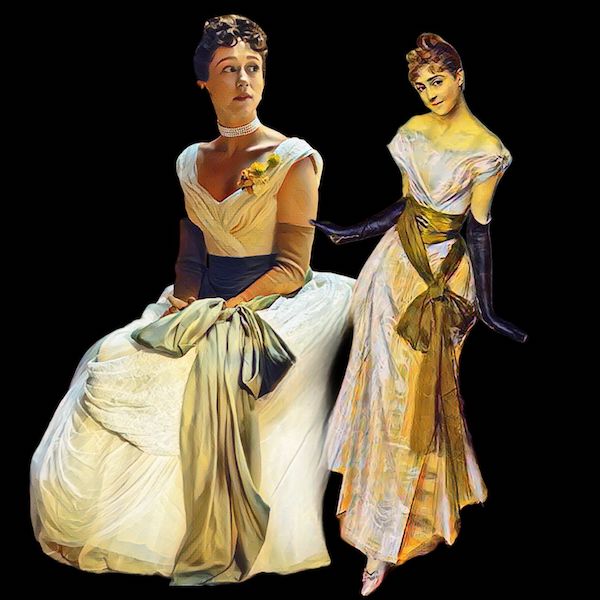
In the latest episode of The Gilded Age, viewers witness a symbolic turning point in the life of Gladys Russell: the formal presentation to New York society of her portrait by none other than John Singer Sargent, the most sought-after painter of turn-of-the-century elites. Known for her free spirit and resistance to the arranged marriage imposed by her mother, Gladys appears again in a white satin dress with a green sash and black gloves — an image that instantly evokes the quiet, penetrating elegance of a true Belle Époque muse.
The curious — and revealing — detail is that the dress worn by Gladys is not a fictional creation of the show’s costume designer, but rather a faithful replica of one immortalized by Giovanni Boldini, Sargent’s stylistic rival, in one of the most iconic female portraits of the 19th century: that of “Signorina Concha de Ossa,” painted in 1888. Here, fiction and history meet with subtle precision.
Emiliana Amelia Concha de Ossa: The South American Muse of Paris
Born in Valparaíso, Chile, in 1862, Emiliana Amelia Concha de Ossa was the daughter of one of the country’s most powerful and visionary men: Melchor Concha y Toro, a businessman, liberal politician, and founder of the now-famous Concha y Toro vineyard. Her mother, Emiliana Subercaseaux, came from a traditional aristocratic family with Spanish roots, ensuring Emiliana access not only to wealth but to a cultivated, cosmopolitan environment.
As a teenager, Emiliana was sent to Paris, as was common among Latin American elites at the time, to complete her education in arts, music, and languages. She quickly stood out not only for her exotic beauty—long—limbed, with delicate features and graceful poise—but also for her intellect and discretion, which opened doors to the artistic and social salons of the French capital.
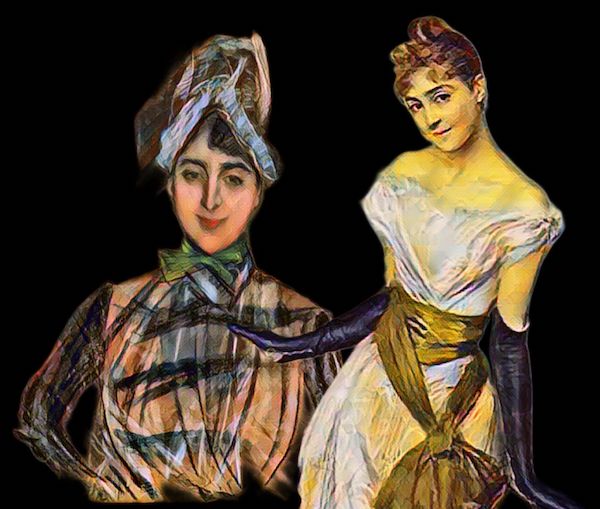
It was in this refined setting that she met the Italian painter Giovanni Boldini, already renowned among Europe’s aristocracy and haute bourgeoisie. Between 1887 and 1889, Emiliana posed for him several times, but the most celebrated portrait — the one that would secure her place in art history — was the “White Pastel” (1888), also known as the portrait of Signorina Concha de Ossa. Monumental in size (approximately 220 x 120 cm), the painting depicts Emiliana in a shimmering white gown, surrounded by an atmosphere of motion and softness, symbolizing the ideal of modern femininity. Displayed at the 1889 Paris Universal Exhibition, the portrait won a gold medal and solidified Boldini’s international fame.
On the right side of the composition, a secondary figure — possibly a maid — watches the model, adding a layer of theatricality and social hierarchy to the scene.
From Muse to Matriarch
Despite her prominence in the Paris art scene, Emiliana never severed ties with Chile. In 1889, shortly after the portrait’s success, she married Luis Gregorio Ossa Browne, a member of Chile’s economic elite. The couple frequently returned to their home country and maintained close ties to the Concha y Toro vineyard, which to this day remains active near Santiago as a popular wine destination and historical landmark.
Her married life appears to have been stable and free from public scandal. Still, Emiliana kept a low profile, avoiding the extravagances of European courts, which contributed to her gradual fading from the public eye in the early 20th century. She died in Lausanne, Switzerland, in 1905, at the age of 43, from a pulmonary infection — possibly tuberculosis, a common and tragic fate among women of her class and era.
Emiliana and Gladys: Parallels Across Time
The parallels between Emiliana Concha de Ossa and The Gilded Age’s Gladys Russell are more than aesthetic — they are narrative. Both are heiresses of vast fortunes, daughters of controlling matriarchs, living between the old and new worlds. Both stand out for their subtle grace and desire to shape their own destinies in a world where marriage was both a financial contract and a social rite. Above all, both used art — or were used by it as a means of self-expression and social affirmation.

In the series, Gladys — who refuses to passively accept a marriage arranged by Bertha Russell — is introduced to the elite through her image transformed into art. The painting, attributed to Sargent, is visually inspired by the dress worn by Emiliana Concha de Ossa in Boldini’s 1888 portrait, but with a witty twist: in real life, Sargent and Boldini were rivals — and in this fictional moment, the character is introduced to the world through a portrait falsely credited to one, but clearly modeled after the style of the other.
Thus, The Gilded Age offers more than a visual homage — it revives a historical feminine archetype: women poised between tradition and modernity, portrait and autonomy. Emiliana Concha de Ossa, immortalized in white by Boldini, continues to speak through the centuries — now, through the lens of fiction.
Descubra mais sobre
Assine para receber nossas notícias mais recentes por e-mail.
 miscelana.com