
Bernardo Joaquim da Silva Guimarães was born 200 years ago, in 1825, in Ouro Preto (MG) and died in the same city in 1884. A lawyer, magistrate, professor, poet, and novelist, Guimarães is regarded as one of the leading figures of Brazilian Romanticism. He studied law at the prestigious São Paulo Law School and befriended key literary figures, including José de Alencar and Álvares de Azevedo.
He published 17 works, but his most famous novel remains A Escrava Isaura (The Slave Isaura), released in 1875—13 years before the Lei Áurea, which formally abolished slavery in Brazil. The book was a commercial success and contributed to the abolitionist climate of the time, though its historical contribution remains controversial.
The novel tells the story of Isaura, the daughter of a Black enslaved woman and a white overseer, Miguel. Isaura is raised as a lady by the wife of her owner, Comendador Almeida, and is promised freedom. But upon the Comendador’s death, her son Leôncio inherits both the estate and Isaura, whom he desires and refuses to free. Isaura’s drama, caught between servitude and her appearance as a white woman, forms the emotional and symbolic core of the story.
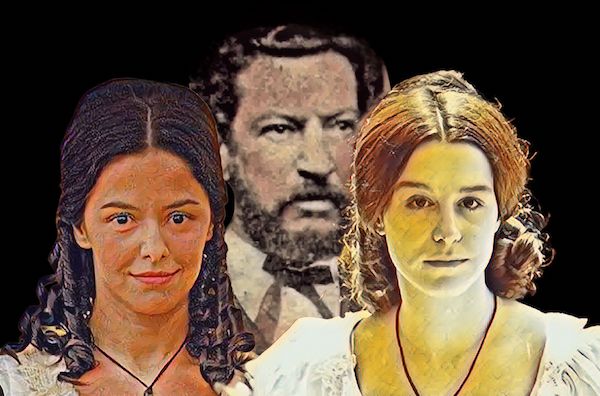
Bernardo Guimarães did not have Black ancestry, and his own racial position in 19th-century Brazilian society was that of a white intellectual embedded in the dominant ideology. According to his grandson, the historian Armelim Guimarães, the idea for Isaura emerged after Bernardo witnessed a public flogging in the 1870s. Still, the choice to make Isaura a “white slave” was deliberate—and strategic. In a society still economically reliant on slavery, portraying a dark-skinned Black woman as a romantic heroine would have been unthinkable for a wide readership at the time.
“Had Isaura been portrayed as a dark-skinned Black woman, the book would never have achieved such widespread success,” wrote Armelin in a 1998 essay. Indeed, Isaura’s European appearance—white skin, delicate features, light enough to “pass”—was crucial to the book’s appeal and its later international adaptations. Her suffering, more palatable to white readers, served as an allegory for slavery while maintaining racial distance.

This romanticization of slavery reached its peak in 1976 with the soap opera Escrava Isaura, adapted by Gilberto Braga and directed by Herval Rossano. Originally suggested by Braga’s literature teacher, the project updated the story for Brazilian television, with some changes and new characters.
Actress Lucélia Santos, then only 19, was cast as Isaura. Her performance became iconic, and the show broke audience records in Brazil and abroad. At its height, the soap opera reached over 80% of Brazilian televisions and became the most exported Brazilian telenovela for over two decades. It was sold to 80 countries, including China, Poland, Cuba, and South Africa, and reportedly caused ceasefires during conflicts so people could watch.
Its theme song, “Retirantes,” with lyrics by Jorge Amado and music by Dorival Caymmi, became unforgettable. Lucélia Santos became an international star. Meanwhile, actor Edwin Luisi (Álvaro, Isaura’s liberator) was welcomed like a rock star in Cuba. Fidel Castro reportedly lifted energy rationing so the population could watch.
Yet, for all its reach, Escrava Isaura carries deep contradictions. Gilberto Braga himself had to navigate censorship during Brazil’s military dictatorship. Terms like “slave” were censored and replaced with “piece.” Scenes of cruelty had to be softened or implied. Even the suicide of the villain Leôncio had to be rendered ambiguous.
More troubling, however, is the representation of Isaura as a victim whose suffering is aestheticized and “acceptable” due to her whiteness. Scholars like Luciana Barros Góes have critiqued the show as a “romanticized portrayal of slavery,” where enslaved people are portrayed as passive and grateful to white saviors. The final scene of the soap opera, in which Álvaro announces the slaves’ freedom and they celebrate beside their white masters, reinforces a Eurocentric historical narrative where Black agency is erased.

In 2004, the story was remade by Rede Record, again directed by Herval Rossano. This version followed a more Mexican telenovela structure, with dramatic plot twists and high emotion. Rubens de Falco and Norma Blum, the original Leôncio and Malvina, returned as the parents of the new villain. Yet the central contradiction remained: Isaura continued to be portrayed by a white actress.
Could Escrava Isaura be remade today with a Black or mixed-race actress in the lead role? The question opens a complex debate. Isaura is canonically described as light-skinned—so light, in fact, that she “could pass for white.” Casting a dark-skinned Black woman might contradict the original description, but casting a Black actress with light skin and fine features could align with the character while challenging long-standing industry norms that reserve major roles for white actresses.
Representation matters, and for many Black viewers and activists today, Isaura’s whiteness—despite her status as enslaved—is a symbol of how Brazilian media often minimizes Black suffering or centers it in white-passing characters. There is growing demand that, if the story is to be told again, it must also reflect the resistance, dignity, and agency of Black Brazilians during slavery—not just their victimization.
In retrospect, Escrava Isaura remains a paradox: a work that contributed to abolitionist awareness while reinforcing a sanitized, romanticized version of slavery. Its international success shows the universal appeal of the fight against oppression—but its aesthetic choices also expose Brazil’s ongoing struggle to confront its racial past with honesty and depth.
The original 1976 version is still available on Globoplay.
Descubra mais sobre
Assine para receber nossas notícias mais recentes por e-mail.
 miscelana.com
1 comentário Adicione o seu