
A gesture that set Reddit buzzing — and had nothing to do with overt drama. When Bertha Russell, in The Gilded Age, asks for Mr. Delancey’s calling card, it leaves viewers puzzled. After all, he was already in her home, and they had spoken and clearly knew each other. So what was the point?
It wasn’t a mere courtesy or polite gesture. It was a social move. A meticulously calculated act meant to assert power, accept an approach, and simultaneously send a message: I decide who enters my home — and my circle. What might seem like just another period detail in the series is, in fact, loaded with the weight of an entire culture built on appearances, conventions, and social codes that shaped the American elite at the end of the 19th century.

Calling cards were everything. They didn’t just organize social life — they drew the line between who was accepted and who was ignored. The famous calling cards were more than elegantly printed names: they were social passports. If someone new arrived in town — especially a lady — her first act was to distribute cards to the homes where she wished to be received. If her card was returned, the door was open for a visit, a friendship, perhaps even an invitation. If there was no reply, it was the silent version of “we don’t belong to the same world.”
But cards were also weapons. They were used to assert status, show disdain with elegance, and even manipulate alliances. A folded corner on a card can signal different intentions, such as condolences or congratulations. Even the tiniest details — who delivered the card (the person or a footman), and whether it was handed in person or left on a silver tray — carried precise meaning. It was a wordless chess game, where the paper said it all.
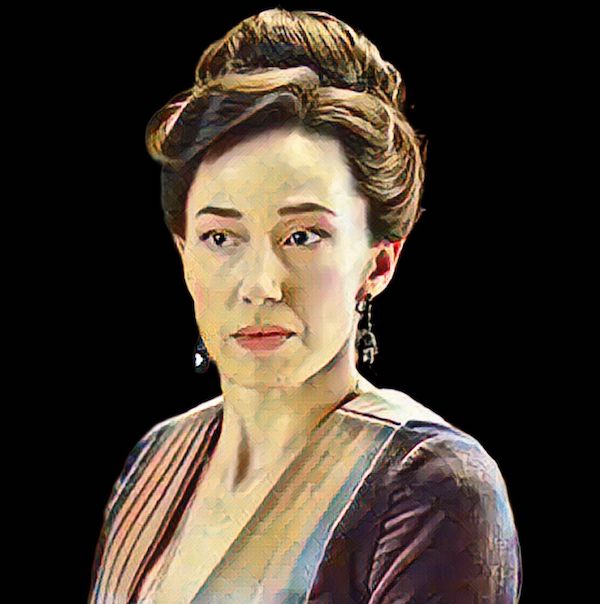
In Bertha’s case, asking for Mr. Delancey’s card is about more than courtesy. She is validating this man as someone worthy of entering her circle — the same circle she fights each episode to legitimize. He represents old society, or at least a bridge to it. When Bertha asks for the card, she’s sending a message: “I see value in you, and I want others to see you in my house.” And more: “I want them to see that you’ve chosen me too.”
It’s her way of rewriting the rules of New York society. As a newly wealthy outsider, Bertha can’t afford to misstep. Every card she gives, requests, or rejects is a strategic move. Unlike Mrs. Astor, who reigns from above, Bertha has to build her network carefully, one name at a time, event by event. And for that, she needs the cards — not just as invitations, but as social proof.
It’s fascinating to think about how we now live in the era of digital invites, RSVPs over WhatsApp, and events managed by algorithms. In the Gilded Age, everything was manual, artisanal, almost ceremonial. And perhaps because of that, every gesture mattered more. The paper had weight. The absence of a response spoke volumes. Acceptance was physical, tangible. A thick card, engraved with a name and delivered at the right moment, could mean everything: reputation, marriage, money, future.
And when we watch Bertha, always so calculating and composed, extend her hand to receive Delancey’s card, we understand: she’s far more interested in alliances than in affection. The card is just a detail — but it’s also everything. Because in that society, to be remembered started with being printed. And being printed was the first step toward being accepted.
Descubra mais sobre
Assine para receber nossas notícias mais recentes por e-mail.
 miscelana.com