
From his first appearance as the adult Aegon Targaryen, Tom Glynn-Carney faced a daunting task: portraying a character who, in George R.R. Martin’s Fire & Blood, is often painted as a weak, cruel, and unworthy king — a man drunk on power, hated by his subjects, and doomed to fall. A functional villain, written to be despised. But Glynn-Carney’s performance on HBO’s House of the Dragon does something remarkable: it does not excuse Aegon’s monstrosities, but it reframes them through the lens of human frailty. This Aegon is still dangerous, still unstable — but he is also lost, unloved, and trapped in a war he never asked for. In Glynn-Carney’s hands, Aegon becomes not just a tyrant, but a tragic figure.

Tom Glynn-Carney is no stranger to complex roles. A graduate of the Guildhall School of Music & Drama, he has performed Shakespeare’s Prince Hal on stage and appeared in Dunkirk (2017), The King, and BBC’s The Last Post. His background in theater is evident in his physical precision and emotional restraint. He doesn’t perform for effect; he simmers. As Aegon II, Glynn-Carney weaponizes discomfort. He walks with a slouch, recoils in his own skin, speaks with the unease of a man aware of his own inadequacy. His Aegon is not born to rule — he barely believes in the idea of himself.
In the books, Aegon is a caricature of royal failure — a petulant usurper propped up by his mother Alicent and grandfather Otto Hightower. His narrative purpose is largely to contrast with Rhaenyra’s legitimacy and charisma. But House of the Dragon offers something more nuanced, and Glynn-Carney seizes the opportunity. He crafts a portrait of a man broken long before he ever sat the Iron Throne — a neglected son, overshadowed by his brother Aemond, and shaped by a childhood devoid of love and full of expectation.
It’s visible in his coronation scene: a spectacle designed to legitimize him, but which he experiences as a private humiliation. His eyes dart with anxiety, his body stiffens in armor that doesn’t fit. This is not triumph — it’s entrapment. Glynn-Carney plays Aegon not as a man stepping into destiny, but as a boy cornered by it.

He infuses Aegon with a deeply unsettling volatility. One moment, he lashes out with drunken arrogance; the next, he falters into silence. The performance dances between bravado and collapse, crafting a character who is aware of his own shortcomings but unable — or unwilling — to change course. It’s in the flickers of shame after Lucerys’s death. In his tension around Rhaenys. In the way he alternately seeks validation and resents those who provide it.
In doing so, Glynn-Carney draws from the narrative gaps left by Fire & Blood — a book written, after all, as a history pieced together by unreliable narrators. The show leans into this ambiguity, and the actor fills it with a subtle, devastating psychology. Aegon becomes not just an antagonist, but a case study in emotional erosion. His cruelty is not born of sadism alone, but of fear, bitterness, and the ache of perpetual inadequacy.
This shift has profound implications for the story’s tone. Viewers who know Aegon’s fate — his ultimate fall, disgrace, and brutal death — now face a narrative tinted not just by justice, but by pathos. Glynn-Carney’s Aegon is not a monster to be slain, but a man to be mourned, if only for the tragedy of what he might have been. He is not Joffrey — gleeful in torment — but something closer to Theon Greyjoy: a fractured soul, dragged into darkness by forces both internal and inherited.


In this light, House of the Dragon doesn’t just deepen a character — it alters the entire emotional architecture of the Dance of the Dragons. With Aegon reimagined as a reluctant usurper, torn between the desire to disappear and the need to matter, the war loses some of its binary framing. Rhaenyra remains the rightful heir — but Aegon becomes more than just the usurper. He’s a symbol of what happens when power is forced on those least equipped to wield it.
Like Nikolaj Coster-Waldau’s Jaime Lannister before him, Glynn-Carney has taken a loathed figure and turned him into a narrative mirror. Through Aegon, we see the costs of patriarchy, the damage of parental projection, the hollowness of power. His performance is not a redemption arc — Aegon still makes horrific choices — but it is a reminder that evil, in Westeros as in life, is often born from wounds left to rot.
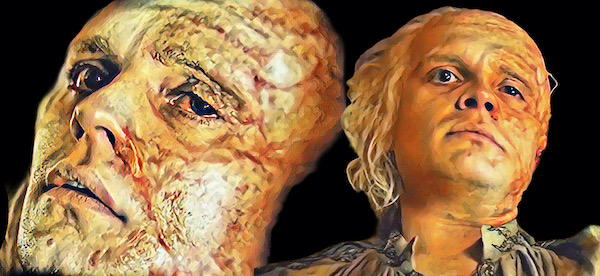
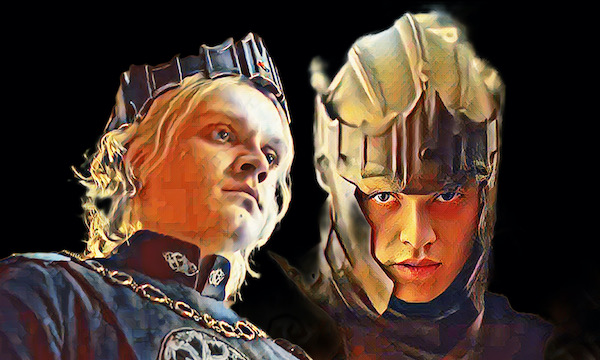
By embracing that rot — letting us see the internal festering, not just the external decay — Glynn-Carney doesn’t just act. He reconstructs. His Aegon is still doomed, but no longer flat. And when the end comes, we will not cheer. We will shudder.
Because this Aegon — the one who flinched at his own crown, who craved love more than loyalty — was never fit to rule. But he was, undeniably, real.
Descubra mais sobre
Assine para receber nossas notícias mais recentes por e-mail.
 miscelana.com
1 comentário Adicione o seu