
Star Wars is a saga about revolutions, bloodlines, and redemption. But amid lightsabers, Star Wars, and political conspiracies, something more intimate pulses beneath the surface: desire. In its many forms — romantic, idealized, forbidden, or silent — desire runs through the journeys of the galaxy’s heroes and villains.
Among the most complex and intriguing elements of this mythology are the love triangles. Some are classic and explicit; others are subtly suggested. All of them reveal something profound about the characters and their inner conflicts between love, duty, and destiny.
This essay explores four of these triangles, beginning with the least traditional — Bix Caleen, Cassian Andor, and Jyn Erso — and moving on to some of the most iconic: Leia, Luke, and Han, Anakin, Padmé, and Obi-Wan, and finally Rey, Finn, and Ben Solo. More than who ends up with whom, what’s truly at stake are impossible choices and the emotional consequences of love in times of war.
Bix, Cassian, and Jyn: The Woman Who Stayed and the Woman Who Arrived
In the Andor series, Bix Caleen is the woman who has known Cassian forever. They share a past of intimacy, survival, and small betrayals. It’s a bond of silent love — tense, charged with unspoken truths — the kind of relationship that didn’t begin recently, but also never truly ended.
Jyn Erso, on the other hand, enters Cassian’s life on the brink of the end. In Rogue One, they meet in a context of mission, distrust, and looming loss. And yet something rare happens: mutual trust, sudden admiration, and a surrender as swift as it is complete. They die together. And that changes everything.
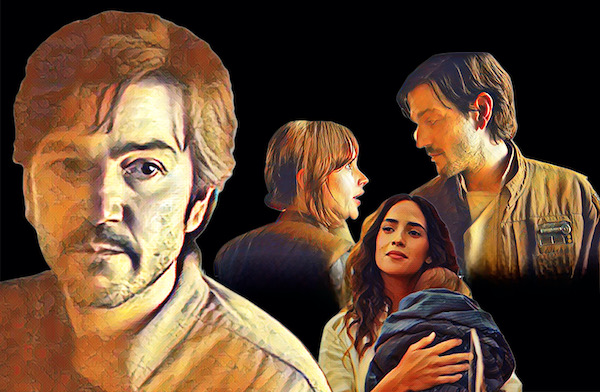
What makes this triangle so moving is that it’s not a competition — it’s about time. Bix represents the past and an unfulfilled promise. Jyn, the future that never came. And Cassian, tragically, belongs to both — and to neither.
In Andor’s second season, when Bix and Cassian finally marry, we — and maybe she — already know: it’s a love sealed by anticipatory grief. Jyn’s ghost doesn’t exist yet, but it already hovers. Cassian is a man split between two women, destined to lose them both.
Leia, Luke, and Han: Between Revelation and Real Affection
This is the most classic — and most deconstructed — love triangle of the original trilogy. Luke falls for Leia. So does Han. And for a while, the three orbit each other through rivalry, teasing, and provocative kisses. The audience takes sides. So do the characters.
But Star Wars has always been about twists. And here, it’s literal: Luke and Leia are siblings. Romantic rivalry dissolves into shared blood. What could have been a cliché — the princess torn between two men — becomes something richer: a fraternal love between Luke and Leia, and a turbulent, sensual love between Leia and Han.

In the end, the triangle becomes a couple. But not without scars. Living with the unspoken, overcoming jealousy, accepting one’s role — all of that makes this arc more mature than it first appears.
Anakin, Padmé, and Obi-Wan: A Triangle of Guilt
The most tragic of all Star Wars love triangles is also the quietest. Anakin loves Padmé. She loves him too, with growing unease. But someone has always been there: Obi-Wan. Not as a declared romantic rival, but as a constant shadow. A presence impossible to ignore.
In Revenge of the Sith, the dynamic among the three becomes a minefield. Anakin suspects Padmé and Obi-Wan. Padmé turns to Obi-Wan to save Anakin. Obi-Wan hesitates — not out of indifference, but sorrow. Some interpretations suggest Obi-Wan loved Padmé and never said a word. Others see him only as the symbol of renunciation. Either way, he is the third axis in a love doomed to collapse.

When Padmé dies, Anakin blames Obi-Wan. Not just because he was there — but because he had always been there. The final clash on Mustafar isn’t only about betrayal and the fall of the Republic; it’s also about jealousy, repression, and a fractured bond fueled by what was never said.
It is a triangle of guilt, loyalty, and loss — where passion destroys and friendship cannot save.
Rey, Finn, and Ben Solo: An Unfinished Triangle
The sequel trilogy tried — not always successfully — to construct a love triangle between Rey, Finn, and Ben Solo. And while it lacks narrative consistency, the emotional groundwork is all there.
Finn is the first to connect with Rey. He sees her, saves her, and follows her. There is the potential for a romance born of admiration and friendship. But it never fully develops. In The Rise of Skywalker, he tries to confess something to Rey — and the film never reveals what it is. Their tension turns into silence.

Meanwhile, Ben Solo, behind the mask of Kylo Ren, forges a mystical connection with Rey — the so-called dyad in the Force. They see each other across distances. They feel each other’s pain. Their duels become choreographies of desire. The final kiss in The Rise of Skywalker doesn’t resolve the triangle — it simply ends it abruptly. Ben dies. Rey is left alone. And Finn? He vanishes from the emotional equation.
It’s a triangle of absences and missed chances. The Force that binds Rey and Ben is transcendent — but what links Rey and Finn is human. And perhaps that’s why the story chose to ignore it. In the end, no one ends up with anyone. Love remains latent, suspended between stars.
Love, War, and Silence
Each love triangle in Star Wars serves something greater. These are not just romances — they’re expressions of guilt, loyalty, idealism, and loss. In a galaxy at war, love is always a risk. That’s why so many of these triangles end in silence, sacrifice, or tragedy.


Perhaps this is Star Wars’ true emotional signature: not the fulfillment of love, but its impossibility. Its heroes fall in love — but at the edge of destruction. Its heroines wait, resist, or perish. What endures is the interrupted gesture. The hand extended, but never held. The kiss before the end.
In the end, Star Wars was never really about couples. It was about fated encounters — and the choices that save us, even when they break us.
Descubra mais sobre
Assine para receber nossas notícias mais recentes por e-mail.
 miscelana.com