
The year 2025 marks 150 years since the untimely death of Georges Bizet at the age of 36. A composer who, at the time of his passing, was viewed with some skepticism by the French operatic establishment—and who today is considered one of the greatest names of the Romantic era. The cruel irony of his trajectory is that Bizet never knew he had created one of the most popular operas of all time. Carmen, his masterpiece, premiered in March 1875. Three months later, in June, he was dead. He did not live to witness the success the opera would achieve throughout the 20th century. Much less could he have imagined that, over time, even his early works would find new life—especially Les Pêcheurs de Perles (The Pearl Fishers), composed when he was still a young man trying to find his place in the music world.
It is this very piece that marks another celebration at the Theatro Municipal do Rio de Janeiro: its 116th anniversary, which opens the opera season with Bizet’s work.
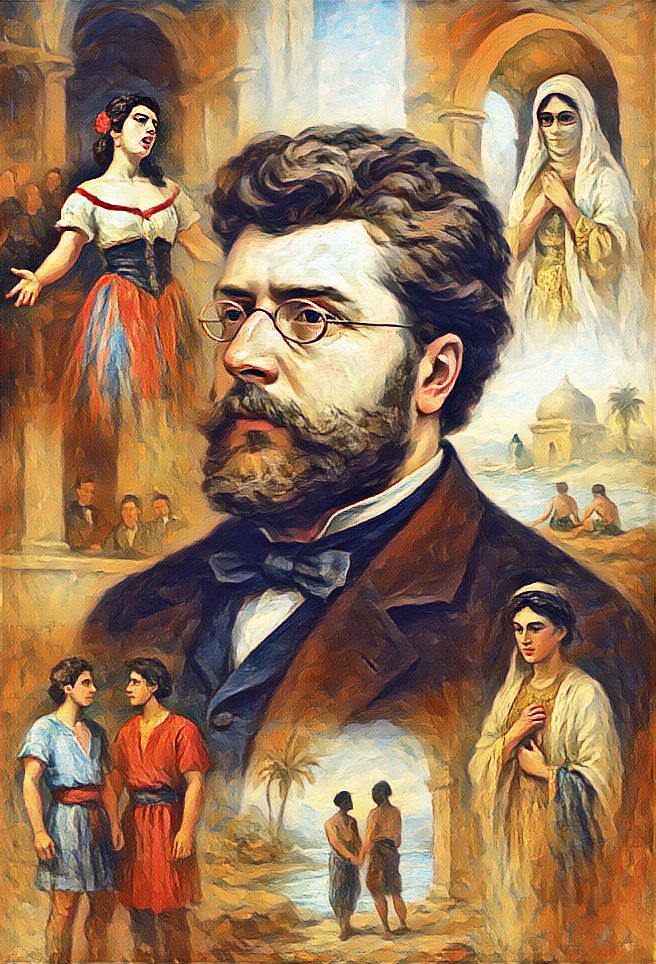
A Young Prodigy and the Search for Recognition
Bizet was born in 1838, in Paris, and from a very young age demonstrated extraordinary talent. At just 9 years old, he was already studying at the Conservatoire de Paris; by 17, he was winning composition prizes; at 19, he earned the prestigious Prix de Rome, which allowed him to study for three years in Italy. He seemed destined for glory, but the French music scene was fiercely competitive, and upon returning to Paris, Bizet struggled to establish himself. He composed tirelessly—piano pieces, one-act operas, songs—but few of his works were staged.
It was in this context that, in 1863, he received a commission to write a full-length opera for the Théâtre Lyrique, which specialized in new works. Bizet was only 24 when he composed Les Pêcheurs de Perles. The libretto, by Michel Carré and Eugène Cormon, was a romantic drama set in a fishing village in Ceylon, now Sri Lanka. A love triangle, a broken vow of friendship, a forbidden love, and final redemption: all the ingredients were there, with a touch of 19th-century exoticism.
Bizet wrote the score in just three months. He worked under pressure, with limited resources and a modest cast. Even so, he delivered moments of surprising beauty—particularly in his use of the orchestra and in the creation of unforgettable melodies such as the duet Au fond du temple saint and Nadir’s aria Je crois entendre encore.

A Tepid Reception and Long Obscurity
Despite the evident talent, the opera’s reception was lukewarm. Critics praised certain musical passages but found the libretto weak, the plot melodramatic, and the exoticism artificial. Les Pêcheurs de Perles had only 18 performances in its first run and was forgotten for decades. Bizet continued composing, creating operas that faced numerous obstacles to reach the stage. Until, in the 1870s, he began working on Carmen—a daring, sensual, tragic opera that was ahead of its time.
When Carmen premiered in 1875, it was met with shock and hostility. Critics found it vulgar, audiences were unsettled by the intensity of the gypsy protagonist, and praise was minimal. Bizet, already ill and emotionally fragile, died without knowing that the opera would become a cornerstone of the operatic repertoire.
The Rediscovery of a Pearl
With the posthumous triumph of Carmen, interest in Bizet’s work resurfaced. And gradually, Les Pêcheurs de Perles was brought back to light. The male duet gained fame, and Je crois entendre encore, sung by Nadir, took on a life of its own outside the opera. Written in compound time (6/8), with a lilting, ethereal melody, the aria has a hypnotic quality. It is a portrait of idealized, distant, almost mystical love. Perhaps for that reason, it has touched generations of singers and listeners alike.
An Aria That Became a Solo Star
The first notable recording of Je crois entendre encore is credited to tenor Edmond Clément in the 1910s. Since then, it has been performed by legendary voices such as Beniamino Gigli, Nicolai Gedda, Alain Vanzo, Luciano Pavarotti, Plácido Domingo, Roberto Alagna, and, more recently, Jonas Kaufmann and Juan Diego Flórez. It is one of those arias that every romantic tenor includes in recital programs.
Off the stage, the aria has also appeared in film soundtracks. It is featured in movies like Moonlight (2016), the Oscar winner, where it briefly serves as the backdrop to a moment of quiet contemplation. It also appears in A Single Man (2009), directed by Tom Ford, in a moving scene featuring Colin Firth. And in an adapted version, it has been used in commercials and documentaries to evoke love, loss, or nostalgia. But it stands out especially in The Man Who Cried (2000), starring Johnny Depp and Christina Ricci.


In the film, Ricci plays Sue (“Suzie”), who hears her father sing the aria in Yiddish before fleeing a pogrom in Soviet Russia. The song becomes the emotional anchor that guides her journey. The music returns in a moving final moment, when she sings to her now-adult father—evoking memory, identity, and family bonds. This transparent use of the aria reinforces its universal power to convey love, loss, and reconnection.
Ney Matogrosso is another admirer of the aria. In 1987, he launched a tour titled Pescador de Pérolas, which led to a live album featuring his performance of the Italian version: Mi Par D’udir Ancora. The album marked a turning point in Ney’s career, as he set aside extravagant costumes and makeup in favor of a more sober, introspective style—wearing suits and exploring a refined, classical repertoire. Including a Bizet aria in a Brazilian Popular Music (MPB) setlist was seen as an act of artistic boldness, bringing lyrical and popular traditions together in an innovative way.
Carmen and Beyond
Despite his late acclaim, Bizet died believing he had failed. But time, as it often does with great artists, corrected that injustice. Carmen is now one of the most performed operas in the world, and Les Pêcheurs de Perles has returned to the stage with sophisticated productions that update its atmosphere without erasing its poetry.

In the year 2025, marking 150 years since his death, it is worth remembering that Bizet was not a one-opera genius. He was a composer of rare melodic sensitivity who knew how to write about love, friendship, sacrifice, and desire with an intensity that has only grown over time.
In the end, what began as a “forgotten pearl” became a rediscovered gem—reminding us that, in art, true beauty sometimes takes time to shine.
The Pearl Fishers will run at the Theatro Municipal do Rio de Janeiro from July 16 to 26, 2025.
Descubra mais sobre
Assine para receber nossas notícias mais recentes por e-mail.
 miscelana.com