
It would have been unthinkable, until recently, to imagine that a cold, slow, and contemplative cinematic work like Barry Lyndon, directed by Stanley Kubrick, could become a cult favorite among the youth in the age of rapid editing, TikTok, and distracted streaming. But fifty years after its original release, the film returns to British cinemas as a sacred relic — a forgotten work of art that, once rediscovered, feels bolder and more subversive than ever.
For a generation that consumes imagery at high speed and favors the emotional intensity of contemporary melodramas, the fascination with an 18th-century epic filled with candlelit silence, meticulously staged duels, and men in wigs wielding muskets might seem out of place. But that’s exactly where its power lies: Barry Lyndon is an anti-film by modern standards — and perhaps because of that, it feels magnetic to those searching for something that resists the formulas of digital entertainment.

When the film debuted in 1975, it was met with coldness. American critics like Pauline Kael dismissed it as a beautiful, tedious spectacle — a three-hour slideshow for art history majors. Audiences, expecting the sensory impact of 2001: A Space Odyssey or the stylized violence of A Clockwork Orange, were also disappointed with a film that seemed to move in slow motion, chronicling a man who fades away even amid luxury and achievement.
But time, as the film itself suggests, levels all things. What once seemed cold became elegance. Restraint turned into irony. And the fatalistic arc of Redmond Barry — the Irishman who rises into English aristocracy through seduction, gambling, and marriage — revealed itself as a sharp critique of masculine vanity, the farce of nobility, and the hollowness of social ambition. Gen Z understood this instinctively.
Perhaps that’s why Barry Lyndon has gained new devotees among young cinephiles and stars like Jenna Ortega, who recently listed it as one of her four favorite films in a Letterboxd interview. On the same platform, fans are creating viral edits of the film accompanied by music from 21 Savage, such as “A Lot” — whose melancholy melody and lyrics about rise and downfall sync unexpectedly with the protagonist’s tragic fate. The viral nature of these edits only reinforces the film’s central paradox: what was once labeled “emotionless” now feels like one of Kubrick’s most emotionally devastating works — precisely because of its surgical detachment.
Curiously, the project was only born because Kubrick never got to direct his long-dreamed Napoleon Bonaparte biopic. After the unexpected success of A Clockwork Orange, he believed he had enough freedom to invest in that personal obsession, but Warner Bros hesitated — especially after the crushing failure of Waterloo, a mega-production helmed by Dino De Laurentiis. So Kubrick, not wanting to waste his extensive 18th-century research, looked for another narrative that could evoke the same world of war, ambition, and moral collapse.
That’s when he came across The Luck of Barry Lyndon, a novel published in 1844 by William Makepeace Thackeray, originally serialized in magazine form. Though less famous than Vanity Fair, the book stands as one of English literature’s most biting satires of male social climbing. Written as a false memoir, the protagonist narrates his own journey — from poverty to wealth and back to ruin — with an arrogant, farcical, and deeply unreliable voice. The critique of masculine pomp, corrupt aristocracy, and women used as social currency is present in every page, though often veiled in dry humor and irony.
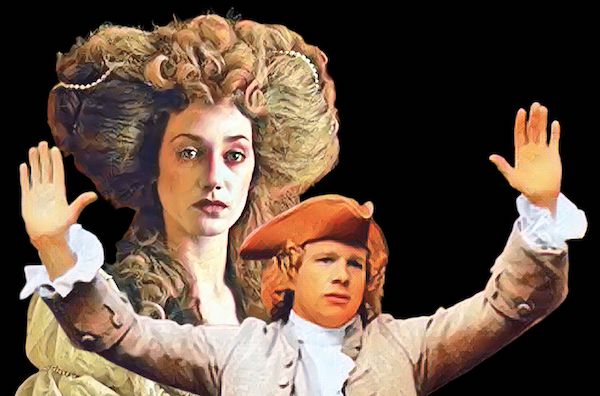
The novel didn’t cause much of a stir at the time, but it was a pioneer in using the first-person perspective to expose a boastful, lying narrator — an antihero far closer to today’s hustlers than classic noblemen. Some scholars even point out the sexual subtext in the book: Barry seduces, manipulates, marries for convenience, and turns desire into power. The female body is treated as a ladder to wealth, and male virility as a performance of dominance — themes Kubrick preserved in the film, though with cool, detached precision.
In adapting the novel, Kubrick eliminated the unreliable first-person narration and replaced it with an omniscient, ironic narrator (voiced by Michael Hordern) who reveals the characters’ fates before they occur, generating a funereal tension and a sense of immutable destiny. His radical decision to film interior scenes by candlelight — using NASA-developed Zeiss lenses — enhanced the painterly aesthetic: each frame looks like a live-action painting by Gainsborough, Reynolds, or Watteau. Costumes, lighting, and minimal camera movements evoke a Europe obsessed with surface while teetering on the brink of collapse.
Behind the scenes, however, the atmosphere was less refined. Kubrick demanded dozens of takes per scene. Ryan O’Neal, a rising American heartthrob, was cast more for commercial reasons than artistic ones. Critics called his performance wooden, missing the point that Kubrick wanted a Barry who was vain, shallow, and ornamental. Marisa Berenson, stunning as Lady Lyndon, was practically mute — a deliberate choice that reinforced the idea of aristocratic women as decorative, submissive, imprisoned figures.
Despite winning four technical Oscars, the film failed to impress in the major categories and was branded yet another example of Kubrick’s excessive coldness. But dissenting voices began to emerge. Martin Scorsese, one of Kubrick’s earliest champions, always claimed the film was one of the most emotional he had ever seen — precisely because it portrayed the ritualized stiffness of English society and the internal collapse of a man who lived for appearances.
Today, that reading is fully embraced. In 2022, the film ranked 12th in Sight and Sound’s list of the greatest films of all time, as voted by directors — second only to 2001: A Space Odyssey among Kubrick’s works. Its influence is especially evident in the films of Wes Anderson, with their use of title cards, symmetrical compositions, unconventional scores, and tragicomic characters trapped in artificial worlds. The opening duel scene in Barry Lyndon could easily open one of Anderson’s films.
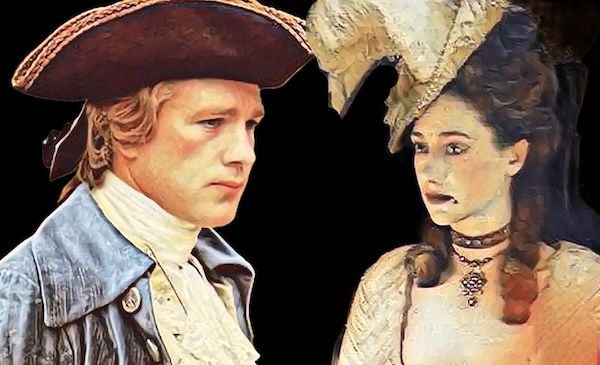
Still, the person most responsible for reviving the film may be British-American rapper 21 Savage, whose song “A Lot” was used in a TikTok fan edit that went viral. The contrast between the lyrics (“How much money you got? A lot”) and Barry’s melancholic downfall created a kind of modern tragedy — connecting 18th-century vanity with the emptiness of contemporary capitalism. The video’s creator, known as Flanthippe, told the Financial Times he was surprised at how perfectly the scenes matched the melody — and grateful that it introduced the film to so many new viewers.
In this sense, Barry Lyndon is triumphing now in ways it never did in the past. Not because it changed, but because the world finally caught up to it. In an age of algorithms, sensory overload, and hollow narratives disguised as relevance, Kubrick offers a slow, silent, breathtaking story about how easy it is to rise — and how inevitable it is to fall. It all ends, as he reminds us, with a black-and-white title card: “they are all equal now.” It’s the genius stroke of a film that has aged more vividly than ever.
Descubra mais sobre
Assine para receber nossas notícias mais recentes por e-mail.
 miscelana.com