
We already know the main spoilers for season 3 of The Gilded Age, but there are still mysteries to be clarified, such as whether Marian Brooks will give up marrying Larry Russell because he lied to her. Since the series has not yet been officially renewed by HBO Max, many things could remain unresolved. Given the story’s dynamics, I believe Julian Fellowes feels confident with at least two more seasons ahead, or at least one more.
There is still much to cover throughout the storyline, but the most devoted fans are concerned about the couple Bertha and George Russell, not only because they are antiheroes nearing villainy, but because they are inspired by the real Alva and William Vanderbilt, who divorced in 1895 — a scandal in high society.

Speculation grows with the introduction of the character Alfred Merrick, the millionaire heir from Chicago, with whom Bertha openly flirted in front of her husband (supposedly at his request). Could he be a parallel to Alva’s second husband, Oliver Hazard Perry Belmont? Will the Russells also get divorced?
No one denies there was a rift in the couple due to Gladys’ forced marriage to the Duke of Buckingham. George understood Bertha’s ambitions but still wanted to ensure his children had marriages based on love, even though he had to break his promise to his daughter and see her in tears at the ceremony — a moment that shocked everyone.
George was not exactly successful because he tried to please both Bertha and Gladys. He made it difficult for the duke to back out, but Bertha, acting behind his back, reversed the situation to her favor. George does not know the details, but he is no fool. That is why he approved Marian’s engagement to Larry, warning his wife to stay away from them. Whether Bertha will listen is another story — but clearly, she will ignore the warning.
In a season where divorce is the thread that ties the families together, it is worth remembering that the divorce of Alva and William Vanderbilt in 1895 was one of the most shocking and significant events in late 19th-century American high society. At a time when divorce was extremely rare, especially among wealthy and influential families, this breakup caused a scandal that shook the powerful Vanderbilt dynasty.
The marriage between Alva and William began surrounded by luxury and status. Alva, known for her strong personality, social ambition, and striking beauty, was the key piece to consolidate the family’s fortune and prestige. William, heir to the vast railroad fortune built by his father Cornelius Vanderbilt, despite wealth and power, was neither faithful nor emotionally available, having known extramarital affairs. Although the era was permissive of elite men maintaining affairs, these issues contributed to the relationship’s deterioration.


There are rumors and speculations that Alva also had extramarital relationships, but these accusations are less documented and seem more the product of the sensationalist press of the time. The fact is the relationship became unsustainable, and the divorce was formalized, ending a marriage already lacking affection or trust.
This end represented not only a personal defeat for Alva but also a blow to the family’s reputation, as divorces were seen as a social and moral failure. It was then that Alva used all her strength to rebuild her position and that of the Vanderbilt family.
In this scenario, Consuelo Vanderbilt, the eldest daughter of Alva and William, appears. Soon after her parents’ divorce in 1895, she married Charles Spencer-Churchill, 9th Duke of Marlborough — a classic marriage of convenience between newly wealthy Americans and traditional European nobility, who sought money to maintain their castles and status, offering prestige in return.
This marriage was strongly influenced by Alva, who saw in the union a way to restore the Vanderbilt family’s prestige after the blow of the divorce. Alva spared no effort to ensure Consuelo married “well,” assuming the role of a true duchess, even if the marriage lacked romantic love.
Meanwhile, Alva remarried in 1896, this time to Oliver Hazard Perry Belmont, a banker and member of the influential Belmont family. Oliver, son of the famous banker August Belmont, had a heritage linked to U.S. naval history (named after the naval hero Commodore Oliver Hazard Perry). He was an elegant, wealthy, and politically active man, known for his love of horse racing and the luxurious Belcourt Castle mansion in Newport, Rhode Island, where he lived with Alva.
The marriage to Belmont lasted until his death in 1908, marking a new phase in Alva’s life. With fortune and influence, she became one of the leaders of the women’s suffrage movement in the U.S., dedicating herself to the fight for women’s voting rights and leaving an important legacy in American social history.
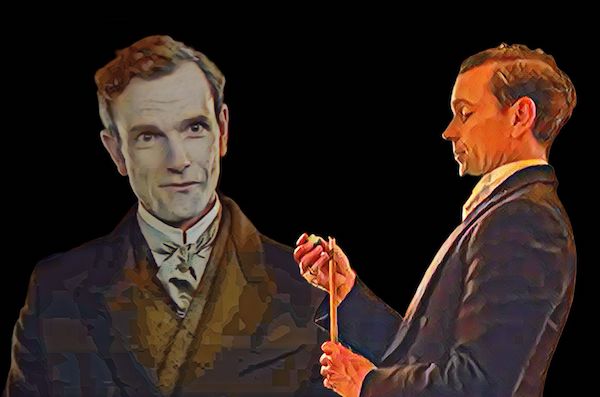
In the realm of historical fiction, The Gilded Age sparks special interest. Some less obvious characters, like Alfred Merrick, raise curiosity about their real role and importance. Merrick, who does not correspond to a widely documented historical figure, may be a fictional creation inspired by people from the journalistic or social circles of the time — a common device used by Fellowes to enrich the plot with multifaceted characters representing the backstage of power.
It is not yet clear how relevant he will be, but if there is indeed a strong Vanderbilt base for the Russells, and if Fellowes is drawing historical parallels, Merrick may play a strategic role, perhaps as someone who knows secrets, influences decisions, or manipulates narratives.
This adds an extra layer of interest for those following The Gilded Age, reinforcing the idea that behind the glamour and appearances of powerful families lies a complex web of relationships and interests, including less visible characters who are fundamental to the story’s dynamics.
In short, the trajectory of Alva Vanderbilt — from betrayed and divorced wife to social strategist, suffragist, and influential woman — along with her daughter Consuelo’s strategic marriage and life alongside Oliver Belmont, form a rich tableau of drama and power that inspires both real history and fiction. If Julian Fellowes continues to base his narrative on these events, there is still much to discover, especially about characters like Alfred Merrick and their possible roles. Meanwhile, the audience eagerly awaits more revelations and to see how the Russells navigate this delicate game of power, love, and scandal.
Descubra mais sobre
Assine para receber nossas notícias mais recentes por e-mail.
 miscelana.com