
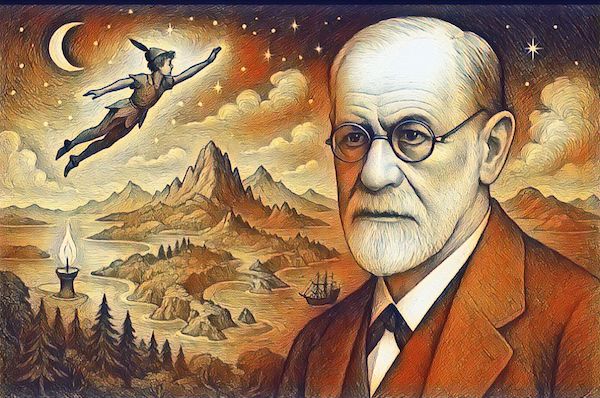
For Freud, dreams are disguised fulfillments of repressed desires. In The Interpretation of Dreams, he states that the dream is the “royal road to the unconscious.” It is at the moment when the ego loosens its control and the superego falls asleep that the unconscious expresses itself, often through symbolic images. The state described by J. M. Barrie in Peter Pan as the two minutes before sleep is what Freud might recognize as the hypnagogic phase, a moment when psychic censorship has not yet completely fallen but begins to fail. It is at this instant that intense but not fully formed images begin to emerge. Neverland, “crammed” and compact, full of interconnected adventures, could be read as a dream condensation (Verdichtung), one of the main mechanisms of the dream according to Freud, in which multiple meanings and desires are fused into a single symbolic image.
Of all the delectable islands, Neverland is the snuggest and most compact, not large and sprawly, you know, with tedious distances between one adventure and another, but nicely crammed. When you play at it by day with the chairs and table-cloth, it is not in the least alarming, but in the two minutes before you go to sleep it becomes very nearly real. That is why there are night-lights.
― J.M. Barrie, Peter Pan
Barrie’s statement that Neverland “becomes very nearly real” suggests this liminal zone between the conscious and unconscious. Psychic reality begins to carry as much weight as objective reality — and for Freud, this is exactly what happens in the dream world, where the symbolic is more “real” than the real.
The Function of Night-Lights: Symbolism and Psychic Defense
The night-lights mentioned by Barrie at the end of the passage fulfill an ambivalent function here. They are real objects but act as barriers against the invasion of the unconscious, as if they had the magical power to prevent Neverland from becoming too real. From a Freudian perspective, they could be read as forms of resistance or repression: symbolic devices to contain fantasy, latent sexuality, fear of loss of control, death, or separation.
We can also extend the analysis: the presence of night-lights as protection aligns with the idea that sleep and dreaming can be distressing, especially for the child, since they involve separation from the caregiver, abandonment of conscious control, and immersion in a symbolic world. The lights are a visual comfort, but also a talisman against the force of what is unveiled in the moments when the superego dozes off.
Jung: Archetypes and Neverland as the Collective Unconscious
Expanding the analysis to Carl Gustav Jung’s analytical psychology, Neverland becomes even richer in symbolism. For Jung, dreams are expressions not only of the personal unconscious but of the collective unconscious, where universal archetypes dwell. Neverland is, par excellence, an archetypal space — the realm of eternal childhood, shadow, anima and animus, adventure, hero, and trickster.
Peter Pan himself is the archetype of the Puer Aeternus, the “eternal boy” who refuses to grow up, a figure analyzed by Marie-Louise von Franz (Jung’s collaborator). Access to this space is not rational: it occurs at moments when the rational mind is about to disengage, and symbols emerge without censorship. Neverland appears in the instants when we are most vulnerable to images of the collective unconscious. It does not belong to the waking world but to archetypal imagination — which is why it only becomes “very nearly real” in the minutes before sleep, when the veil between worlds thins.
The Child as Dreamer: Winnicott and the Transitional Space
Donald Winnicott, another fundamental theorist of the child psyche, offers a reading more focused on the child’s relation to the symbolic world. For him, there is a “transitional space” between the internal and external — the space of play, imagination, and dreaming. Neverland is, in this context, the transitional space par excellence: created by the child but shared with others, real in subjective experience but not empirical.
The moment before sleep is when the transitional object — such as a blanket, teddy bear, or night-lights — gains greater importance. These objects facilitate the psychic crossing between the real and the imagined. Barrie seems to intuit this. The play with chairs and tablecloths during the day is symbolic and controlled, but on the threshold of sleep, the symbolic assumes an almost mystical power. It is when play turns into dream.
“Neverland is always more or less in the direction of the morning star. It varies greatly from boy to boy. When you are asleep, it draws near your bed and, as soon as you awake, it slips silently out of the window.”
― J.M. Barrie, Peter Pan
Contemporary Currents: Neuroscience and Hypnagogic States
Contemporary neuroscience recognizes the existence of liminal states between wakefulness and sleep — the so-called hypnagogic and hypnopompic states — as fertile moments for visual hallucinations, sensations of displacement, and intense creativity. These states are common in children, especially in phases of vivid imagination. Barrie’s description aligns with this modern knowledge: there is a compression of space-time, an alteration of perception, an intense experience of mental images.
Studies show that at these moments, the brain still produces alpha waves but begins to generate theta waves — characteristic of light sleep and dream activity. It is at this crossing that the brain allows one to “see” Neverland, not as an abstraction, but as a real sensory experience. “Subjective reality” transcends the boundaries of what would be mere fantasy.
Neverland as a Shared Dream
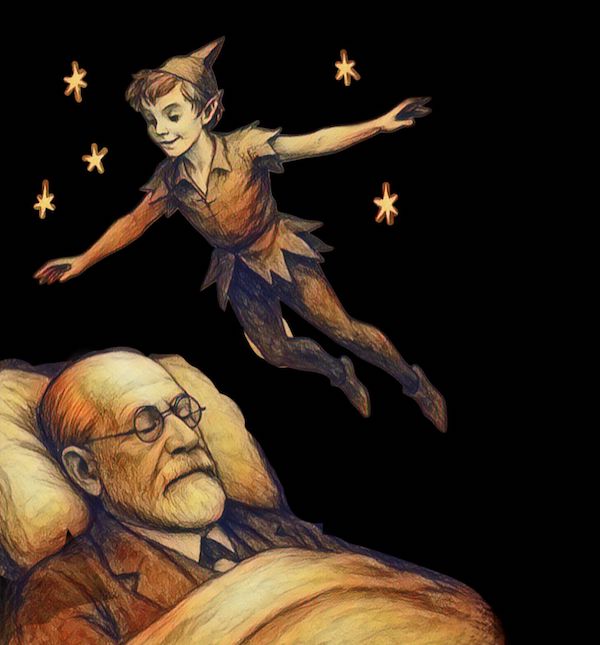
The excerpt from Peter and Wendy can be read as an allegory of the very experience of dreaming — a personal and universal experience, laden with desire, symbols, fears, and projections. By saying that Neverland becomes real before sleep, Barrie seems to suggest that the truest dreams do not occur only at night but at the edges of consciousness. And that adults only fail to see Neverland because they have extinguished the childhood night-lights.
Freud would say that the child fulfills repressed wishes through dreams. Jung would see Neverland as a map of the collective unconscious. Winnicott would say it is the place of play, where the true self emerges. Neuroscience sees it there a transitional state rich in imagination and brain plasticity. J. M. Barrie, with his delicate and precise prose, seems to intuit all these theories as he gives form to the invisible: the soul of a child at the very moment he is about to dream.
Descubra mais sobre
Assine para receber nossas notícias mais recentes por e-mail.
 miscelana.com