
With over four decades of history, the Alien franchise has established itself as one of the cornerstones of science fiction and horror cinema, characterized by its shadowy aesthetic, futuristic social commentary, and, above all, its intense and unforgettable female protagonists. Now, with the arrival of the highly anticipated series Alien: Earth, created by Noah Hawley and executive produced by Ridley Scott, the universe of xenomorphs takes on new dimensions—and for the first time, invades Earth.
The franchise began with Alien (1979), directed by Ridley Scott. This genre-defining masterpiece introduced the world to Lieutenant Ellen Ripley, played by Sigourney Weaver, and solidified the alien creature as a symbol of existential horror. The claustrophobic atmosphere aboard the Nostromo, the mounting tension, and the iconic chestburster scene became cinematic legend.

In Aliens (1986), directed by James Cameron, action took center stage without abandoning the horror roots. Ripley evolved into a maternal warrior figure, battling not just aliens but also the negligence of a greedy corporation—Weyland-Yutani. The film expanded the universe, introduced the alien queen, and reinforced the franchise’s critique of corporate power structures.
Alien 3 (1992), directed by David Fincher, was controversial but maintained the bleak tone, delivering a tragic (at the time final) arc for Ripley. Alien: Resurrection (1997), directed by Jean-Pierre Jeunet, presented a cloned, hybridized Ripley, echoing humanity’s obsession with genetic manipulation and the quest for immortality.
The 2000s brought spin-offs like Alien vs. Predator (2004) and AVP: Requiem (2007), which crossed over with another iconic franchise, though they diluted some of the original’s critical and aesthetic weight. It wasn’t until Prometheus (2012) and Alien: Covenant (2017), both directed by Ridley Scott, that the franchise returned to its philosophical and existential roots. These prequels explored the origins of the alien species and probed into questions of creation, the creator, and the human desire to transcend death.

Now, Alien: Earth marks the boldest step yet. Set in the year 2120, the FX series brings the xenomorph horror to Earth, now controlled by five mega-corporations: Prodigy, Weyland-Yutani, Lynch, Dynamic, and Threshold. The latest technological frontier is the creation of hybrids—robots with human consciousness—and the first of their kind is Wendy, portrayed by Sydney Chandler.
When the Weyland-Yutani ship USCSS Maginot crashes into Prodigy City, Wendy and a ragtag group of soldiers make a discovery more terrifying than anything they could have imagined. The series revives the franchise’s core themes of corporate greed, while updating its ethical dilemmas: what makes us human? How far will we go to achieve immortality?
Strong female characters remain central. Wendy, like Ripley before her, embodies the collision of vulnerability and strength, science and emotion. While Ripley fought monsters in a world dominated by men and machines, Wendy is herself the threshold between human and post-human. She is the result of the latest technological ambition—and as the franchise has always shown, tampering with the unknown comes at a price.
Alien: Earth features a diverse international cast, including Timothy Olyphant (Kirsh), Alex Lawther (Hermit), Samuel Blenkin (Boy Kavalier), Babou Ceesay, Essie Davis, Kit Young, among others. The mythology of the Alien universe expands with new characters and conflicts, including rival corporations, cyborgs, and synthetics—figures that have long symbolized the eerie overlap between control and consciousness.
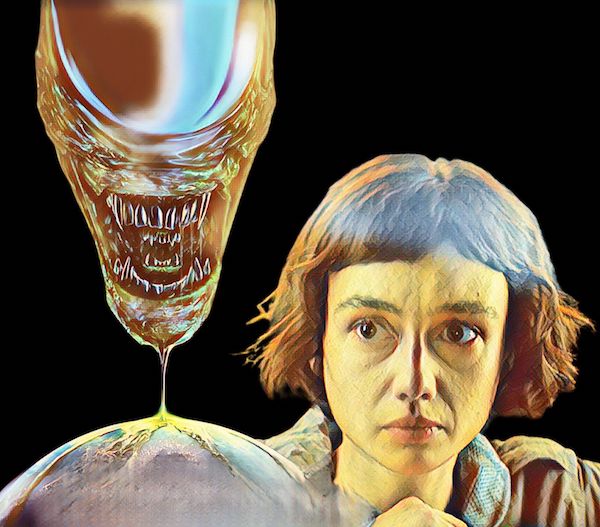
Produced by Ridley Scott and creatively led by Noah Hawley—known for reinventing universes like Fargo and Legion—the series is already generating high expectations. The trailers hint at a moody, atmospheric, and unsettling tone, echoing the original films while establishing a distinct visual identity. And for the first time, the xenomorph threat looms on a planet already on the brink.
Alien: Earth premieres on August 12, with the first two episodes launching simultaneously. New episodes will drop weekly. This is a new generation’s chance to experience biological horror, the terror of the unknown—and to confront that age-old question: in space, no one can hear you scream… but what about on Earth?
Alien has never been just about monsters. It’s about the limits of humanity, the dangers of ambition, and the fight for survival in a universe that couldn’t care less. Now that the threat is on solid ground, the question is: who will survive—and what will be left of them?
Descubra mais sobre
Assine para receber nossas notícias mais recentes por e-mail.
 miscelana.com