
As published on Bravo Magazine
That’s because episode 10 of the third season, which was supposed to be the finale, ended on a cliffhanger with images suggesting more to come, leaving everyone somewhat confused: is there still more ahead?
Well, just feel the energy. Instead of wanting more, we were anxious about the possibility. Especially because in the episode “Better Than Sex”, Carrie was praised for repeating phrases three times in the final chapter of her book — which reminded me of Beetlejuice, one of Tim Burton‘s classics, where saying the character’s name three times is one of the film’s most famous rules and part of a magical ritual that summons (or banishes) the grotesque, comedic, and dangerously unpredictable bio-exorcist, played by Michael Keaton. That repetition creates a tension between humor and horror, between the desire for control and its loss. It grants power, but also strips it away.
In Beetlejuice, this wordplay is, at its core, a metaphor for the human desire to control the uncontrollable — and the price paid for trying. Saying the name three times is a choice. It seems harmless, until it isn’t. In the case of And Just Like That, the name was said. The spirit was summoned. And the goodbye came.

Since its debut, And Just Like That… seemed to carry not only the weight of nostalgia but also the need to prove its own relevance. The Sex and the City revival arrived with promises of maturity, representation, and realism. But what it delivered was a parade of inconsistencies, poorly resolved deconstructions, and scripts that, instead of evolving the beloved characters, diluted them into caricature. Three seasons later, it’s hard to defend the project as anything more than a vanity exercise — aesthetic, visual, but dramatically hollow.
The first season began under the sign of grief: Mr. Big’s death in the opening episode was not just a narrative shock but marked a melancholic shift. Carrie, once witty, provocative, and sharp-tongued, now stumbled through silences. Miranda, one of the original series’ most complex characters, was dismantled in cringe-inducing scenes, entangled in an arc with Che Diaz that felt more like a writing experiment than an organic story. Charlotte, meanwhile, seemed trapped in an emotionally infantilized bubble, reduced to a perfectionist mother struggling with the modern world.
Even the attempts to update the show’s universe felt forced. Including more diverse characters — Black women, queer, and non-binary characters — wasn’t the issue. The issue was the superficial way they were handled. Instead of becoming part of the show’s fabric, they always felt like didactic add-ons inserted to signal progress. And the dialogues? Full of awkward pauses, off-key jokes, and situations that felt more like cringeworthy sketches than dramatic moments.
Visually, the series kept up its standard — glamorous costumes, sophisticated locations, and Manhattan as a supporting character. But even that felt more like a pastiche than a new aesthetic proposal. It seemed the series was betting everything on outer sparkle to compensate for a lack of substance.
Season two got better. Yes, better. But still far from justifying its existence. “Better than the first, but still bad.” Miranda remained lost, with no clear purpose. The arc with Che became a running joke, and their predictable breakup offered no catharsis. Carrie, once again, was thrown back into the cycle with Aidan — a storyline we already knew the ending to, stretched across multiple episodes as if it had something new to say. It didn’t.
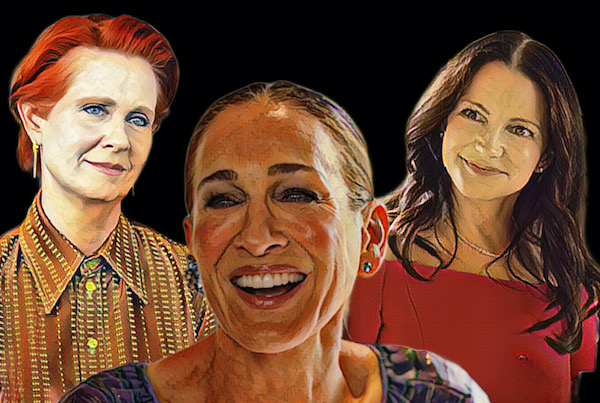
The show seemed to aim at reviving the sparkle of female conversations and urban interactions. Some scenes even tried. Charlotte had good moments — as a mother, as a woman confronting aging, and as a comic figure. Lisa Todd Wexley experienced a real and touching storyline with the loss of a baby, but the impact was diluted by the show’s erratic pacing, which dropped subplots as casually as changing outfits. Oh! And her father was killed twice, an unforgettable blunder. Seema, Nya, Anthony, and Steve survived without real arcs. They were just set pieces in a world that could no longer hold the emotions of the past.
Once again, visually, the show remained seductive. But the wardrobe turned into a caricature. Carrie in haute couture to water her plants, Charlotte looking like a wax doll, and Miranda with no fashion identity. The aesthetic became the content — and that’s always a problem.
Season three brought some relief. For the first time, And Just Like That delivered episodes with a minimally coherent narrative thread. Carrie, as she definitively closed the Aidan chapter, showed maturity. There was the character we’d long been searching for. Charlotte and Harry also had more interesting arcs, especially as they dealt with modern parenting challenges and identity dilemmas.
Still, the pacing dragged. Entire episodes where “nothing happens.” The contrast between what could’ve been a sophisticated commentary on middle age, aging, and social transformation was lost in the lack of dramatic courage. The show avoided real conflict. It wanted to please everyone — and in the end, said nothing.
Perhaps the third season’s greatest merit was its farewell tone. The sense that the show finally understood its time had come. And with that, some of the final scenes gained an emotional weight that had previously been absent. Carrie, now sober, mature, and self-aware, embodied the closing not just of a romantic chapter, but of a television era. One that began with Sex and the City, but never truly came back to life in And Just Like That.

Throughout three seasons, what we saw was a series trying to reinvent itself without knowing who it was. It wanted to win over new generations and reclaim its old fans — and failed at both. Lacking the freshness of the original and the boldness of a new vision, And Just Like That was a nostalgic collage with few new ideas. And in the end, perhaps what remains is the painful realization that not every story needs a sequel. Some should have ended at their peak.
A sad ending for a franchise that was once so bold and innovative.
“Miranda, Samantha, and Charlotte — there will never be better friends, and how lucky for Carrie to have met and loved Seema and LTW, divine new connections. Carrie Bradshaw was the center of my professional heart for 27 years. I think I loved her more than all the others,” wrote Sarah Jessica Parker on Instagram. “MPK (Michael Patrick King) and I acknowledge together, as we have before, that this chapter is closed. AJLT was pure joy, adventure, the most rewarding kind of hard work. It will take a lifetime to forget. I hope you love these last two episodes as much as we all did,” she added.
I doubt it will erase the stumbles, but I’ll watch them with an open heart. And Just Like That says goodbye without leaving behind longing — only the uncomfortable silence of a farewell that had already happened long ago.
Descubra mais sobre
Assine para receber nossas notícias mais recentes por e-mail.
 miscelana.com